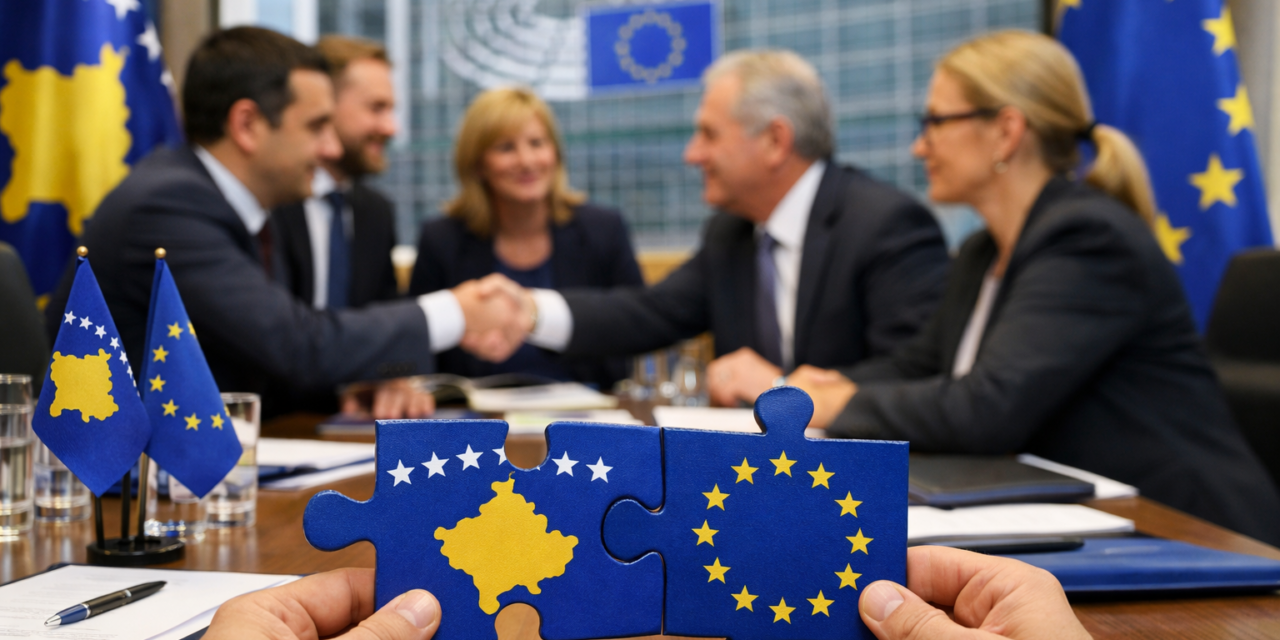
The prospect of European Union membership has long been a driving force behind political and economic reforms across the Western Balkans. For Kosovo, a young state with a complex history and ongoing challenges, the path towards EU integration is a multifaceted journey. This essay will explore the process of Kosovo’s accession to the European Union, examining the key milestones, the obstacles encountered, and the expected trajectory leading up to May 15, 2026. It will delve into the conditionalities set by the EU, the internal reforms Kosovo has undertaken, and the external factors that influence its accession bid. Understanding this process requires an appreciation of Kosovo’s unique circumstances, including its declaration of independence and the ongoing dialogue with Serbia, as well as the broader geopolitical context within which these negotiations take place. The period up to May 2026 represents a critical phase where significant progress or stagnation could define the future of Kosovo’s European aspirations.
The Framework for Enlargement and Kosovo’s Aspirations
The European Union’s enlargement policy is guided by the fundamental principle that each candidate country must meet a set of strict criteria, commonly referred to as the Copenhagen criteria. These criteria, established in 1993, include political stability, a functioning market economy, and the adoption of the EU’s acquis communautaire – the body of EU law and jurisprudence. For countries in the Western Balkans, the EU has reiterated its commitment to their European perspective, particularly through the Stabilization and Association Process (SAP). Kosovo, like other countries in the region, formally embarked on this path. The Stabilization and Association Agreement (SAA) between the European Union and Kosovo, signed in October 2015 and entered into force on April 1, 2016, marked a significant step. The SAA is the first contractual relationship between Kosovo and the EU and serves as a framework for cooperation, aiming to support Kosovo’s approximation of EU standards and legislation. It provides a platform for political dialogue and trade liberalization, laying the groundwork for potential future membership.
Kosovo’s aspiration for EU membership is deeply rooted in its desire for economic development, enhanced security, and broader democratic consolidation. Following its declaration of independence in 2008, the EU became a key partner in its state-building efforts. However, the recognition of Kosovo’s independence remains divided among EU member states, which presents a unique challenge to its accession process. While the European Commission and a majority of member states support Kosovo’s integration, the reservations of a few countries, notably Spain, Greece, Romania, Slovakia, and Cyprus, complicate the formal steps of accession negotiations and eventual membership. Despite these internal EU divisions, Kosovo has consistently expressed its commitment to the European path and has worked towards fulfilling the necessary reforms. The ambition for membership serves as a powerful incentive for domestic reforms across various sectors, from the rule of law to economic governance.
Key Milestones and Conditionality on the Road to Accession
The journey towards EU accession is characterized by a series of pre-accession milestones and rigorous conditionality. For Kosovo, these have included the Visa Liberalization Dialogue, the establishment of the EU Rule of Law Mission in Kosovo (EULEX), and the ongoing dialogue with Serbia. The Visa Liberalization Dialogue, which began in 2012, was a crucial process for Kosovo. For years, Kosovo was the only country in the Western Balkans whose citizens could not travel visa-free within the Schengen Area. The EU set clear benchmarks that Kosovo needed to meet, including reforms in the justice system, fighting organized crime and corruption, and border management. After a prolonged period of negotiation and reform efforts, the European Commission announced in April 2023 that Kosovo had met the remaining requirements. This was a significant political and symbolic achievement, with the European Parliament and Council of the EU formally approving the lifting of visa requirements for Kosovar citizens for short stays in the Schengen Area, expected to take effect by May 2024. This milestone demonstrates Kosovo’s capacity to meet EU standards in a key area and enhances people-to-people contacts and economic opportunities.
Another significant aspect of Kosovo’s engagement with the EU has been the presence and role of EULEX. EULEX Kosovo is the EU’s largest civilian mission to date, mandated to assist Kosovo authorities in the rule of law, including police, judiciary, and customs. Its presence, while evolving over time, has aimed to support the development of independent and multi-ethnic institutions capable of upholding the rule of law. The ongoing reforms in the judiciary and law enforcement sectors, often guided and supported by EULEX recommendations and assistance, are critical for meeting the accession criteria, particularly in the areas of fighting corruption and organized crime.
The dialogue between Kosovo and Serbia, facilitated by the EU, is another central pillar of Kosovo’s European integration. This dialogue aims to normalize relations between the two entities and resolve outstanding issues. Progress in this dialogue is considered a crucial condition for both Kosovo and Serbia’s respective EU accession paths. Key areas of discussion have included freedom of movement, energy, telecommunications, and the establishment of the Association of Serb Municipalities in Kosovo. The EU has consistently emphasized that a comprehensive and legally binding agreement on the normalization of relations is essential for Kosovo to advance in its accession process. This conditionality highlights the interconnectedness of regional stability and EU integration, and the EU’s commitment to ensuring that any accession contributes to a peaceful and stable neighborhood.
Challenges and Obstacles to Accession
Despite the formal framework and the progress made in certain areas, Kosovo’s path to EU membership is fraught with significant challenges. The most prominent of these is the issue of recognition. As mentioned, five EU member states do not recognize Kosovo’s independence. This lack of universal recognition by EU members creates an inherent obstacle to the formal accession process, which requires the unanimous consent of all member states at various stages, including the opening of accession negotiations and the final ratification of membership. While the EU as an institution engages with Kosovo and supports its integration, this internal division within the Union poses a considerable hurdle.
Internally, Kosovo faces persistent challenges related to the rule of law, corruption, and organized crime. While reforms have been initiated and progress has been made, the effective implementation and enforcement of these reforms remain a concern for the EU. Weak judicial institutions, political interference in the justice system, and high levels of corruption can deter foreign investment, undermine public trust, and hinder economic development, all of which are critical for meeting EU standards. The European Commission’s annual progress reports consistently highlight these areas as requiring further attention and sustained effort. For instance, reports often point to the need for greater professionalism and independence within the judiciary, as well as more robust investigations and prosecutions of high-profile corruption cases.
The political landscape in Kosovo also presents challenges. Political instability, frequent changes in government, and a sometimes polarized political discourse can slow down the reform process and the ability to reach consensus on key policy decisions necessary for EU accession. Furthermore, the ongoing tensions with the Serb minority in Kosovo, particularly in the northern part of the country, and the relationship with Serbia continue to be a source of concern for the EU. The effective integration of all communities and the resolution of inter-ethnic issues are seen as prerequisites for a stable and prosperous Kosovo, capable of fulfilling its obligations as an EU member. The proper functioning and implementation of agreements reached in the dialogue with Serbia, including the establishment of the Association of Serb Municipalities, are closely monitored by the EU and are directly linked to Kosovo’s progress towards integration.
The Expected Trajectory up to May 2026
Considering the current pace of reforms, the ongoing challenges, and the EU’s enlargement policy, projecting Kosovo’s accession process up to May 15, 2026, requires a realistic assessment. By May 2024, the visa liberalization for Kosovar citizens is expected to enter into force. This will be a significant psychological boost and a practical improvement for Kosovo, fostering greater connectivity and potentially economic activity. It will also serve as a testament to Kosovo’s ability to meet demanding EU criteria.
The period between May 2024 and May 2026 is likely to be a crucial phase for Kosovo to solidify its reform agenda and demonstrate sustained progress in the areas that remain critical for accession. The EU’s emphasis will continue to be on the rule of law, the fight against corruption and organized crime, and the normalization of relations with Serbia. Progress in the dialogue with Serbia, leading to a comprehensive and legally binding agreement, will be paramount. Without significant breakthroughs in this area, Kosovo’s accession talks are unlikely to move beyond the initial stages. The EU’s approach to enlargement in the Western Balkans has become increasingly conditionality-based, with a strong emphasis on the rule of law and good neighborly relations.
It is unlikely that Kosovo will achieve full membership in the EU by May 15, 2026. The accession process is inherently long and complex, typically taking many years, even for countries with fewer challenges than Kosovo. The formal opening of accession negotiations requires unanimous agreement from all EU member states, which, given the recognition issue, remains a significant hurdle. Even if negotiations were to open, the process involves screening, negotiating chapters of the acquis, and implementing reforms across all policy areas. Given these complexities, achieving full membership within the next two years is an ambitious, if not improbable, target.
However, significant advancements can be expected. Kosovo could potentially move closer to opening accession negotiations, especially if there is demonstrable progress in the rule of law and the dialogue with Serbia. The EU may continue to offer Kosovo enhanced cooperation and support in various sectors, building on the Stabilization and Association Agreement. The European Commission might recommend the opening of accession negotiations, but the final decision rests with the member states. By May 2026, the focus will likely be on whether Kosovo has managed to address the core concerns of all EU member states and made tangible progress on the ground, particularly in areas of governance and inter-ethnic relations. The situation regarding the recognition by the remaining EU member states will also be a key determinant of the pace and feasibility of future progress.
Conclusion
The process of Kosovo’s accession to the European Union up to May 15, 2026, is a complex and dynamic endeavor. While significant strides have been made, particularly with the anticipated visa liberalization, substantial obstacles remain. The path is heavily influenced by both internal reforms within Kosovo and the broader political dynamics within the EU and the Western Balkans region. The core conditionality of the rule of law, the fight against corruption, and the normalization of relations with Serbia will continue to be central to Kosovo’s integration aspirations. The divided recognition of Kosovo’s independence by EU member states presents a unique and formidable challenge that will likely prevent full membership by the specified date. Nevertheless, the period up to May 2026 is critical for Kosovo to consolidate its progress, demonstrate its commitment to European values, and lay a stronger foundation for future accession. The journey is long, but the European perspective continues to serve as a vital catalyst for reform and development in Kosovo, shaping its domestic agenda and its role within the broader European landscape. The coming years will be a test of Kosovo’s resilience, its political will, and its capacity to navigate the intricate requirements of the European Union.
Bibliography
European Commission. Kosovo 2023 Report. Brussels: European Commission, 2023.
European Commission. Kosovo 2024 Report. Brussels: European Commission, 2024.
European External Action Service (EEAS). EU-Facilitated Dialogue between Belgrade and Pristina. Brussels: EEAS, 2023–2025.
Council of the European Union. Stabilisation and Association Agreement between the European Union and Kosovo. Brussels: Council of the EU, 2016.
European Parliament Research Service. Kosovo: State of Play in EU Accession. Brussels: EPRS, 2024.
European Union Agency for Fundamental Rights. Fundamental Rights Report – Kosovo Chapter. Vienna: FRA, 2024.
International Crisis Group. Serbia–Kosovo: Normalisation and Stalemate. Brussels: ICG, 2024. Freedom House.
Nations in Transit – Kosovo. Washington, D.C.: Freedom House, 2024.
World Bank. Kosovo Country Economic Memorandum. Washington, D.C.: World Bank, 2023.
Bieber, Florian. The Western Balkans and the EU: Enlargement, Stagnation and Geopolitics. London: Routledge, 2023.
Krasniqi, Gezim. “Statehood, Recognition and the EU: Kosovo’s European Future.” Journal of Balkan and Near Eastern Studies, 2024.
European Court of Auditors. EU Support for the Rule of Law in the Western Balkans. Luxembourg: ECA, 2024.
United Nations Security Council. Reports on Kosovo (UNMIK). New York: United Nations, 2023–2025.
References:
https://journals.sagepub.com/doi/10.1177/0003603X251364917
https://www.iieta.org/journals/ijsdp/paper/10.18280/ijsdp.181231
https://newunionpost.eu/2025/12/22/eu-measures-kosovo-lifted-commission/
https://www.cyelp.com/index.php/cyelp/article/view/244
https://www.tandfonline.com/doi/full/10.1080/13501763.2025.2513652