An expanding Community
The fall of the Berlin Wall in 1989 brought about an increase in the size of the Community, but not an increase in the number of countries which belonged to it. Within a year, the two halves of Germany, very different in their economic and political characteristics, were united. What had been the separate state of East Germany had ceased to exist. It could have been granted an Association Agreement or become a thirteenth state within the EC. Instead, it decided to join with the Federal Republic, and as it was incorporated into a member country there was no legal alteration in Community membership. This addition was not technically an enlargement, for there was no treaty of accession. If it had been an entry following the usual negotiations, more specific provision would have been made to cope with the particular difficulties involved in integrating the less developed economy of the old German Democratic Republic into the more advanced West.
There was a need to consider carefully the implications for the Community of the transition to democracy in Eastern Europe, for some of the countries once dominated by Moscow would be keen to align themselves more closely with the West, now that they were free to do so. In particular, as the Cold War came to an end, the security policies which had been based on the Cold War needed to be re-examined. The whole role and strategy of NATO – effectively an anti-communist alliance – was in need of serious rethinking.
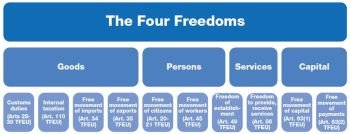
Some EFTA members were also queuing up to join the Community and for EFTA as a whole there was the prospect of developing closer ties with the EC by the formation of a European Economic Area (the EEA). The EEA was a free-trade area covering the nineteen states that belonged to either EFTA or the EC. In effect, it extended many of the benefits of the SEA to the EFTA countries, so that over a vast section of the continent there was free movement of capital, goods, services, and workers. To ensure compliance with rules and regulations, EFTA countries agreed to abide by around 80 per cent of the Community’s rules on the single market. Switzerland rejected the opportunity to join the EEA in a referendum. In fact, much of the significance of the new body was shortly to be diminished, for three EFTA countries (Austria, Finland, and Sweden) were keen to enter the EC as full members.
These were all weighty questions ripe for consideration. Once the passage of the SEA had been completed and work was in hand to achieve the single market by the end of 1992, there was a chance to reassess the position of the Community in changing circumstances. It was on the verge of possible – indeed likely – enlargement. Before this could happen, the prevailing view in some member countries was that there must be a deepening of Community bonds to prevent any dilution once membership increased.
In the ‘widening or deepening’ debate, there were many in the British government who came down firmly in favour of widening first, in the hope that this might make any deepening impossible. In the late Thatcher/Major years, there was a growing coolness within the Conservative Party about all things European.
On most of the issues which arose for discussion from the passage of the SEA onwards, the majority of British ministers seemed to be seeking to stem the tide of European advance. They wanted to limit Community competence as much as possible, and keep to the idea of a common market with, maybe, a little intergovernmental cooperation tacked on, where this seemed appropriate. Such an attitude was far removed from what the makers of the European Community had always had in mind.
It was during the presidency of Jacques Delors (1985–94) that the Commission began to develop policies designed to bring about a closer union extending well beyond anything achieved since the signing of the Treaty of Rome. The Delors programme Jacques Delors was an energetic and activist president of the Commission. In that capacity, he had unveiled the proposals for a single market to the European Parliament in 1992. Two years later, he presented a new programme in which he dealt with the challenges created by the steps already taken – the prospect of moving onwards towards closer union, via increased cooperation on economic and monetary policy, and on matters of foreign policy. In addition, he saw a need to re-examine Community finances and review the workings of the Common Agricultural Policy. He then began work on a plan for economic and monetary union which the European Council had asked a committee chaired by him to devise.
In June 1989, the Delors Report was presented to the Council of Ministers. It envisaged a three-stage progression to its ultimate goal of full monetary union, of which a common currency would be an important element. For Delors and Chancellor Kohl of Germany, economic and monetary union (EMU) was justifiable not only on economic grounds. They viewed it as a further step towards the creation of political unity in Europe. President Mitterrand of France took a similar view. By a majority vote, the decision was taken that there should be an intergovernmental conference to examine EMU and other issues more thoroughly.
Delors believed that the EC was more than a common market. It was ‘an organised space governed by commonly agreed rules that [will] ensure economic and social cohesion and equality of opportunity’. In other words, there was a social dimension to the market, which involved the protection of individual rights so that the Community worked for the benefit of all its citizens.
In May 1989, the Commission produced a draft Charter of Fundamental Social Rights in connection with terms of employment. This was the Social Charter, later to become the Social Chapter. It was a bold document, but largely as a result of pressure from the British government it was much watered down in its next version. Even this was unacceptable to the British, who alone refused to go along with the proposals.
Approach to Maastricht
Two intergovernmental conferences were convened in 1990. One concerned EMU, the other political union. The key decisions were reserved for the meeting of the European Council to be held at Maastricht in December 1991. In the months leading up to the summit, issues such as the Social Charter, the common currency, and the democratic deficit were much argued over by politicians and in the press. There was to be a settlement of a number of European matters, with a view to signing a treaty which would, among other things, set out the target dates for achieving the next stages of the Delors Plan.
Many British Conservatives expressed strong hostility to the author of these suggestions, for they realized that he wished to see a massive transfer of power to Brussels and away from individual governments. His comment back in 1988 that he expected to see 80 per cent of all legislation in member countries coming from Brussels within ten years convinced many of his critics that the implications of any proposals from him needed to be carefully studied.
Maastricht Treaty
The Maastricht Summit (December 1991) was an important step in the process of moving towards a united Europe. It laid the foundations for more radical moves towards a federal-style union which would follow later in the decade. At British insistence, the ‘f ’ word (federal) was excluded from the agreement, but the commitment remained to work towards an ever closer union of the peoples of Europe.
The most important agreement was to fix a definite date for the achievement of economic and monetary union (EMU), 1999 at the latest, or 1997 if seven members met the necessary criteria. The French government, backed by the Germans, was determined to set an irreversible date for the introduction of a single currency. Leaders in both countries understood that shifts in public attitudes could lead to a questioning of the idea, especially as the German people realised that their familiar D-Mark could disappear. Tying the community to a fixed date would, it was hoped, preempt the emergence of any such doubts. The commitment made to achieve union was strong even in countries such as Italy and Spain, for whom achieving convergence looked a more daunting task.
As a quid pro quo (a ‘something for something’ bargain), the French backed the German desire for a powerful central bank which would be free from political interference. The Germans also gained their wish that there should be tough rules governing entry into EMU, involving strict criteria on budget deficits, interest rates, and inflation. The effect of such conditions would be that countries with high inflation and low productivity would need to improve their performance, or become depressed areas of the Community.
In certain major areas, the Parliament was to have new powers of co-decision with the Council of Ministers, allowing it to reject a proposal if agreement could not be reached. This applied particularly to areas where the Council could decide matters on the basis of majority voting. Co-decision-making covered issues relating to the internal market, and common policies for research and development, training and consumer affairs, among other things.
The Parliament could also request the Commission to draw up proposals where it decided, by a majority vote, that new EC legislation was needed. In addition, the Commission and its president would be subject to Parliamentary approval at the beginning of their mandate. Some progress was made towards a common foreign and security policy. In foreign policy, the principles would have to be agreed unanimously, but it could be unanimously agreed to use weighted majority voting for their implementation. NATO was accorded the key role, but defence arrangements might be gradually Europeanised, with the WEU becoming the vehicle for implementing EC policies. For those eleven nations which were signatories to it, the Social Chapter (formerly the Social Charter) meant that they could embark on new measures as soon as they were agreed. No longer would they need to fear a British veto when they were seeking significant improvements in workers’ rights. The three pillars, as described in bellow, were set out in Title 1 of the Treaty of Maastricht. Title 2, the longer section of more than 100 pages, was concerned with the complex but necessary legal amendments to the Rome Treaty. In addition to the main document, there were seventeen protocols and thirty-three declarations attached to the Maastricht Treaty. One important protocol was that on social policy, which was designed to improve working conditions and industrial employment practices. This is better known as the Social Chapter.
The texts, much criticised for their obscurity and complexity, were subject to ratification by all twelve national parliaments of the member states.
The three pillars of the Maastricht Treaty
The concrete result was agreement on the text of a Treaty of European Union. In the words of the Preamble, it was designed to achieve ‘an ever closer union among the peoples of Europe where decisions are taken as closely as possible to the citizens’.
The agreement marked a new phase in the life of the Community, establishing a Union based on three separate sections, or ‘pillars’.
1. First Pillar: the new European Community
The First Pillar, built on the existing EC treaty, was a development of what was already occurring. In many ways, it formalised the Community’s commitment to what happened in practice. In addition, it extended its scope to cover such matters as economic and monetary union and the growth in power of the European Parliament.
Maastricht took the SEA further. Internal frontiers were already due to be abolished by January 1993, and the new Treaty decreed that citizens of member states would automatically become members of the European Union. As such, they could live and work in any member state, stand for municipal office or for the European Parliament wherever they lived, and vote in the country of residence.
The key clauses were concerned with the irrevocable path to economic and monetary union. Other important developments were that:
• The Council of Ministers would be able to act on a qualified majority vote, in some new policy areas, effectively removing the national veto.
• The Parliament was to acquire greater powers.
• A Parliamentary Ombudsman was to be established.
2. The other two pillars
The other two pillars were based on intergovernmental cooperation, outside the scope of the existing treaties. In both cases, provision was made for reporting to the Council and Parliament.
Second Pillar
The new arrangements on foreign and security policy were important. In the SEA, there had been a formal mention of European Political Cooperation, a process which was already in existence and which referred to the search for a Common Foreign and Security Policy (CFSP). At Maastricht, this term was used and the cooperation involved was strengthened.
The Second Pillar was intended ‘to assert the Community’s identity on the international scene’. It covered all aspects of European security, and included provisions for the eventual framing of a common defence policy and perhaps a common defence force. Decision-making would generally be through unanimity, though the governments could decide to take implementing decisions by majority voting. Policy-making was to be through the WEU, but it was agreed that it not conflict with NATO obligations.
Third Pillar
This was concerned with policing and immigration control, and dealt with matters ranging from asylum and illegal immigration to the fight against drug-trafficking and terrorism. The intention was to agree a common asylum policy by the beginning of 1993, and to develop police cooperation to combat drug-trafficking and organized crime through EUROPOL, the new international police unit.