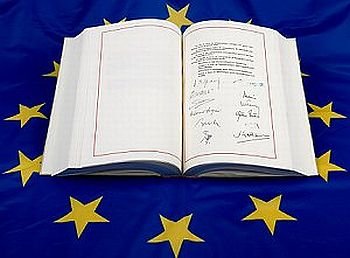
Archive Signature of treaties of Rome 1957
The Treaties of Rome: Euratom and the European Economic Community
In March 1957, two treaties were signed in Rome to establish two separate organizations: the European Atomic Energy Community (Euratom) and the European Economic Community. Euratom was created to research and develop nuclear energy, create a common market for nuclear fuels and supervise the nuclear industry.
Again, as with coal and steel, it was understood that a common community for atomic energy would limit its potential as a means of war. However, its scope was limited, focusing as it did primarily on the peaceful uses of nuclear energy, the major concerns being issues of health and safety, supplies, security and trade. The Euratom Treaty had no grandiose ambitions of the type found in the Preamble to the Treaty of Paris, but in one respect it did continue a theme consistently expressed in the evolution of the European Community. Having stated that ‘nuclear energy represents an essential resource for the development and invigoration of industry’, it went on to say that the new body would ‘permit the advancement of the cause of peace’.
When commentators refer to the Treaty of Rome, they usually mean the one creating the European Economic Community (EEC). Its purpose over the long term was clearly stated in its Preamble: to establish ‘an ever closer union’ between European peoples. However, the more tangible objective was stated in Article 2:
The Community shall have as its task . . . to promote . . . a harmonious development of economic activities, a continuous and balanced expansion, an increase in stability, an accelerated raising of the standard of living and closer relations between the states belonging to it.
The main Rome Treaty set out major guidelines for the Six, including:
• Establishing a customs union in which all internal barriers to trade would be removed, and a common external tariff applied to the outside world
• Developing a common agricultural policy
• Harmonizing social security arrangements
• Providing for the free movement of labour and capital
• Developing regional and social funds to assist poorer areas of their territory to produce new products and retrain workers whose skills become obsolete.
With the fulfilment of these objectives, there would be a ‘Common Market’, comprising the three elements of the ECSC, the EEC and Euratom.
The treaties again contained elements of Supranationalism and intergovernmentalism.
Although the Preamble contains the wish to move to ‘an ever closer union among the peoples of Europe’, it does not specifically say that this must eventually be a federal outcome. At the time, national sensitivities were recognised, so that there was a need to balance the aspirations of pioneers of European integration with provisions for states to protect their national interests.
Yet this was another defining point in postwar Europe. Although the EEC had a much wider remit than the ECSC, there was also strong continuity. Once again six nations had confirmed their determination to press ahead with integration via supranational activity, in a process that was intended to be irreversible. Again, Britain was removed from the centre stage when the momentous development took place.
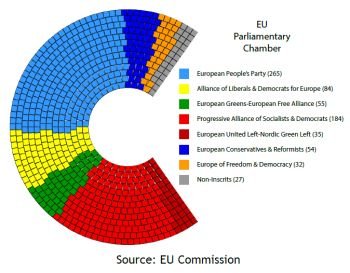
The institutions were all-important, however. As with the ECSC, they contained important supranational bodies, the European Commission (the equivalent of the High Authority of the ECSC) and the Assembly (later known as the Parliament), which initially had only very limited powers. In the evolution of the Community, the decisions of the Court of Justice have also provided an important push towards integration. Again, the Economic and Social Committee, though only advisory, has provided a useful ‘transnational complexion to policymaking by institutionalising the concept that European interests take precedence over national interests’.
Of the supranational elements, the Commission was the most important. It was to deal with the day-to-day functioning of the EEC and had responsibility for implementing Treaty provisions and making recommendations. The national interest was again intended to be safeguarded via the Council of Ministers, which was made responsible for Community-level decision-making.