European Coal and Steel Community (ECSC)
For some time, Monnet had been looking for a way of bringing about economic integration in Europe. He was looking for a bold idea which would capture the imagination of internationalists in Western Europe.
Although he was a visionary, he understood that the politicians and civil servants in his own country and other countries would only back his ideas if they were in line with their national interests and their postwar recovery programmes. In his Memoirs, he later recalled why his fertile mind alighted on a plan for future coal and steel harmonisation:
Coal and steel was at once the key to economic power, and the raw materials for forging the weapons of war. This double role gave them immense symbolic significance, now largely forgotten . . . To pool them across frontiers would reduce their malign prestige and turn them instead into a guarantee of peace.
Problems in the coal and steel industries
In the late 1940s, a crisis in the steel industries of Western European countries seemed likely, for there was the potential to produce vast quantities of the material. Europe appeared to be running into excess steel production. It was estimated that by 1952 production would be approximately 69m tons, and consumption plus exports only 61m – hence the danger of a cut-throat price war or some new international cartel to keep prices artificially high.
Monnet was aware that France had a clear interest in tackling the problem of excess capacity. He was conscious of Germany’s economic resurgence and against this background was keen to safeguard French national interests. He wanted to ensure that his country had access to German raw materials and European markets. As he wrote in his diary in l950: ‘France’s continued recovery will come to a halt unless we rapidly solve the problem of German industrial production and its competitive capacity’.13 The problem needed to be tackled before German recovery enabled it to outstrip France and become a potential danger once again. It required new thinking and Monnet did not seek to ‘solve the German problem in its present context. [We must] change the context by transforming the basic facts’. Monnet’s brainchild was to devise a plan for the harmonization of the coal, iron, and steel industries of France and Germany. The French foreign minister, Robert Schuman, was enthusiastic. Both men wanted to lay aside the age-old tensions between France and Germany, and joint action between the two countries would make this more likely. Such a scheme would have the advantage that although limited in its specific scale, it was bold in its implications. Schuman was responsible for the political action needed to implement the initiative. With his backing, Monnet drew up proposals for a coal–steel pool in Western Europe. Instead of allowing the French and German governments to agree the development of the industries through negotiations and bargaining, the two men proposed the creation of a High Authority whose decisions would be binding on the two countries. This was Supranationalism in action, for it meant that in a limited sphere there was a cessation of national control. It was also a realistic step, the way for Europe to make progress.
Though French Prime Minister Bidault was rather lukewarm about the Schuman Plan and showed little interest in its details, the approval given by the French cabinet on 9 May marked a turning point in the development of postwar Europe. Schuman14 could go public and announce the scheme in a speech known as the Schuman Declaration.
Two aspects of his pronouncement stand out:
1. The recognition of the importance of the Franco-German relationship to Europe’s future. In the last paragraph quoted, there is even an implication that the two countries could initially act on their own. The pronouncement really marks the beginning of that Franco-German axis which has underpinned much of the development of the European Community, later Union.
As such, this was a dramatic development in French and European affairs.
2. Schuman implicitly recognised that there would not be any swift creation of a federal Europe with its own constitution. In his view, there would be no ‘single framework’, but rather there must be action ‘concentrated on one limited but decisive point’. In other words, this was an acceptance of progress via functional means.
Gathering support from the beginning, Monnet and Schuman could see that the proposal would be better if more countries were involved, so that it was open to others to join.
However, the Plan had matured in secrecy, and it was sprung upon the relevant nations in such a way as to cause maximum impact. This would achieve a momentum, and get negotiations swiftly started on the right level of boldness and vision.
The French foreign minister announced that ‘it is no longer the moment for vain words, but for a bold act – a constructive act’. He referred to the French initiative as ‘preparing the creation of a united Europe’. The German chancellor, Adenauer, was surprised at the news of the French project, but welcomed it and gave his country’s approval, for it was ‘a magnanimous step . . . making any future conflict between France and Germany impossible. It is a step of extraordinary importance for the peace of Europe and of the entire world’. Adenauer was a shrewd politician who saw that the ‘magnanimous step’ was good not only for Europe, but also for West Germany. It provided him with the opportunity of rebuilding his fledgling state and giving the country enhanced respectability. To an aide he observed that the plan for an ECSC was ‘our breakthrough . . . our beginning’.
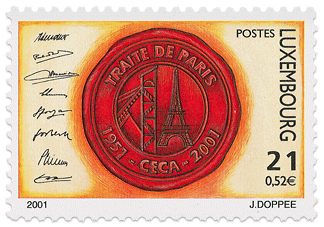
Agreement on the principles between France and Germany was the essential starting point, the precondition for securing assent from Italy and the Benelux countries. The French invited six countries to participate in discussions. Britain declined the offer, whereas the others accepted. They signed the Treaty of Paris in April 1951.
The idea underlying the new Community was to establish a new body to manage all coal and steel production. There would be a tariff-free market in which there would be no customs barriers to restrict trade in coal and steel across Western Europe. It began to operate in 1952, a date which marks the foundation of serious economic union in Europe.
Monnet18 was candid about his end goal. Addressing the Common Assembly for the first time, he stated:
We can never sufficiently emphasise that the six Community countries are the forerunners of a broader united Europe, whose bounds are set only by those who have not yet joined. Our Community is not a coal and steel producer’s association; it is the beginning of Europe. The Preamble to the Paris Treaty makes this clear, for it offers an explicit commitment to ongoing integration.
When the ECSC was formed, there was a choice of routes available. Europe could opt again for the intergovernmental approach in which national sovereignty was retained. Or it could instead take a significant new departure and over a limited area abandon any notion of national control and go for the supranational.
It chose the latter. This meant that, whatever its broad sympathy, Britain was not likely to be content with the new arrangements. The American secretary of state, Dean Acheson, rote of his reactions to Schuman’s exposition of its detail. He described it as ‘so breathtaking that at first I did not grasp it: [Later] we caught his enthusiasm and the breadth of his thought, the rebirth of Europe which, as an entity, had been in eclipse since the Reformation’.
Aftermath of the ECSC: a new defence community?
In August 1950, the French Chamber of Deputies voted for the Pleven Plan, named after its author, the prime minister. It proposed the creation of a European army into which German units could be integrated. In October, the French officially launched the idea of two new communities, one for defence and one for a political community. The European Defence Community (EDC) involved ‘the creation, for common defence, of a European Army under the authority of the political institutions of Europe’.
In many ways, the proposal was a logical development of the neofunctional approach, for it was an expansion of cooperation sector by sector. The initiative indicated that once the momentum to closer integration had been started it was difficult to rein in. Indeed this was precisely what the British feared. They saw the ECSC as a step along a long road which, at varying speed and by different routes, would lead to the ultimate goal of a Europe united along federalist lines. Five of the six nations ratified the twin proposals, but in August 1954 it was ironically the French who effectively scuppered the idea as a result of an adverse vote in the French Assembly. British participation might have helped to persuade the French to go ahead but this was never on the cards. Britain was prepared to work with an EDC, but not to participate in one. Churchill actually urged the Six to ratify the plan, and declared himself in favour of the immediate creation of a European army under a unified command. He offered to play ‘a worthy and honourable part’. But that part was ‘all support short of membership’. Churchill was aware of several factors that inclined Britain to stand aloof – its island tradition, its Commonwealth associations and its commitments to the United States. All were still important in the British psyche.
In a way, the idea of an EDC suffered by being too ambitious, for as yet the ECSC had not been given a chance to demonstrate how well close cooperation along supranational principles could work. It was remarkable that it got as near to being successful as it did. Its failure suggested that the moment was not yet right and that the pioneers of the new Europe were perhaps rushing their fences. As Desmond Dinan puts it: ‘It was a bridge too far for European integration’.
Failure was a setback to the dreams of the federalists and had a significant impact on the character of future cooperation. Duchêne has argued that ever since then ‘political federation as such has never been on the Community agenda. In fact, the federal element in all European integration plans was cut to the bone’. Europe was certainly not ready for closer political integration, which was too far-reaching for many of those involved. Step-by-step economic integration was to be instead the chosen route to unity.
The Americans and the British had a contingency plan for a failure of the French Assembly to ratify the EDC. They decided to widen the Brussels Treaty of 1948 so that Italy and Germany could join in an enlarged Western European Union which was created in 1955. Furthermore, it was agreed that the occupation of Germany was to be ended and Germany was to be allowed to join NATO.
This formulation was acceptable to the Americans, and the French were persuaded to accept it. Further economic progress; preparations for a wider economic community. The success of the ECSC inspired the Six to extend their cooperation over the whole area of economic activity, and at the Messina Conference in 1955 they decided to examine the possibility of a general economic union and the development of the peaceful use of atomic energy. The intergovernmental conference was seen as an opportunity to prelaunch the European idea, and to do so by extending the ECSC into a wider area of the economy. The countries involved wished to see a structure develop which would increase the chances of their achieving recovery and growth. They thought in terms of an enlarged free-trade area. This time, the initiative came not from the Franco-German axis, but from the Benelux countries which had shown how neighbours could work together and harmonise their policies. The Dutch had suggested the idea of a common market for all industrial goods back in the early part of the decade. When they revived their idea in 1955, it met with general approval.
The leading Belgian federalist, Paul-Henri Spaak, and Monnet were the statesmen who did much of the preparatory work for the new meeting. They ensured that there was an achievable agenda which would enable agreement to be reached on basic and concrete steps. The Messina Conference went well, and its participants were convinced, in the words of the joint resolution, that ‘It is necessary to work for the establishment of a United Europe by the development of common institutions, the progressive fusion of national economies, the creation of a common market and the progressive harmonisation of social policies’.
Spaak’s draft treaty formed the basis of the intergovernmental discussions which took place in June 1956, talks which were as much concerned with the progress in moving towards an atomic community as they were with the creation of a free trade one. Yet it is the creation of the common market which is most remembered about this period. The discussions were carried out in a way which has become characteristic of Community development, with gains for any country in one area being matched with concessions in another. The French were keen to see the atomic community develop along the lines they urged. The Germans were more committed to an enlarged free-trading area. Neither side would have agreed to the other proposal unless it was able to achieve what it wanted in the area of its preference. That two treaties could be signed together made a ‘trade-off’ possible. In the discussions on free trade, agriculture was especially significant. For the French this was an area of enormous interest and importance, for the sector was one which aroused strong feelings in rural France. The Germans were concerned to get a customs union covering goods, services, and capital. As long as they achieved this, they were happy to allow agriculture a special position; Germany had its own farming community to appease. In those negotiations, the leading figures showed that they had learnt from the failure of the defence scheme. Federalism was still to be the end goal, but in devising the machinery of the new arrangements more concessions were made to intergovernmentalism so that national governments could always defend their country’s overriding interests.