
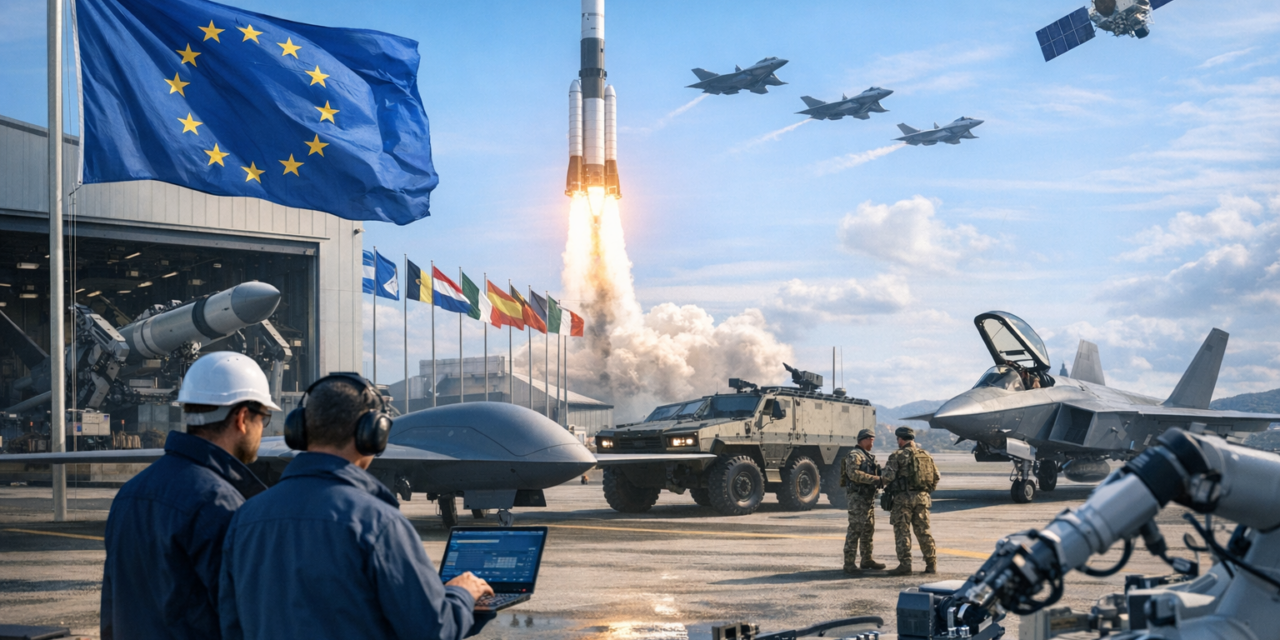
The year 2026 marks a transformative period for the European Union as it deepens its commitment to collective security and technological sovereignty. For decades, the defense architectures of European nations remained fragmented, characterized by independent procurement strategies and a reliance on external suppliers. However, the shifting geopolitical landscape, marked by persistent instability and the urgent need for rapid modernization, has forced the European Union to reconsider how it designs and acquires military hardware. The transition toward common procurement and joint development of defense technologies is no longer an optional policy goal but a functional necessity for the survival and autonomy of the bloc. This shift is designed to eliminate duplication, enhance interoperability among member states, and ensure that European industry can sustain itself during times of crisis. By pooling resources, the European Union aims to create economies of scale that were previously unreachable for individual countries operating in isolation. This essay examines the evolution of these initiatives, the technological advancements currently underway, the economic implications of unified procurement, and the strategic challenges that continue to face the European Union as it pursues a more integrated defense future.
The Shift Toward Strategic Autonomy
The move toward integrated defense procurement in 2026 is rooted in the broader concept of strategic autonomy. In the years following the start of the current decade, European policymakers recognized that relying heavily on foreign technology left the continent vulnerable to global supply chain disruptions and political pressures. Strategic autonomy does not mean total isolation from global partners but rather the ability to make independent decisions regarding defense posture and operational capabilities. By developing core technologies within the European Union, member states ensure that they retain control over maintenance, software updates, and the operational life cycles of their equipment.
The European Defence Fund has emerged as the central engine for this transformation. By 2026, this fund has evolved from a pilot project into a mature instrument that incentivizes cross border collaboration. When companies from different member states work together on a single project, they are eligible for significant financial support from the union budget. This has led to the formation of large transnational industrial consortia that bring together the best minds from across Europe. These collaborations have proven that defense technology can be developed more efficiently when national interests are subordinated to collective requirements. As the continent faces modern threats such as drone warfare and sophisticated cyber attacks, the ability to rapidly iterate on new technologies has become the defining metric of success.
Challenges of Unified Procurement
Despite the clear benefits of a unified approach, the path toward 2026 has been fraught with structural obstacles. The primary challenge remains the nationalistic nature of defense contracting. Historically, member states have viewed their defense industries as essential parts of their national identity and economic pride. Giving up control over procurement often feels like a loss of sovereignty to local governments. Furthermore, different countries operate with vastly different military requirements based on their geographic location and historical security threats. A country bordering the sea has different equipment needs compared to a landlocked nation with mountainous terrain. Synchronizing these diverse requirements into a single procurement program is an administrative and diplomatic feat of immense proportions.
Another challenge involves the standardization of military components. In the past, tanks or jet fighters built by different European nations used unique parts that were not interchangeable. This lack of interoperability meant that in a joint mission, spare parts and fuel supplies could not be shared effectively. By 2026, the European Union has implemented stricter standards for technical specifications. While this helps on the battlefield, it often creates friction for smaller defense contractors who struggle to meet these rigorous, union wide compliance standards. Balancing the need for high tech uniformity with the desire to keep small and medium sized businesses competitive in the market has been a constant struggle for the European Commission. These businesses often provide the innovation that drives the defense sector, but they lack the massive scale of traditional defense giants.
Technological Priorities in 2026
In 2026, the focus of common procurement has shifted toward high demand, high tech areas such as artificial intelligence, unmanned aerial vehicles, and space based communication systems. The development of next generation air defense systems has become a top priority. Unlike the legacy systems of the previous decade, these new platforms are designed to operate as a network. Using advanced data links, individual units communicate in real time to create a dense, impenetrable defensive shield over European territory. This level of coordination is only possible because the software controlling these units was developed as a common standard across the union.
Artificial intelligence plays an equally critical role. The European Union has invested heavily in AI driven logistics, which allow for predictive maintenance of military assets. Instead of waiting for a machine to break down, sensors track the usage and wear of every critical part, allowing for proactive repairs before a mission commences. This keeps a higher percentage of the fleet operational at any given time. Additionally, the development of swarm technology for drones has seen significant breakthroughs. Common research programs have enabled European engineers to perfect the software that allows hundreds of small, inexpensive drones to act as a single, coordinated entity. This technology is viewed as a force multiplier that allows European forces to remain competitive without having to match the sheer mass of adversaries in terms of personnel.
Economic and Industrial Impact
The move to integrate defense procurement has had a profound impact on the European economy. By streamlining the demand side of the defense market, the European Union has created a more predictable environment for investors. Defense companies are now able to plan long term investment cycles knowing that there is a guaranteed market for their products across the union. This stability has led to increased innovation and lower costs per unit. When multiple countries agree to buy the same platform, the cost of research and development is shared, and the price of production drops due to the economies of scale.
Furthermore, the integration of European supply chains has strengthened the industrial base. By mandating that a certain percentage of defense components must be sourced from within the union, policymakers have ensured that jobs remain within member states. This strategy also prevents the erosion of critical skills. In the past, when a country stopped building tanks or naval vessels for a long period, the skilled workforce drifted to other industries, leading to a loss of knowledge that was difficult to recover. In 2026, the continuous cycle of collaborative projects keeps these factories busy, ensuring that the necessary technical expertise is always preserved for future developments. The defense industry is no longer just a cost center but an engine for technological growth that feeds into the civilian economy through spin off inventions.
The Role of European Defense Industry Policy
The European Defence Industrial Strategy, which has gained significant traction by 2026, serves as the regulatory framework for this cooperative era. It outlines clear goals for self sufficiency, emphasizing that the union must be able to produce 50 percent of its defense equipment within its own borders by the end of the decade. This policy encourages member states to participate in joint procurement auctions, which are transparent and open to all capable firms within the union. This transparency has reduced the potential for corruption and has forced companies to become more efficient to remain competitive.
The strategy also addresses the issue of financing. Recognizing that defense projects require massive upfront capital, the European Investment Bank and various union initiatives have expanded their support for defense startups. This provides a bridge for companies that have promising technology but lack the financial backing of the traditional, larger firms. By creating a more vibrant ecosystem, the union is fostering a culture of competition and innovation that was previously stifled by national protectionism. This has allowed European products to compete more effectively in the global export market as well, which generates additional revenue to reinvest in further research.
Cooperation and Future Outlook
Looking toward the future, the integration of defense procurement is expected to deepen even further. While the current focus is on shared procurement and joint development, the long term vision includes a more synchronized military doctrine. If member states can agree on how to use their equipment, they are more likely to procure the same types of technology. The progress made by 2026 serves as a blueprint for this deeper integration. The experience of working together on complex defense projects has fostered trust and cultural understanding between military and industrial leaders who were once strangers to one another.
However, the future is not without risks. The success of these initiatives depends heavily on the political will of the member states to remain committed to collective goals. If economic conditions worsen, there may be a temptation for countries to revert to protecting their own national industries at the expense of the collective. Additionally, the rapid pace of technological change means that the procurement process itself must become even more agile. The current procedures, while much improved, still struggle to keep up with the speed of innovation in areas like software development and cyber warfare. The ability of the European Union to adapt its own bureaucratic processes will be just as important as the technological advancements themselves.
Conclusion
The evolution of the European Union toward common procurement and development of defense technologies by 2026 represents a landmark achievement in the history of European integration. By moving beyond a collection of independent national defense strategies, the union has positioned itself as a more credible and capable geopolitical actor. The benefits of this transition are clear, ranging from enhanced interoperability on the battlefield to a stronger, more efficient industrial base that drives technological progress. While the challenges of national sovereignty and the complexities of harmonizing diverse requirements remain, the progress achieved thus far is undeniable. The union has demonstrated that when it speaks with one voice and invests as a single entity, it can overcome the limitations of individual states to create solutions that serve the entire continent. As Europe continues to navigate the complexities of the modern security environment, its commitment to shared defense technology will be the bedrock upon which its peace and stability are secured. The success of these initiatives in 2026 provides a solid foundation for the future, proving that cooperation is not just a political ideal but a practical necessity in a competitive and rapidly changing world. The journey is far from complete, but the direction is firmly established, and the European Union has shown the capacity to adapt, learn, and grow in the interest of its common security.
Bibliography
- European Commission. European Defence Fund: Annual Review 2025. Brussels: Publications Office of the European Union, 2025.
- European Commission. European Defence Industrial Strategy (EDIS). Brussels: European Union, 2024.
- European Defence Agency (EDA). Defence Cooperation and Joint Procurement in the EU: Trends and Outlook. Brussels: EDA, 2025.
- Fiott, Daniel. Strategic Autonomy and European Defence Integration. Paris: EU Institute for Security Studies, 2024.
- Biscop, Sven. European Defence and Technological Sovereignty. London: Routledge, 2025.
- European Parliament Research Service (EPRS). EU Defence Policy in 2026: Strategic Developments and Future Scenarios. Brussels: EPRS, 2026.
- European Court of Auditors. Joint Defence Procurement: Performance and Accountability Review. Luxembourg: ECA, 2025.
- Howorth, Jolyon. Security and Defence in the European Union. 4th ed. London: Palgrave Macmillan, 2024.
- European Investment Bank. Financing Innovation in Europe’s Defence Sector. Luxembourg: EIB, 2025.
- NATO & EU. Emerging Defence Technologies and Cooperative Security. Brussels: NATO Publications, 2025.
References:
https://www.bruegel.org/policy-brief/joint-public-procurement-tool-european-union-industrial-policy
https://academic.oup.com/book/45784/chapter/400599995
https://link.springer.com/chapter/10.1007/978-3-031-64060-5_3
https://ideas.repec.org/a/vrs/poicbe/v19y2025i1p1755-1765n1021.html
https://www.emerald.com/doi/10.1108/09555349910256854
https://ec.europa.eu/docsroom/documents/10488/attachments/1/translations/en/renditions/native
https://eu-opensci.org/index.php/politics/article/view/8182
https://sjms.nu/articles/10.31374/sjms.303
https://www.bruegel.org/policy-brief/european-defence-industrial-strategy-hostile-world