
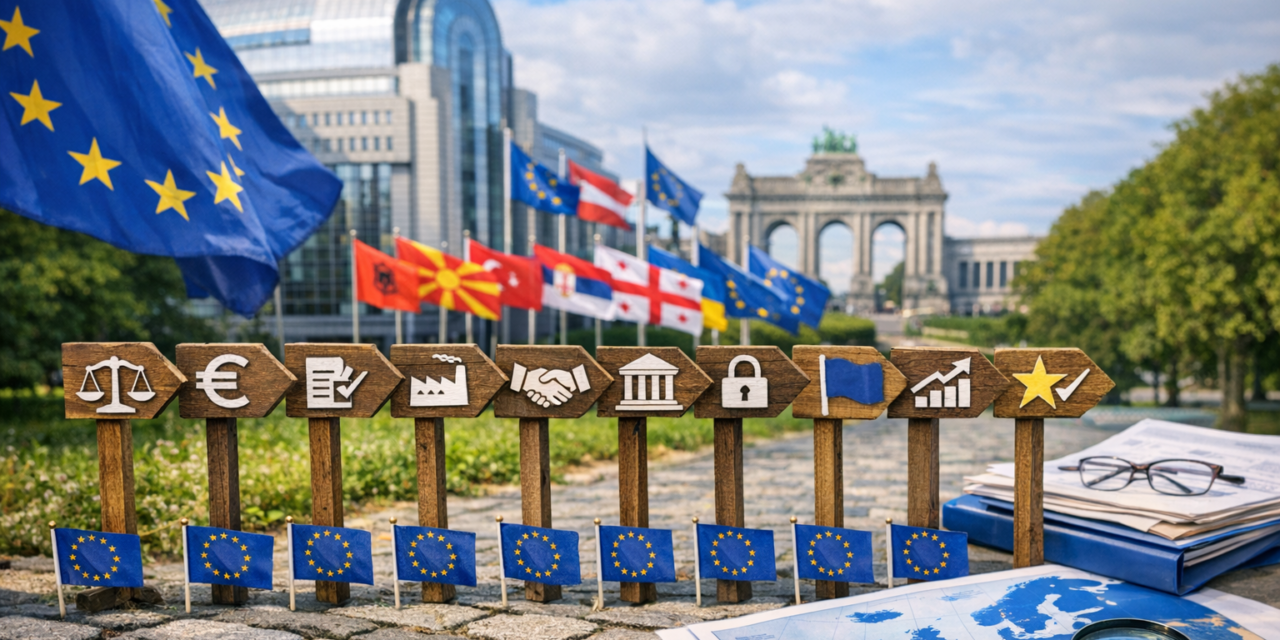
The European Union continues to represent one of the world’s most ambitious political and economic integration projects, offering membership to European states willing to embrace its values, legal order, and long‑term strategic vision. Accession is not a mere administrative procedure; it is a demanding, multi‑phase transformation guided by political, economic, and institutional benchmarks. While the EU treaties establish the basic eligibility requirement-being a European state-the practical journey toward membership is shaped by the Copenhagen criteria, adopted in 1993 and continuously reaffirmed in subsequent enlargement strategies. As of 2026, these criteria remain the backbone of EU enlargement policy, shaping the trajectories of current candidates such as Ukraine, Moldova, Georgia, and the Western Balkan states.
The Copenhagen Criteria: The Foundational Tenets
1. Political Stability and Democratic Governance
The first pillar requires stable democratic institutions capable of guaranteeing the rule of law, human rights, and the protection of minorities. This includes an independent judiciary, free elections, and effective checks and balances. Recent enlargement developments-particularly the opening of accession negotiations with Ukraine and Moldova in 2024 and their continued progress through 2025-have underscored the EU’s insistence on judicial reform, anti‑corruption measures, and media freedom as non‑negotiable prerequisites.
2. A Functioning Market Economy
The second pillar demands a functioning market economy able to withstand competitive pressures within the EU’s single market. This includes macroeconomic stability, predictable fiscal policy, and structural reforms. By 2026, several candidate countries have intensified efforts to align with EU economic standards. The Western Balkans continue to face challenges related to state‑owned enterprises, labor market rigidity, and investment climate reforms, while Türkiye’s negotiations remain frozen due to persistent political and economic divergences.
3. Capacity to Adopt and Implement the Acquis Communautaire
The third pillar concerns administrative and institutional capacity to implement the acquis communautaire-the full body of EU law. This remains the most technically demanding requirement, involving thousands of regulations across 35 negotiation chapters. Countries such as Montenegro and Serbia, which have opened many chapters but struggle to close them, illustrate the complexity of aligning national legislation with EU norms. Meanwhile, Ukraine’s rapid post‑2022 reforms have demonstrated unprecedented political will, though implementation capacity remains a central challenge.

Procedural Steps and the Role of Negotiation
Formal Application and Candidate Status
The accession process begins with a formal application, followed by a detailed assessment by the European Commission. Candidate status is granted only when the political criteria are sufficiently met. Since 2022, the EU has accelerated its evaluation mechanisms to respond to geopolitical shifts, granting candidate status to Ukraine, Moldova, and Bosnia and Herzegovina, and recognizing Georgia as a potential candidate pending further reforms.
Opening and Conducting Negotiations
Once candidate status is confirmed, the European Council must unanimously agree to open accession negotiations. These negotiations are structured around 35 thematic chapters, each requiring alignment with specific areas of the acquis. Progress is monitored continuously, with benchmarks set for opening and closing each chapter. As of 2026, Montenegro remains the most advanced Western Balkan candidate, though political reforms and rule‑of‑law issues continue to slow progress.
Unanimous Approval by Member States
A critical but often underestimated requirement is the need for unanimous approval by all existing EU member states. Any member state may block progress or final accession due to bilateral disputes or political concerns. The EU’s experience with North Macedonia-whose accession path was delayed for years due to disputes with Greece and later Bulgaria-demonstrates how political consensus can be as decisive as technical compliance.
Commitment to the EU’s Long‑Term Objectives
Beyond technical alignment, candidate countries must demonstrate a genuine commitment to the EU’s overarching goals, including deeper political integration, adherence to common foreign policy principles, and respect for the Union’s strategic direction. The final step is the signing and ratification of the Accession Treaty, requiring approval by all EU member states and the candidate country.
Conclusion
The ten pathways to EU membership remain anchored in the Copenhagen criteria, reinforced by procedural rigor and political consensus. As of January 2026, the enlargement landscape is shaped by renewed geopolitical urgency, particularly following Russia’s invasion of Ukraine, which has revitalized the EU’s commitment to supporting democratic transformation in its neighborhood. Yet the accession process remains demanding, requiring sustained reforms, institutional resilience, and alignment with the EU’s long‑term vision. Ultimately, membership is not merely a policy milestone but a profound national transformation-one that reshapes political systems, economies, and societies in pursuit of a shared European future.
Bibliography
Foundational Works on European Integration
- Desmond Dinan – Europe Recast: A History of European Union
- Andrew Moravcsik – The Choice for Europe: Social Purpose and State Power from Messina to Maastricht
- Neal Nugent – The Government and Politics of the European Union
- Heather Grabbe – The EU’s Transformative Power: Europeanization Through Conditionality in Central and Eastern Europe
- Frank Schimmelfennig & Ulrich Sedelmeier – The Politics of European Union Enlargement: Theoretical Approaches
- Milada Anna Vachudova – Europe Undivided: Democracy, Leverage and Integration After Communism
- Tanja A. Börzel & Thomas Risse – The Oxford Handbook of Comparative Regionalism (sections on EU conditionality)
- Wojciech Sadurski – Democracy and the Rule of Law in the European Union
- Kim Lane Scheppele & Dimitry Kochenov – Reinforcing Rule of Law Oversight in the European Union
- Jan Zielonka – Europe as Empire: The Nature of the Enlarged European Union
- Barry Eichengreen – European Economy Since 1945: Coordinated Capitalism and Beyond
- Paul De Grauwe – Economics of Monetary Union
- Ali M. El-Agraa – The European Union: Economics and Policies
- Dimitris N. Chryssochoou – Theorizing European Integration
- Mark A. Pollack, Helen Wallace & Alasdair Young (eds.) – Policy-Making in the European Union
- Sabine Saurugger – Theoretical Approaches to European Integration
- Michael E. Smith – Europe’s Foreign and Security Policy: The Institutionalization of Cooperation
- Nathalie Tocci – The EU and Conflict Resolution: Promoting Peace in the Backyard
- Timothy Garton Ash – Homelands: A Personal History of Europe