The importance and definition of competences
EU law and the balance of competences: A short guide and glossary
Division of competences within the European Union

COMPETENCES OF THE EU
Supranationality v inter-governmentalism: Is the EU a federation?
Many scholars have tried to conceptualise the EU legal order, the central question being: “Is the EU an international organisation of a type similar to a confederation or is it an embryonic federal state?”
Many issues make the debate difficult:
1. The concept of a federation is complex: there are many definitions of federalism and many models of federal states. Examples are the USA, Canada, Germany, South Africa, Belgium and Switzerland. The issues are which variant of federalism should we use in a comparative reflection on the nature of the EU, and should we refer at all to the established models of federation for comparative guidance, given that the EU is unique and that European integration exhibits sui generis features?
2. Should the debate be restricted to a legal or constitutional definition of a federation or should it encompass sociological, economic, political and cultural aspects?
3. The EU is of a complex multidimensional nature.
4. How relevant are the nineteenth-century definitions of “state”, “sovereignty” and “treaty” to a conceptual discussion on the nature of the EU in the twenty-first century environment? Should we rethink or reformulate “old” definitions instead of trying to fit the EU into them? Or perhaps a new word is needed to describe the entity that is the EU? Having said the above, it may be useful to provide a basic, unsophisticated definition of a federation and a confederation.
Confederation
In a confederation two or more independent states unite for their mutual welfare and for the furtherance of their common aims. Usually they sign a treaty to this effect, which is often replaced by an agreed constitution. A central government is created that has certain powers, mostly in external affairs and defense. Component states retain their powers for domestic purposes. Often a common currency is introduced. The central government acts upon the member states, not upon the individuals. Each component state is fully sovereign and independent and thus possesses international legal personality. Each component state is free to leave the confederation. Examples of confederations are: Switzerland (between 1291 and 1848), The Netherlands (between 1581 and 1795), the US (between 1776 and 1788) and Germany (between 1815 and 1866). While the EU in many respects does not fit into the definition of a confederation, it exhibits some of its features:
-It is a union of states based on international treaties;
-It tried but failed to adopt a formal constitution. However, many scholars, including the author, accept that the EU already has a constitution, that is, the founding treaties as amended;
-Member States have delegated certain powers to EU institutions. Nevertheless, crucial areas, in particular foreign affairs and defense, are still within the individual realm of each Member State;
– Member States of the EU are allowed to have different forms of government;
-Each Member State is fully sovereign, independent and possesses international legal personality;
-There is a common currency although not all Member States have adopted it;
-A Member State is free to leave the Union if it so wishes. The right to withdraw is contained in Article 50 TEU;
EU law is relevant to individuals, as they can bring claims in national courts based on EU law and can be direct addressees of measures taken by the EU institutions.
Federation
It is difficult to provide a definition of a federation without being too simplistic or too vague. Accordingly the following is far from being perfect.
In a federation two or more states unite to such an extent that they abandon their separate organization as sovereign and independent states. Federations can be founded on international treaties, emerge as a result of decentralization of a unitary state (for example, Belgium and Brazil) or be created by means of coercion (the USA). Governmental responsibilities are divided between the federal authority and the constituent members of the federation. Usually the federal government is entrusted with exclusive competence in foreign affairs, defense, immigration, citizenship, and so on, while member states have competence in respect of internal matters. Only the federal state possesses international personality and is regarded as a state under international law. There is a general principle that member states of a federation cannot enter into separate relations with foreign states, although some federal constitutions give member states a limited capacity to do this. The self-governing status of a component state is typically enshrined in a constitution and cannot be altered by a unilateral decision of the central government. Members have no right to leave a federation. Important features of a federation are the existence of a constitution, which is supreme, and of an independent arbiter of that constitution.
The EU exhibits the following federal features:
It has supranational institutions:
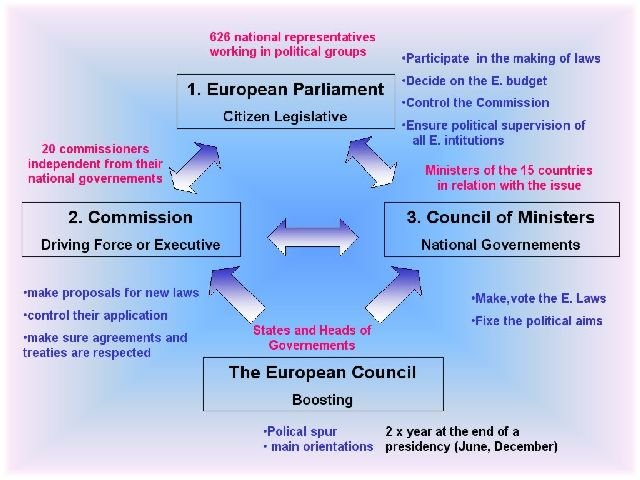
(a) The Commission, which is independent, initiates legislation, acts as a watchdog to ensure the due application of EU law by all parties and is the executive of the EU. However, the Commission cannot be equated with a federal government because it is the European Council that gives the necessary political impetus to European integration, and the right to initiate legislation is not vested solely in the Commission;
(b) The EP: while the EP is democratically elected by EU citizens, it is less powerful than a national parliament. The EP cannot initiate legislation, is not the sole legislative body in the EU (see Chapter 6.5) and, unlike national parliaments, cannot impose taxes;
(c) The ECJ: interprets EU law, rules on the validity of EU law, conducts judicial reviews of EU acts and monitors the uniform interpretation of EU law. Member States, EU institutions and, in limited circumstances, individuals have access to the ECJ. There is no doubt that the ECJ exercises an integrative influence on the EU, but the ECJ cannot be equated to a federal court and cannot be regarded as a supreme judicial arbiter in all matters because its role under EU law is different from that exercised by a federal court. In a federal state only the federal court (not a state court) can interpret the constitution, monitor the division of competences between the states and the centre, conduct judicial reviews and supervise a bill of rights. The ECJ does not directly supervise the division of competences between the EU and the Member States and the final arbitrator on human rights issues will be the ECtHR. Further, the ECJ is too inaccessible to citizens of the EU to be regarded as a federal court;
– EU law is supreme and thus prevails over the national law of a Member State;
– Individuals are subject to EU law;
– The direct effect of EU law ensures that individuals can rely on it in proceedings before national courts;
– The EU has created its own citizenship;
– It has a single currency, the euro;
– The division of competences between the EU and the Member States is based on the principles of conferral, subsidiarity and proportionality. In particular, the principle of subsidiarity is akin to a federation. However, the EU requires the consent of a majority of
the Member States to legislate even in areas in which it enjoys exclusive competence. Thus the Member States retain control over the EU’s actions;
-The Member States are responsible for the implementation of legislative measures adopted by the EU;
-The EU has its own resources and its own budget.
It is submitted that the EU is neither a federation nor a confederation. Its uniqueness lies in the fact that it encompasses some features of both to accomplish its objectives. It exhibits many federal features, while in the CFSP it exhibits features inherent to an international organization of a type similar to a confederation. The EU is a new hybrid political and legal system that encompasses many of the political and legal advantages of a federal state while preserving the sovereignty of nation states. The preservation of sovereignty is particularly evident in areas of foreign policy, defense and taxation, which are typically within the competence of a federal state, but being particularly dear to many Member States, are within the exclusive competence of each of them.
Perhaps the best answer as to the identification of the nature of the EU is provided by Douglas-Scott in the following terms: “In the end, it surely matters not whether we call the EU a federal system or not. It exhibits enough federal features to satisfy those who are determined to find it federal, and lacks some which would entitle purists to reject the title . . . The EU . . . is too sui generis, too complex, too multidimensional, to fit any such categorization.”