The Revolutions of 1989 in Eastern Europe
THE REVOLUTIONS OF 1989
The first test of Moscow’s new thinking came, once again, from Poland. Since the martial law crackdown on Solidarity in 1981, Poland had muddled along in political stalemate and economic stagnation. The government had lifted martial law in 1983 and released Lech Walesa, but he remained officially a “nonperson.” In 1988, a new round of price hikes sparked worker protests and strikes. At first, the strikers’ demands were largely economic, but soon they expanded to include calls for political change, including the legalization of Solidarity. The government turned to Walesa to help end the strikes, leading to a series of roundtable negotiations among representatives of the government, the Catholic Church, and Solidarity.
The negotiations were concluded in April 1989, with a path-breaking set of agreements that provided for the reinstatement of Solidarity and for parliamentary elections in which Solidarity could put up candidates against the communist incumbents. At the signing ceremony of this pact, Walesa proclaimed, “This is the beginning of democracy and a free Poland.” The elections were scheduled for early June, just two months after the roundtable agreements. The Solidarity-led opposition was at an incredible disadvantage, trying in that short time to transform itself from illegal underground to legal electoral contestant. Nevertheless, in June, the opposition staged a stunning victory, winning almost every single seat it was allowed to contest.
With this unexpected turn of events, the Communist Party no longer commanded a majority in the parliament. In August, a coalition government was formed under Tadeusz Mazowiecki, an attorney, editor, and Solidarity supporter. For the first time since 1948, a noncommunist government held power in Eastern Europe. This was a blunt challenge to the principles of the Brezhnev Doctrine, but all through these events, the Kremlin looked on quietly and even with approval. That summer, a Gorbachev spokesman jokingly referred to Moscow’s new “Sinatra Doctrine.” This referred to Frank Sinatra’s song “My Way” and implied that the Soviet satellites would now be allowed to go their own way. The next year, Lech Walesa was elected president of Poland. The Brezhnev Doctrine was dead.
The Polish roundtable negotiations and elections opened the floodgates of reform in the rest of the Soviet bloc. In Hungary, the government and the opposition entered into Polish-style negotiations on the future of the country. Within a few months, they had agreed on constitutional reform, a multiparty system, and free parliamentary elections in 1990. By the fall of 1989, the Hungarian Communist Party was dissolved, and the word “People’s” had been dropped from the name “Hungarian People’s Republic.”
Hungary opened its borders with the West, with a ceremonial cutting of the barbed wire barrier on the Austrian border. Hungary then became a funnel through which thousands of Eastern Europeans traveled, on their way to the West. East Germans, in particular, now had a way around the Berlin Wall, and tens of thousands fled to the West.
In East Germany, a hard-line communist leadership under Erich Honecker had resisted Soviet-style reforms. But tensions came to a head in October 1989, as a result of two circumstances: the popular exodus through Hungary and other countries, which had reached almost two hundred thousand people by then, and the visit to Berlin by Gorbachev. The Honecker government had at first allowed some East Germans to travel to West Germany through other countries but then clamped down. The new restrictions led to protests and demonstrations in East Berlin, Dresden, Leipzig, and other cities. At this time, Gorbachev came to East Berlin to participate in the country’s fortieth anniversary celebrations. Wherever he went, he was greeted by chants of “Gorby! Gorby!” and the police had to break up several demonstrations and protests.
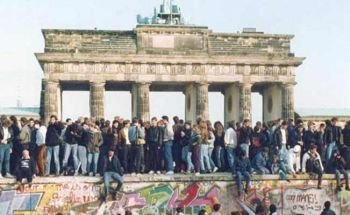
After his departure, the demonstrations grew larger and more political, reaching three hundred thousand in Leipzig and half a million in East Berlin. Demands were made for free emigration, the resignation of Honecker, and the legalization of a political opposition. In the first few days of November, the entire government resigned, then the Communist Party’s leadership did the same. As the government weakened and travel restrictions were eased, people once again poured out of the country. Finally, on November 9, 1989, the government ended all travel restrictions, and the Berlin Wall was opened. Young people stormed the wall, chopped at it with pickaxes, and celebrated with champagne.
That day marked the beginning of the end for East Germany. Over the next months, the Communist Party made an effort to reform and democratizes itself, as was happening in Hungary and Poland. The country’s parliament voted to end the communists’ leading role and promised free elections in the spring of 1990. But, by then, a flood tide was under way, from both East and West, for the unification of the two Germanys. East Germany disappeared on October 3, 1990, absorbed into a reunified Germany less than a year after the collapse of the Berlin Wall.
The turmoil in East Germany in October and November of 1989 spilled over into neighboring Czechoslovakia. As huge demonstrations in the capital city, Prague, demanded political change, Václav Havel and members of Charter 77, as well as of other opposition groups, put together the Civic Forum to coordinate the protests and to demand the resignation of the Communist Party leadership. On November 24, after 350,000 people had gathered in Prague’s Wenceslas Square to cheer Alexander Dubcek (the hero of 1968) and Václav Havel, the entire party leadership resigned.
A new leadership agreed to the formation of a coalition government, free elections, and freer travel to the West. The communists had bowed out without a fight, and Czechoslovaks exalted over their Velvet Revolution.
As Havel claimed, with only slight exaggeration, the revolution had taken ten years in Poland, ten months in Hungary, ten weeks in East Germany, but only ten days in Czechoslovakia. In December 1989, Václav Havel became president of Czechoslovakia.
In the course of just six months, from June through December of 1989, communist governments fell in Poland, Hungary, East Germany, Czechoslovakia, Bulgaria, and Romania. Only in Romania did the revolution turn violent. There, over the course of just ten days, more than a thousand people were killed in the uprising, culminating in the execution of communist dictator Nicolae Ceausescu and his wife, on Christmas day. Remarkably, with that lone exception, all other East European revolutions occurred peacefully.
Never before in history had so many countries undergone revolutionary changes in such a short time. Some were managed by Reformist Party leadership, as in Hungary; some by “people power,” as in East Germany and Czechoslovakia; and some by a combination of the two, as in Poland and Bulgaria. In every case, though, the ease and rapidity of change was breathtaking. Regimes that were considered well entrenched and well protected simply tumbled, one after another, into the “dustbin of history” (a phrase Marx had used to describe the fate of capitalist states). Within two years, communism collapsed in the Soviet Union itself.
Václav Havel, Frank Zappa, and the Velvet Revolution
In the Soviet Union and Eastern Europe, as in tsarist Russia in the nineteenth century, the ban on opposition parties or organizations meant that writers, artists, and intellectuals played an important political role. One of the most prominent dissident intellectuals in Eastern Europe was the playwright Václav Havel. In his twenties, he took a job as a stagehand at Prague’s ABC Theater and began writing plays himself. During the more open period of the Prague Spring in 1968, he traveled to the United States, where he identified with the 1960s counterculture, especially rock music. After the Soviet intervention put an end to the Czechoslovak reforms in August 1968, the new hard-line government in Prague banned Havel’s plays, arrested him several times, and jailed him twice.
In 1977, the government arrested and tried a popular Czechoslovak rock band called The Plastic People of the Universe, named after lyrics in a song by American rocker Frank Zappa. In protest of the trial, a number of Czechoslovak artists and intellectuals signed a manifesto for artistic and political freedom, which they called Charter 77. This became a kind of floating intellectual protest organization, with Havel as the spokesman. Havel formulated his ideas about resistance to tyranny in an important 1969 essay, “The Power of the Powerless,” which later became a book. He argued there that a totalitarian political system is built on lies and that people allow the system to exist by accepting the lies and living within them. The only moral solution to and way out of totalitarianism is for individuals to reject the lies and “to live within the truth.”
Havel’s essay, published illegally in Czechoslovakia and other Eastern European countries, was widely influential and became, in essence, a blueprint for what happened in 1989. With the fall of communism in Czechoslovakia’s Velvet Revolution, Václav Havel became the president of the country (and remained so until 2003). As president, he brought Frank Zappa to Czechoslovakia, told him his music had helped inspire their revolution, and offered him a job as special ambassador to the West for trade, culture, and tourism. American Secretary of State James Baker nixed the idea.