Decolonization and Nationalism Triumphant: Crash Course World History (Video)
THE UNITED NATIONS AND DECOLONIZATION
DECOLONIZATION
At the same time that Europe was recovering from World War II and being split in half by the Cold War, it was shedding its colonies. Most of the European empires had been acquired in the nineteenth century and had become an integral part of the European economies.
With some exceptions, most of the European empires remained intact up through World War II. Germany had lost its colonies with its defeat in World War I; Italy (and Japan) lost theirs with their defeat in World War II. Even so, in 1945, large parts of the world’s population and land masses were still under the control of Britain, France, Holland, Belgium, and Portugal. Britain’s far-flung empire was 125 times as large as Britain itself. The Belgian empire was 78 times the size of Belgium; the Dutch empire 55 times the size of the home country; and the French empire, 19 times. Virtually all of these empires evaporated within about thirty years.
After the war, many factors worked against the continuation of European imperialism. Both the United States and the newly formed UN were opposed to old-style colonialism. When President Roosevelt and Prime Minister Churchill signed the Atlantic Charter in 1941, laying out their wartime goals and postwar plans, they acknowledged the “right of all peoples to choose the form of government under which they will live” and called for “sovereign rights and self government restored to those who have been forcibly deprived of them.” Perhaps this was aimed mostly at territories seized by Nazi Germany and Imperial Japan, but it also held promise for the colonies of Churchill’s Britain and for those of the other Allied powers.
Even if the Europeans wanted to keep their colonies, they were not really in a position to do so. All of these countries had been devastated and exhausted by the war; many were still issuing ration coupons to their citizens several years after the war’s end. They no longer had the financial or military resources to enforce their rule in distant realms.
Furthermore, a new breed of colonial elites, many of them educated in Europe, had learned the language of nationalism and democracy and was pressing their demands for independence. The disintegration of the European empires, and the emergence of dozens of new independent states from their ruins, revolutionized global politics, and laid the basis for a transformed Europe.
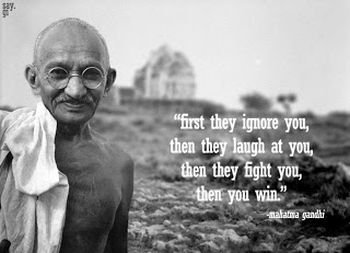
For Britain, the largest empire in world history, the most important of these independence movements occurred in India-with a population of 400 million, it was the “jewel in the crown” of the British Empire. Led by Jawaharlal Nehru and Mohandas Gandhi-the prophet of nonviolent resistance-India finally wrested independence from Britain in 1947. The struggle against Britain was largely peaceful, but independence came with horrible costs-an orgy of violence between Hindus and Muslims; the largest population movements in world history; and the creation of separate Hindu (India) and Muslim (Pakistan, and later Bangladesh) states out of British India. Gandhi was assassinated in 1948 by a Hindu extremist who opposed the Mahatma’s efforts to keep Hindus and Muslims together in one country. India became the world’s largest (and poorest) democracy, but ever since independence the subcontinent has been tormented by tensions and violence between religious communities, and between India and Pakistan-now both armed with nuclear weapons.
At the same time that Britain was negotiating India’s independence, it was trying to disengage from its commitments in the Eastern Mediterranean. The most volatile of these areas was Palestine, part of the former Ottoman Empire that had been entrusted to Britain by the League of Nations after World War I. Most of the residents of Palestine were Arabs, although the interwar period had seen a steady stream of Jewish immigrants, mostly from Europe, hoping to establish a Jewish state in what they considered the Promised Land. Hundreds of thousands of Jews fled to Palestine during and after World War II, having escaped or survived the Holocaust. In 1947, the United Nations called for the division of Palestine into separate Jewish and Arab states, but the plan was rejected by the Arabs, and when Britain formally withdrew from the territory in 1948, Jewish leaders unilaterally proclaimed the establishment of Israel.
Immediately, neighboring Arab states declared war on Israel, the first of a series of conflicts over the next thirty years. More than one million Palestinian Arabs fled or were expelled from Israel, becoming refugees in neighboring Jordan and other Arab states. Most Arab states still do not formally recognize the state of Israel, and the area has remained a seemingly intractable source of tension, violence, and conflict.
France’s major colonial possessions were in Southeast Asia and North Africa. In the former, in what was called French Indochina, a national independence movement had emerged in Vietnam during World War II, under the leadership of a communist named Ho Chi Minh. At first, the conflict was mostly a guerilla insurgency against the French, but as the Cold War developed, the local conflict became an international one, with conventional armies on each side supported and supplied by the United States and the Soviet Union. Despite the commitment of half a million troops to the conflict, the French suffered a major defeat at Dien Bien Phu in 1954. The government in Paris decided to cut its losses, closes the books on Indochina, and withdraw its troops. The Geneva Accords later that year provided for a temporary division of Vietnam into a communist north and a non-communist south, and free all-Vietnamese elections within two years. With the Cold War in full swing, though, Vietnam remained divided, the United States stepped in to replace the French, and the Vietnam War raged on for another twenty years, until the final victory of the communist North Vietnamese in 1975.
Just a few months after the devastating fall of Dien Bien Phu, France was confronted with another nationalist uprising in an even more important colony-Algeria. For France, this was a different kind of colony altogether than Vietnam. Algeria, after all, was just across the Mediterranean from France, and was the home of over a million French citizens. (Another half million lived in nearby Morocco and Tunisia.) Indeed, Algeria was considered part of France, as represented by the popular slogan “Algérie, c’est la France.” The recent loss of Vietnam made the French even more reluctant to abandon Algeria, and the conflict there persisted for a decade, roiling both the colony and France itself. The government in Paris fought off a military coup d’etat; brought back into the presidency the World War II military hero Charles De Gaulle to settle the crisis; and ushered out the Fourth Republic with a new constitution, authored by De Gaulle, in 1958. Algeria was given independence in 1962.
De Gaulle was elected to prevent the loss of France’s most important colony; Britain’s Winston Churchill complained that he had not become Prime Minister “in order to preside over the liquidation of the British Empire.” But under their auspices, their countries lost their most important colonial possessions-Algeria and India-and soon thereafter virtually all of their remaining colonies. Holland ceded independence to Indonesia in 1949. Beginning in 1957, with the independence of Ghana from Britain, one after another of Europe’s African colonies became free. The Age of Imperialism, which happened so quickly with the Scramble for Africa in the last decades of the nineteenth century, collapsed almost as quickly in the first decades following World War II.
Independence and self-determination for the European colonies was a consequence and legacy of the evolution of liberty and democracy in Europe, with roots in the Enlightenment and the French Revolution. So, these many new independent countries, constituting over half of the membership of the UN by the 1980s, were products of the ideals that had shaped modern Europe. The influence went both ways, however, because decolonization also had a big impact on Europe, as well as on the rest of the world.
For the Europeans after World War II, domestic economic growth came to be seen as more important than colonial trade. At the same time, the shedding of colonies reduced the imperial powers to the same standing as other European states, making cooperation among them less problematic and facilitating their integration into the Common Market (and eventually the European Union). All of the European countries retained strong ties with their former colonies, however, allowing a flood of immigrants into Europe. These two contrasting forces-of harmonization and integration on the one hand, and immigration and diversification on the other-would pose the major challenges facing Europe in the twenty-first century.
The multitude of newly independent countries came to be known as the “Third World,” belonging neither to the First World of capitalist democracies, or the communist Second World. Indeed, the Third World became the central arena of Cold War rivalry between the United States and the Soviet Union, each striving to extend its global influence and limit that of its rival. Many Third World leaders refused to be drawn into this great power conflict, constituting the “Non-Aligned Movement,” which has since grown to represent nearly two-thirds of the members of the UN.