Cold War – After Stalin (1953-1956) (VIdeo)
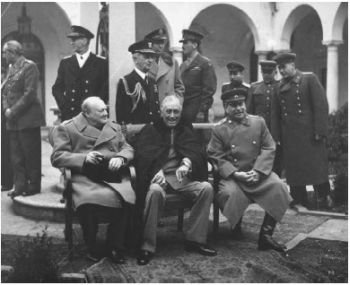
Conference of the Big Three at Yalta makes final plans for the defeat of Germany. Prime Minister Winston S. Churchill, President Franklin D. Roosevelt, and Premier Joseph Stalin, February 1945. National Archives (111-SC-260486).
Europe Divided, the Cold War, and Decolonization
At the conclusion of World War II, Europe was ruined, exhausted, occupied, and divided. The death and devastation from the second war of the century was even greater than that from the first. The major European powers, having dominated the Continent for centuries, had all been occupied, bombed, ravaged, or defeated. The victorious armies of the United States and the Soviet Union, each with millions of men in uniform, stood astride the Continent. But, the wartime alliance between them that had defeated Nazi Germany soon broke apart over differences on the treatment and future of Germany and other occupied lands. The tensions between the United States and the Soviet Union became known as the Cold War: a war, in that they viewed each other as mortal enemies, but cold in that they did not engage in actual military conflict.
As the Cold War emerged, Europe became divided in almost every way, including nomenclature: Western Europe and Eastern Europe. The United States assisted in the economic recovery of Western Europe and promoted the development there of liberal democracies. The Soviet Union imposed communist political systems in Eastern Europe and came to control and dominates that region. Germany, caught in the middle of the Cold War, was itself divided into East and West, as was the former capital of Berlin. The Berlin Wall, running through the center of the city, came to symbolize the division of Europe and the Cold War itself. The East–West tensions that were centered in Europe shaped much of world politics for the next half-century. Not until the collapse of communism and the fall of the Berlin Wall in 1989 were the Cold War brought to a close.
The weakness of Europe after World War II, in combination with the rise of national liberation movements in Europe’s overseas colonies, forced the European imperial states to cede independence to their colonies.
This process of “decolonization” began at about the same time that the Cold War was developing, and continued for the next two decades. Decolonization compelled west Europeans to become more dependent on the United States, and on each other, eventually facilitating the economic integration that evolved into the European Union.
The Division of Europe
In February 1945, Franklin Roosevelt, Winston Churchill, and Joseph Stalin met at the Soviet resort town of Yalta to plan the final stages of World War II and to negotiate the postwar order in Europe. The Anglo-Americans were not in a very strong bargaining position because they had liberated only France, whereas the Soviet army had pushed the Germans out of most of Poland, Hungary, Yugoslavia, Czechoslovakia, and Romania and were only about one hundred miles from Berlin (which they would take three months later). Among the provisions of the Yalta Agreements, as these negotiations came to be known, were the movement of Poland’s borders some one hundred miles westward (leaving parts of eastern Poland to the Soviet Union), the temporary division of Germany into occupation zones (with the Soviets occupying the eastern part), and the agreement that the nations of Eastern Europe were to be democratic and “friendly” to the Soviet Union. The three leaders also agreed to begin work on a new international organization to be called the United Nations (UN).
In later years, Yalta became a symbol of betrayal for many of the peoples of Eastern Europe who felt that the Allies had given Stalin a free hand in the region. Indeed, in the three years following the Yalta Conference, the Soviets systematically undermined democratic politics and established Soviet-style communist regimes throughout the area. Given the circumstances of 1945, however, it was almost inevitable that the Soviet Union would come to dominate Eastern Europe. As a result of postwar military operations, by the time of the Nazi surrender in May 1945, the area was almost completely under Soviet military occupation. So, just as the American, British, and French forces swept the Germans out of the western part of Europe and initiated Western-style democratic governments in those countries, the Soviets occupied Eastern Europe and established “people’s democracies” that were “friendly” to the Soviet Union.
From the Soviet point of view, and especially from Stalin’s, “friendly” meant “socialist”- a capitalist state would by nature be hostile to the communism of the Soviet Union. Furthermore, for the Soviet Union, the lands of Eastern Europe were far more important strategically than they were for the West. Most of these countries bordered the Soviet Union, and this region historically had constituted the principal route of invasion into Russia and the Soviet Union by numerous armies, including those of Napoleon in 1812, the Poles in 1919–1920, and the Germans in both world wars. So, control over the area was of critical importance for the Soviet Union, and for Stalin.
At the end of the war, the Soviet army was in military control of Poland, Hungary, Czechoslovakia, Bulgaria, and Romania. Moscow began a gradual process of extending political dominance over these countries, in a procedure described by the Hungarian Communist Party chief as “salami tactics,” meaning one slice at a time. The first round of parliamentary elections in each country was generally free and fair, resulting in coalition governments including both communist and noncommunist parties. But, by 1947, most of the noncommunist parties had been squeezed out, the news media and the police had been placed under control of the communists, and elections were increasingly rigged. A seizure of power by the Communist Party in Czechoslovakia in February 1948 signaled the end of democratic politics in Eastern Europe. The former British prime minister, Winston Churchill, had foreseen this division of Europe two years earlier, when in a speech at Westminster College in Missouri, he intoned that an “iron curtain” had descended across Europe “from Stettin in the Baltic to Trieste in the Adriatic.”
The Onset of the Cold War
The U.S. government complained about the erosion of democracy in Eastern Europe but was not prepared or inclined to do much about it in an area of peripheral strategic concern to the United States. But in two other areas – Germany and the combined regions of Greece and Turkey – the United States was prepared to take action, and in those two areas, the Cold War lines began to harden. In 1946 and 1947, Turkey was under pressure from the Soviet Union to return some territory that it had seized from Russia just after the communist revolution of 1917. Greece was mired in a civil war between the royalist government and communist insurgents who had won broad popular support for their resistance to the Nazis during the world war. Historically, both Greece and Turkey had looked to Britain to support them against their powerful northern neighbor. But Britain, weakened by the war and a postwar financial crisis, informed the U.S. government that it could no longer assume these responsibilities.
American president Harry Truman went to Congress with a request for funds to assist the two countries, but phrased the appeal in broad and universal terms; the money would be spent “to assist free peoples who are resisting attempted subjugation by armed minorities or by outside pressures.”1 This pledge to assist democracy everywhere, known as the Truman Doctrine, marked a sharp departure from traditional American isolationism and was a virtual declaration of leadership of the free world.
The Truman Doctrine was primarily a response to events in Greece and Turkey, but came at a time of heightened U.S.–Soviet tensions over both the consolidation of communist rule in Eastern Europe and the administration of Germany. At the end of the war, Germany had been divided into four occupation zones (U.S., Soviet, British, and French) jointly administered by an Allied Control Commission. The capital city of Berlin, deep inside the Soviet zone, was also divided into four zones. From the start, Moscow and the Western allies differed over how to deal with Germany.
In essence, Stalin wanted to keep Germany weak and prevent it from ever mounting another military threat against the Soviet Union. The U.S. Truman administration, cognizant of the effects of reparations on Germany after World War I, was more intent on rebuilding Germany and integrating it into the world community. The disagreements paralyzed the Allied Control Commission, so the United States, Britain, and France went their own way, merging their three zones into one and then, in 1948, introducing a new currency in their zone without consulting the Russians.
Moscow protested by blocking rail and road access from the Western zone of Germany to the Western zone of Berlin, one hundred miles inside the Soviet zone. President Truman briefly considered breaking the Berlin blockade by sending a column of U.S. armored troops into Berlin.
Almost certainly, this would have led to armed conflict with the Soviet Union, just three years after the conclusion of World War II. Instead, Truman resorted to an airlift of supplies to the three million residents of West Berlin. The Berlin airlift lasted almost a year, with one plane landing in West Berlin every minute until Moscow finally lifted the blockade. But, by then, Europe was firmly divided. In 1949, elections in West Germany were held to constitute the Federal Republic of Germany, and a few months later, the Soviets set up their own state in East Germany, which they called the German Democratic Republic.
President Truman was convinced that Soviet pressure on Turkey, the communist insurgency in Greece, Moscow’s salami tactics in Eastern Europe, and the Berlin crisis were all part of a broader Soviet plan to expand communism. A State Department official, George Kennan, had written an important article advocating a U.S. policy of the “containment of Russian expansive tendencies.” This doctrine of the containment of communism became the governing principle of American foreign policy for the next fifty years. Worried that the precarious political and economic conditions of some European countries provided a breeding ground for communist expansion, in 1947, the United States launched the Marshall Plan, which provided $17 billion for the reconstruction of Europe over five years.
In 1949, the United States sponsored the creation of the North Atlantic Treaty Organization (NATO), which guaranteed U.S. military protection for Western European countries under attack. This was the first peacetime military alliance for the United States since the time of the Revolutionary War and was yet another indication of the shift of power-political, military, and diplomatic—from Europe to the United States.
The Cold War soon shifted to Asia and became a global competition. In October 1949, Mao Zedong and his communists won power in China, fueling fears in the United States of a global “red tide” of communism. The next year, when communist North Korea attacked South Korea, President Truman viewed the situation as 1930s-style aggression, instigated this time by Moscow: “If the Russian totalitarian state was intending to follow in the path of the dictatorships of Hitler and Mussolini,” he said, “they should be met head on in Korea.”2 U.S. troops committed to Korea were soon fighting communist Chinese forces in the north, and the American commander, Douglas MacArthur, called for carrying the war into China (including using nuclear weapons). The Korean War stalemated, and an armistice was signed in 1953, but within another few years, the United States was committed to protecting another Asian country, South Vietnam, from the possibility of communist takeover.
There was another dimension to the Cold War-the nuclear arms race and the “balance of terror.” The U.S. monopoly on nuclear weapons was broken with the detonation of an atomic weapon by the Soviet Union in 1949. After that, both sides engaged in a competitive arms buildup such that, by the 1990s, each superpower had about twenty-five thousand nuclear weapons, including about eleven thousand on each side that were “strategic weapons” (i.e., those with intercontinental ranges). The strategic weapons were placed on Soviet or American territory or on submarines, but many intermediate and short-range ones were placed on European soil, on either side of the Iron Curtain. Britain and France, worried about being reduced to sideline spectators in world politics, also developed their own independent nuclear arsenals. If the Cold War had become hot-and nuclear-much of the destruction would have occurred in Europe.
The UN also became a casualty of the Cold War. The UN, largely an inspiration of Roosevelt, was meant to replace and improve upon the discredited League of Nations.3 In an effort to include all the major powers this time, each of the Big Five victorious allies-the United States, the Soviet Union, China, France, and Britain-were given permanent seats on the UN’s governing Security Council, as well as veto power. In this way, any of the five could prevent action that they disagreed with. With the emergence of the Cold War, however, the United States and the Soviet Union could agree on hardly a single international issue, so UN action in settling international disputes was constantly frustrated by U.S. or Soviet vetoes.