Marxist Terror and Tyranny in Russia – Story of Lenin (Video)
War and Revolution in Russia 1914 – 1921
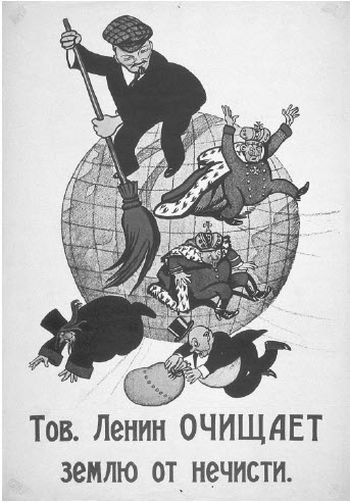
Comrade Lenin Sweeps the World Clean. This 1920 Soviet propaganda poster illustrates the party’s commitment, later abandoned, to promoting world revolution. Courtesy of the David King Collection
MARXISM AND LENINISM
The idea of communism was first developed by Karl Marx and others in the middle of the nineteenth century. The word “communism” basically disappeared from political discourse after the 1850s in most of Europe, although much of Marxism had been incorporated into the socialist movements and parties that thrived with the expansion of the urban working classes. In Russia, the absence of both a working class and parliamentary politics through most of the nineteenth century meant that Marxism had little influence in any form. It is somewhat ironic, then, that Marx’s ideology of communism was revived not in an advanced capitalist state, but in Russia, the least developed of the major European powers.
The ideology of Marxism appealed for a number of reasons to people working for fundamental change in the Russian Empire. First of all, many Russian radicals had given up in frustration at trying to radicalize the Russian peasants (a goal of the populists in earlier decades) and liked the Marxist focus on urban workers, the proletariat, whom they thought would be more receptive. The scientific and antireligious elements of Marxism also had appeal to many Russian intellectuals, an instrumental group in the reform and revolutionary movements in the country. Marxism appealed to many because it had the potential to make Russia more modern and “enlightened.”
Marxist theory also helped explain Russia’s backwardness as part of a process of historical development and not as some flaw in the Russian character. Finally, Marxism had some advantages tactically because the Russian regime and secret police thought it was harmless! Russian radicals living outside Russia formed the Marxist Social Democratic Labor Party in 1898. Despite its small size, within a few years, the nascent party split into two factions, with the Bolsheviks (majority) pressing for a quick revolution in Russia and the Mensheviks (minority) arguing for a more gradual approach. It was the Bolsheviks, led by Vladimir Lenin, who in 1917 would seize power in the Russian Revolution.
Lenin was born in 1870, to a middle-class family. His older brother was hanged in 1887 for a plot to assassinate the tsar, and this contributed to Lenin’s radicalization. He became involved in revolutionary activity, was arrested, and spent three years in exile in Siberia. From 1900 onward, he spent most of his time outside Russia, planning for an eventual revolution in his country.
For Lenin and other Russian Marxists, the Russian situation posed somewhat of a dilemma and a challenge. Marx had posited that a revolution would occur in an advanced capitalist state with abundant wealth and a large but exploited proletariat. Russia in 1900 was still a mostly rural country, just beginning to industrialize, with a working class that made up only 3 percent of the population. Lenin resolved this dilemma by proposing a number of modifications to Marx’s original theories. In his 1902 essay “What Is to Be Done?” he argued that since the Russian working class was so small and weak, it was necessary to create a “vanguard of the proletariat,” a small, disciplined elite that would help workers develop revolutionary consciousness and lead them to revolution. The Bolsheviks would play this role.
The other dilemma was the undeveloped state of Russian capitalism. Were Russian Marxists simply to wait for capitalism to evolve and develop its contradictions, as Marx seemed to suggest was necessary? For Lenin, the answer was for Russia simply to skip over the capitalist phase of development and proceed directly from feudalism to communism. For this to happen, though, the Russian communist state would need assistance from other wealthier states to provide the material abundance that was necessary for communism to work. He believed that this would happen because a revolution in Russia would break the weakest link in the chain of worldwide capitalism, which was sustained by Western imperialism.
“Imperialism,” Lenin wrote, was “the highest stage of capitalism” and the final one. Once the Russians established their revolutionary state, workers in other, more developed capitalist states would be inspired to conduct their own revolutions. These countries, then, could help to sustain the revolution in Russia, thus fulfilling Marx’s vision.
These ideas of Lenin, who was in exile and marginalized, were at best airy theorizing and speculation. Few people in Russia paid much attention to the Bolsheviks, and when the 1905 revolution broke out, the Bolsheviks were hardly involved. But Lenin’s ideas are important for understanding how the 1917 revolution came about and why the Soviet Union, as it eventually emerged, looked so much different from what Marx had in mind. When the leaders of the Soviet Union referred to their communist ideology in later years, they called it Marxism-Leninism.
WORLD WAR I AND THE TWO REVOLUTIONS
Lenin and the Bolsheviks might have disappeared into weighty history books were it not for the erosion and collapse of the Russian state during World War I. As we saw in the previous chapter, the war had a devastating effect on all European states, but on none more than the Russian Empire. The doddering political system was not up to the task, and the Russians suffered far more casualties than any of the other belligerents.
Nicholas II, although a kind family man, was a weak and feckless leader. He spent most of the war at the front, attempting to direct military operations there. He left the operation of government to his wife, Alexandra, and an influential, but bizarre, monk named Grigory Rasputin, who had a hypnotic ability to stop the bleeding of Alexandra’s hemophiliac son.
By the beginning of 1917, both the military and the country were near collapse. Soldiers were undersupplied and were sometimes sent into battle without weapons or even boots. Over fourteen million peasants were in military service, which contributed to widespread food shortages. In March of that year, bread riots (begun by women), strikes, and demonstrations convulsed the capital city of Petrograd (St. Petersburg was renamed during the war to avoid the German sound of it). Troops summoned to maintain order turned on their officers and mutinied.
Nicholas was forced to abdicate. Three hundred years of Romanov rule had come to an end. A provisional government established by the Duma promised to form a constitutional government and hold free elections. But it made a fatal error in not pulling Russia out of the war, which eroded its popularity and legitimacy. Meanwhile, throughout the country, workers and soldiers had established alternative governing bodies called soviets (councils). The Petrograd Soviet, where the Bolsheviks and other socialists had considerable sway, took over some functions of city administration and increasingly challenged the provisional government.
In April 1917, Lenin returned from exile to Petrograd, rallied the Bolsheviks, promised “peace, land and bread,” and called for “all power to the Soviets,” directly confronting the provisional government. Over the next months, the Bolsheviks gained strength in soviets around the country, and by the fall, had won a majority in the Petrograd Soviet and elsewhere. On November 7, Bolsheviks and their supporters in the Petrograd Soviet occupied the Winter Palace, disbanded the provisional government, and seized power. In his 1927 film, director Sergei Eisenstein depicted these events in the film October, showing hundreds of citizens shooting their way into the Winter Palace. In fact, the real event was practically bloodless, and more damage was done to the Winter Palace in the filming of October than in the November 7 events themselves. Nevertheless, the Eisenstein version became the icon of the Russian Revolution, and November 7 was celebrated every year in the Soviet Union, with parades, speeches, and huge posters of Marx, Engels, and Lenin, as the day of the first communist revolution.
The Bolsheviks were not the largest or most popular of the political movements in Russia at the time of the revolution, but they were one of the best organized, and Lenin was a charismatic speaker and leader. In the chaos and virtual anarchy of the war and the collapse of the monarchy, these characteristics were enough to ensure a Bolshevik victory.
Lenin moved quickly to consolidate power, to remove or neutralize rival parties, and to establish the soviets as the government. The Bolsheviks were renamed the Communist Party. To fulfill Lenin’s promise, the new regime opened negotiations with Germany to end Russia’s involvement in the war, signing the Treaty of Brest-Litovsk in March 1918. Russia had to concede most of Germany’s territorial demands, losing a quarter of its prewar population and three-quarters of its iron- and steel-producing areas. Lenin believed, however, that these losses were incidental and temporary, as the Bolshevik seizure of power was only the first stage of worldwide revolution and Germany itself would not be far behind.
The Bolsheviks and the Role of Women
When the Bolsheviks came to power in 1917, they expected that, under socialism, the family would “wither away,” as would the state. They believed that capitalism was particularly oppressive for women, and they aimed to remedy that. Lenin envisioned the establishment of public dining rooms, kitchens, laundries, and kindergartens that would relieve the woman “from her old domestic slavery and all dependence on her husband.” Free unions of men and women would replace marriage, which would increasingly become superfluous. In the early years of communist rule, legislation (including legalized abortion) was crafted to liberate women and to encourage the disappearance of the family. In the 1930s (under Stalin), however, much of this social experimentation was reversed as the government emphasized more traditional family roles.
CIVIL WAR, NEP, AND CONSOLIDATION
The treaty with Germany ended one major problem for the new communist government, but almost immediately it was faced with a host of new ones threatening its very survival. Groups opposing the Bolsheviks, including supporters of the tsar, the provisional government, or other political parties, organized to resist the new government, causing a devastating civil war that lasted four years. Worried that Tsar Nicholas would serve as a rallying point during the civil war, the Bolsheviks executed him and his family in 1918.
The Bolsheviks also faced challenges from other quarters. The newly formed government of Poland, a creature of the Versailles settlements, moved into areas vacated by the Germans and clashed with the Russians.
The Polish-Soviet war raged for twenty months, until Lenin finally sued for peace. Meanwhile, other nationalities that had been part of the Russian Empire were declaring independence and sometimes fighting against the Bolsheviks-in the Ukraine, Finland, the Caucasus, and the Baltic’s. To complicate and inflame matters even further, French, British, American, and Japanese troops became involved in some of these conflicts, usually fighting against the Bolsheviks.
By 1921, the communists had defeated most of the White Russian (anti-Bolshevik) armies and settled the conflict with Poland. Foreign troops had withdrawn from Russia. But the country was ruined by eight years of war, revolution, terror, civil war, and famine. Lenin called a truce on the domestic front as well, announcing a New Economic Policy (NEP) intended to revitalize the economy by allowing greater freedom in agriculture, industry, and trade. This was also a period of consolidation. In 1922, the communists established the Union of Soviet Socialist Republics (USSR, or Soviet Union), consisting initially of Russia, Byelorussia, Ukraine, and the Caucasus, but over the years expanding to include fifteen republics.
In 1924, the Supreme Soviet of the USSR formally adopted a constitution, declaring the founding of the USSR to be “a decisive step by way of uniting the workers of all countries into one World Soviet Socialist Republic.”