The Treaty of Versailles – An Overview
Primary Documents – Treaty of Versailles, 28 June 1919
TREATY OF VERSAILLES, 1919 – IMPACT OF WORLD WAR I
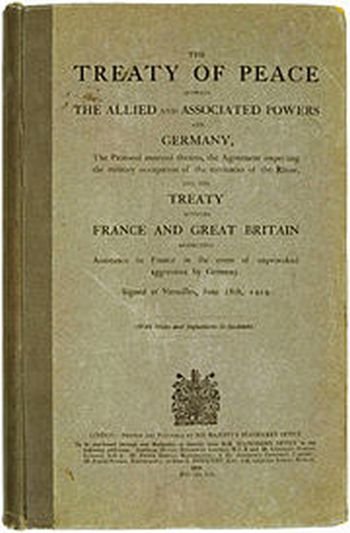
VERSAILLES, THE PEACE SETTLEMENTS, AND THE LEAGUE OF NATIONS
The Allied victors assembled in Paris in the winter of 1919 to draw up peace treaties dealing with each of the defeated states. The preeminent figure in these negotiations was President Wilson, who had arrived in Europe to a hero’s welcome. Near the end of the war, Wilson had laid out his ideas for a postwar peace in his Fourteen Points, which trumpeted principles of democracy, liberalism, and nationalism and echoed the ideals of the Enlightenment, the French Revolution, and the Peoples’ spring of 1848. Wilson called for national self-determination for the peoples of Europe and the redrawing of European borders along national lines. He also appealed for “a general association of nations,” an international political organization to settle disputes among states and prevent war. Both of these ideas became central to the discussions at the peace negotiations.
Despite Wilson’s lofty and idealistic goals, the peace treaty for Germany, the Versailles Treaty, was heavy-handed and punitive. Even though the origins of the war could hardly be laid at the feet of only one state, Germany was assigned blame for the war and was compelled to accept explicit responsibility for Allied losses in the war. German territory was much reduced in size, with Alsace-Lorraine returned to France and parts of the prewar state assigned to the newly established state of Poland. East Prussia was separated from the rest of Germany by a sliver of land, the Polish Corridor, allowing Poland access to the Baltic Sea. The coal- and steel-producing areas of the Saar region (along the border with France) were placed under French control for fifteen years. Germany was stripped of her colonies in Africa and elsewhere, and they were assigned by the League of Nations to other states to administer as mandates. To prevent Germany from becoming a future military power, its army and military production were strictly limited. All of these were humiliating conditions for a country that had already suffered mightily through four years of war.
Although the Paris treaties reduced the German state, they also created a host of new central European states and drew a whole new geography for the Continent. Out of the defunct empires were carved seven new independent states: Finland, Estonia, Latvia, Lithuania, Poland, Czechoslovakia, and Yugoslavia. Austria and Hungary were now small, separate states. Romania was enlarged by the addition of parts of Russia and Hungary. Greece acquired territory from Turkey. With the breakup of the Ottoman Empire, Turkey emerged as an independent republic, and Syria, Lebanon, Palestine, and Iraq were given as League of Nations mandates to France or Britain. Theoretically, these new states and border changes were all based on nationality, in accordance with Wilson’s Fourteen Points. But central Europe was such a jigsaw puzzle of nations that some minorities inevitably remained in most states: Germans and Hungarians in Czechoslovakia; Ruthenium’s in Poland; Poles in Lithuania; Bulgars and Hungarians in Romania; and so forth. These areas became fertile ground for troublemakers and demagogues in the following years.
The other great brainchild of Woodrow Wilson was the “general association of nations,” which emerged from the Paris meetings at the new League of Nations. The League was based on the principle of collective security, which held that all countries collectively would be responsible for protecting the sovereignty and independence of every other country.
Member states pledged not to resort to war and to utilize the institutions of the League, headquartered in Geneva, Switzerland, to discuss and settle international disputes peacefully. As a universal organization with all nations represented, the League would replace the old system of alliances, balance of power, and war as an instrument of policy.
The League of Nations never lived up to this potential, however. The biggest problem was that the United States itself did not join the organization. When Wilson returned to the United States to promote the League, he was faced with a hostile Republican Senate and an isolationist public.
The treaty failed in the Senate by one vote. Other crucial countries were also not involved in the League: The new communist regime in Russia refused to join an organization they considered to be dominated by bourgeois states; and Germany, as part of its punishment for the war, was prohibited from entering the League until 1926. Almost from the beginning, then, the League of Nations was fatally weakened, and when Hitler began challenging the European status quo in the 1930s, the League proved ineffectual.
CONSEQUENCES OF THE WAR
World War I, the “war to end all wars,” altered Europe like no other war or revolution before or since. The human casualties alone were devastating: Some eight million men were killed and another twenty million were wounded, many of them disabled or horribly mutilated. These losses were spread all around the Continent; each of the European Great Powers, except for Italy, lost at least a million men in the war. The U.S. casualties, 115,000 killed and a similar number wounded were light in comparison and were fewer than those the main combatants suffered in single battles like Verdun or the Somme. Europe lost, essentially, an entire generation of young men. As Winston Churchill wrote presciently about the war in 1929, “injuries were wrought to the structure of human society which a century will not efface and which may conceivably prove fatal to the present civilization.”
The duration and totality of the war transformed the home fronts in other ways as well. In every country, governments became more involved in economic planning and control as consumer economies were regarded for military production. With most men at the military fronts, women were brought into the workforce by the millions. (A 1916 British propaganda poster read, “Shells made by a wife may save a husband’s life.”)
This wartime upheaval in gender roles continued after the war and accelerated the movement toward women’s suffrage in Britain and elsewhere. In Britain, women over thirty years of age gained the vote in 1918, and full female suffrage was extended in 1928. Women also won the right to vote in Germany, Scandinavia, the newly created states of Czechoslovakia, Hungary, and Poland, and in the new communist state of the USSR.
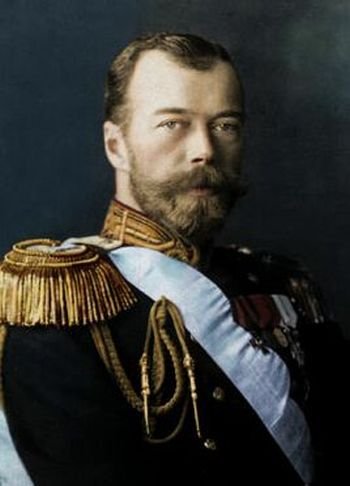
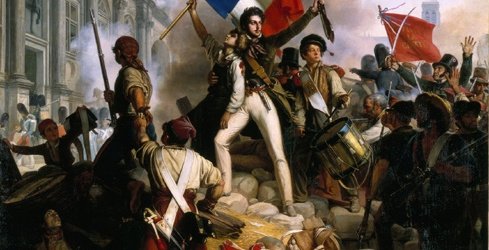
The war also marked the final end of absolute monarchies in Europe, culminating a process that had begun with the French Revolution of 1789. With the defeat of the Central powers, the autocrats of Germany, Austria-Hungary, and the Ottomans were banished, and with the 1917 revolution in Russia, the tsar was ousted and then executed by the Bolsheviks. This time, unlike after previous revolutions and wars, the monarchies would not reappear. Out of the old empires emerged many incipient democratic states based on eighteenth-century ideals of popular sovereignty and nineteenth-century ideals of liberalism and nationalism.
This was a great advance for democracy, but many of these new states were weak, poor, and unaccustomed to democratic traditions of tolerance, compromise, and incremental change. The Bolshevik Revolution in Russia inspired unsuccessful left-wing revolutions in Germany, Austria, and Hungary in 1918–1919, polarizing those populations between the Left and Right. Some states, Germany especially, chafed under the punishments and restrictions of postwar peace settlements. Perhaps in good economic circumstances the new political order in Europe could have gained a footing and flourished, but the worldwide economic depression of the late 1920s and 1930s dashed any such hope. In Germany, already weakened by punishing reparations payments after the war, the depression was devastating. With millions of Germans unemployed, impoverished, and resentful about Versailles, the stage was set for the rise of Adolph Hitler.
The Russian Revolution and Communism
The Bolshevik Revolution in Russia in November 1917 took that country out of World War I and, in many respects, also took it out of Europe and launched it on a bold experiment: building a communist state based on the ideas of Karl Marx. The impact of the 1917 Russian Revolution was at least as great as that of the French Revolution of 1789 in terms of both its domestic consequences and its international implications. The year 1917, like 1789, was one of great political, social, and economic revolution.
Also, like their French counterparts, the Russian revolutionaries claimed that their ideology was transcendent and universal, and they fully believed that the revolution in Russia would be the spark to ignite revolutions throughout the world.
The communist ideology of the new Russia was both anticapitalist and atheistic, so the Western governments, especially the United States, feared and distrusted it. The U.S. government hoped and expected that the communist regime in Russia would fail and refused to extend diplomatic recognition to the new government until 1933. The fear and hostility between Russia and the West were intensified by the communists’ stated desire to spread communism elsewhere in the world, including into Western Europe and the United States. These tensions were muted somewhat during the interwar years because both the United States and the Union of Soviet Socialist Republics (USSR), the new name for the communist state, were focused on internal, rather than international, issues, and then during World War II because of their common alliance against Hitler’s Germany.
But with the end of World War II and the emergence of the United States and the Soviet Union as the world’s two superpowers, those tensions reemerged and dominated international politics during the Cold War.