Unification of Italy and Germany!
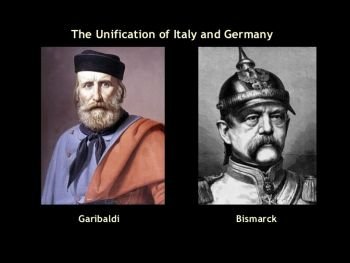
The Unifications of Italy and Germany
With the unification of Italy and Germany, the 1860s saw the emergence of two important new states in central Europe. At roughly the same time that a civil war was testing the unity of the United States of America, statesmen in Europe were using warfare and civic nationalism to forge powerful new nation-states out of a disparate collection of smaller political units. The Peoples’ Spring of 1848 had unleashed forces of nationalism and liberalism, but these forces were contained and reversed by a conservative reaction and the reestablishment of autocratic rule. In 1848, nationalism was popular-from the streets-and this threatened and frightened the conservative establishments of Europe. But even within that establishment, there was support for the creation of unified, centralized states. A decade after the popular revolutions, strong figures in Germany and Italy acted to create national states from above, using the modern technology of warfare to do so. The creation of a united Germany and a united Italy changed the face of, and the balance of power in, Europe. After the completion of Bismarck’s wars of German unification in 1870, Germany was the largest and strongest state in Europe.
NATIONALISM AND THE NATION-STATE
As we saw in chapter 4, the nation-state, a political unit bringing together most people of one nationality, had begun emerging in Europe in the sixteenth century, but the process was a slow one. Before 1860, there were only two major nation-states in Europe, England and France. Other nation-states like Portugal, Holland, and the Scandinavian countries existed, but these were mostly small and peripheral countries. In central Europe, most political units were mini-states, such as Hanover, Bavaria, Tuscany, and Sicily. From the sixteenth century, strong monarchs began forging strong national states by breaking the power of local lords and consolidating governmental power. After the French Revolution of 1789, popular nationalism became another force for national unity, independence, and the creation of nation-states.
The whole concept of a nation was relatively new and derived in part from Enlightenment ideas of popular sovereignty and the spread of literacy, which accompanied the Industrial Revolution and urbanization. A nation is a group of people with a common culture, a sense of identity, and political aspirations. Aspects of culture can include language, religion, ethnicity, traditions, customs, and history. Those common characteristics are not sufficient to constitute a nation, however, which also requires the psychological (or social psychological) element of identity and aspiration: A people has to feel these common ties to be a nation.
This sense of national identity was fostered in the nineteenth century by artists, writers, musicians, and linguists in almost every national culture. In Poland, for example, which was part of the Russian Empire at the time, the romantic and patriotic poet Adam Mickiewicz penned an epic poem called Pan Tadeusz (1834) that depicted a rural and idyllic society. At the end of this epic, young people don the uniform of the Polish Napoleonic army and proclaim the peasant a free citizen.
The Finnish national epic, the Kalevala, was a compilation of folk stories and verses first published in the nineteenth century, at a time when Finland was dominated by Sweden and Russia. These literary works, like many others all over the Continent, helped define national groups and give them a sense of identity and pride. Musicians also contributed to this process, weaving folk tunes and themes into their compositions; witness, for instance, the mazurkas and polonaises of the Polish composer Frederic Chopin and the nationalist tone poem Finlandia by the Finn, Jean Sibelius.
At the same time, linguists began compiling dictionaries and grammars of many languages, many of them appearing in written form for the first time in the nineteenth century. As ethnic groups began acquiring a literary, artistic, and musical heritage, as well as a written language, they increasingly recognized their common identity, and this shaped their aspirations for their own political communities. This was nationalism. When nationalism arises in multinational states or empires, such as the Ottoman, Russian, or Austro-Hungarian empires, national groups typically want to break away from the larger empire, which is dominated by other nationalities, such as the Turks, Russians, or Germans. This nationalist separatism is, of course, a threat to the survival of the empire and so is naturally resisted by its rulers. Nationalism led to the breakup of the Ottoman Empire in the nineteenth century and the emergence of new nation-states like Greece, Serbia, Bulgaria, and Romania out of that empire.
It also roiled the Russian Empire throughout the nineteenth century (especially in Poland) and almost brought down the Austro-Hungarian monarchy in 1848.
The popular revolts of 1848, sometimes tinged with socialism, had frightened European rulers and aristocrats and even the new middle class. However, currents of nationalism stirred within the middle and upper classes too. Often, this nationalism took a very different form, called irredentism, which is the demand for territory belonging to another state. This top-down nationalism, used by national leaders making irredentist claims, fostered the creation of unified states in Germany and Italy.
Verdi and Italian Independence
The great Italian composer Giuseppe Verdi wrote operas with nationalistic themes (including his popular masterpiece Aida), leading many to consider him the musical figurehead of the struggle for Italian independence and unification. In his third opera, Nabucco (1842), the chorus of Hebrews lamenting their captivity in Babylon was, for Italians under Austrian rule, a thinly veiled reference to their own longing for freedom. Verdi’s name even became a kind of codeword for those supporting Victor Emmanuel, then king of Sardinia, to assume leadership of all of Italy: Vittorio Emanuele Re D’Italia (Victor Emmanuel King of Italy). Victor Emmanuel did become king of Italy in 1861, and Verdi himself was elected a member of the newly created Chamber of Deputies.