Marx’s Theory of Economic Crisis
MARXIST THEORY
It is difficult to summarize and synthesize the writings and theories of Karl Marx because these are so voluminous and because his ideas are rich, complex, and sometimes dense and even contradictory. But it is important to understand the basic principles of Marxism because they were so influential in the development of European socialism and remain important (albeit controversial) today.
The Collected Works of Karl Marx and Friedrich Engels number almost fifty fat volumes and occupy about six feet of library shelf space. The most important of these works for understanding Marxist theory are The Communist Manifesto, published in 1848, and Das Kapital, the first volume of which was published in 1867, and the second and third volumes of which Engels completed, edited, and published after Marx’s death in 1883. In the early writings, many of them not published until many years later, Marx primarily set forth humanistic critiques of the excesses of capitalism in much the same way that Charles Dickens criticized urban capitalism in
his novels. Marx’s later work, however, was more historical and systematic, and attempted to create a “science” of history and economics. Marx wanted to create a sort of universal theory for human society; much like Charles Darwin had done for natural history (with his Origin of Species, published in 1859). Indeed, Marx considered dedicating the first volume of Das Kapital to Darwin.
Marx’s “scientific” approach to the study of human society reflected mid-nineteenth-century trends in literature, the arts, and philosophy in which there was a breaking away from romanticism toward realism and materialism. After the failure of the 1848 revolutions, Marx offered a vision that was realistic and hardheaded, not idealistic and utopian. He branded other versions of socialism as utopian (and excoriated many of those in the Manifesto); his socialism, on the other hand, was “scientific.” A key component of this aspect of Marxist theory is historical materialism. Marx pointed to the material basis of all things, including historical development. He argued that one can understand history, and one’s particular stage in history, by recognizing the means of production in that society: what it is that produces material things of value. So, in a feudal society, which is based mostly on agriculture, land is the means of production, the factor that produces agricultural goods. In a capitalist society, it is capital, which mostly takes the form of factories that produces material goods. In every society, the owners of the means of production dominate virtually every aspect of society and form the basis of the class structure of that society. In a feudal society, the owners of the means of production are the landowners (usually the nobility); in capitalist society, the bourgeoisie are the owners of the means of production, and the proletariat is the subordinate class of individuals who work in their factories.
These material and economic relationships constitute the foundation, or substructure, of society on which all else is built. The forms of economic production determine the dominant class, and the dominant class controls the economy, political system, social relationships, and culture of that society, all of which are part of the superstructure of society. As Marx wrote in his Contribution to the Critique of Political Economy (1859), the mode of production in material life determines the general character of the social, political, and intellectual processes of life. It is not the consciousness of men which determines their existence; it is on the contrary their social existence which determines their consciousness.
So, even consciousness and human nature are parts of that superstructure and are, therefore, changeable; when the substructure changes, so too will all aspects of the superstructure, including human consciousness and our notions of human nature. Religion is also part of this superstructure, of course, and is simply a tool of the dominant class to keep the lower classes in their place in this world, with the expectation of a better existence in the hereafter. Religion, in the words of Engels, is the “opiate of the masses.”
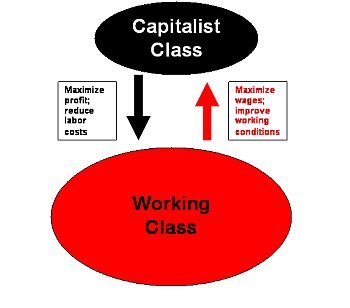
Marx saw all history of every society as proceeding on a predetermined path, moving from one stage to another after a clash between dominant and subordinate classes. “The history of all hitherto existing human society is the history of class struggles,” he contended. All societies begin in the primitive-communal stage, move through a system of slavery (the dominant class being the slave owners), then feudalism, then capitalism, and eventually communism, at which point classes would no longer exist. A good deal of Marx’s writing, then, was focused on the capitalist stage and the way capitalism would be overthrown by a proletarian revolution and replaced with communism. Marx believed that this process would occur naturally and inevitably in every society. Marx believed that the decline of capitalism was already under way in advanced capitalist states like England, France, and Germany. He explained that capitalism, like every previous stage of history, both paved the way for the next stage and sowed the seeds of its own destruction in a process that Marx referred to as the dialectic. The capitalist system, through factories and mass production, generates enormous amounts of material goods, enough to provide the basics for everyone, actually, if it weren’t for the inequitable distribution of those goods. The underpaid workers often cannot even afford to purchase the very products that they assemble. The workers receive in wages only a fraction of the value of the products they produce. The factory owners (the bourgeoisie) keep the rest as “surplus value.” This leads to the accumulation of goods that people cannot afford to buy and to periodic crises of overproduction in capitalist societies that force entrepreneurs to scale back production and lay off workers. This has two consequences: periodic and increasingly severe economic crises and the increasing “immiseration” of the working class as wages decline and more and more workers are unemployed. Economic crises and increasing immiseration foster growing class consciousness by the proletariat and the realization that they have nothing to gain from the system. Finally, during one of these economic depressions, workers will simply seize control of factories in a revolution that will displace the bourgeoisie and initiate a new stage in history.
Robert Owen, Karl Marx, and Indiana
In Part III of The Communist Manifesto, Marx and Engels criticize alternative theories of socialism, including “reactionary socialism,” “bourgeois socialism,” and “critical-utopian socialism.” In this last category, they mention Robert Owen (1771–1858), one of the first socialists and also one of the first cotton barons of Manchester and Scotland. Owen was appalled by the condition of workers in the mills, and especially of children. When he purchased four textile factories in New Lanark, Scotland, he tried to create a model community for his employees by prohibiting the employment of very young children, reducing working hours, establishing schools, and providing subsidized housing and factory stores. Owen argued (much as Marx did later) that a person’s environment shapes his or her character, so the way to produce better people, and thus a better society, is to create the right environment.
Owen’s increasingly radical ideas, including his negative views on religion, alienated him from many in Britain, so in 1825 he purchased land in southern Indiana and established a community there, which he called New Harmony. He believed that his utopia could more easily be achieved in the New World than in the Old and that New Harmony would be the seed for other such communities. The community was to be based on cooperative labor, communal upbringing of children, and free education and medical care. The experiment was soon overcome, however, by internal divisions, financial difficulties, and a plethora of opportunists and hangers-on. Within five years, Owen gave up on New Harmony and returned to Britain to work on social reforms and the development of trade unions.
Marx and Engels criticized the work of Owen and other socialists as utopian and as failing to recognize historical dynamics and class struggle sufficiently. They not-so-subtly criticized Owen’s experiments in New Lanark and New Harmony as “pocket editions of the New Jerusalem.”