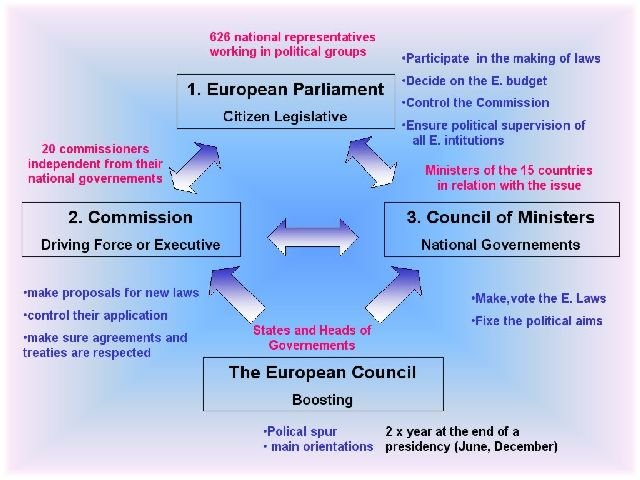

COMPETENCES OF THE EU
The control of subsidiarity by national parliaments
Under Protocol 2 on the Application of the Principles of Subsidiarity and Proportionality a new procedure known as the “yellow and orange cards” has been introduced which gives national parliaments the opportunity to monitor the proper application of the principle of subsidiarity.
Under Protocol 1 on the Role of National Parliaments in the European Union, all EU draft legislative acts must be forwarded to national parliaments. Within eight weeks of receipt of a draft legislative act or of any amendment to it, national parliaments may issue a reasoned opinion stating why what has been received does not comply with the principle of subsidiarity and indicate their opposition by voting against the proposal.
Each national parliament has been allocated two votes. If the parliament consists of two chambers or houses, each of them holds one of these votes. In a EU of 27 Member States, the total number of votes available is 54. If at least one third of those votes (18 votes) indicate that the principle of subsidiarity has not been complied with, the Commission, or the institution which initiated the proposed act, must review the proposal and decide whether it wishes to withdraw, amend, or maintain it. A reason must be given to justify the decision.
In respect of a proposed legislative act concerning the area of FSJ originating from the Commission or a group of Member States, lower thresholds apply. The review procedure is triggered if at least one quarter of the votes of the national parliaments disagrees with the proposal. This is the “yellow cards” procedure.
The “orange cards” procedure applies only to the ordinary legislative procedure. If at least a simple majority of votes cast by national parliaments (currently 28) indicate objections to a proposal, the Commission must review the proposal. If the Commission decides to maintain its proposal, it must issue a reasoned opinion stating why it considers that the proposal complies with the principle of subsidiarity. This reasoned opinion, together with reasoned opinions from the national parliaments, is then forwarded to the legislator (that is, the Council and the EP jointly), which decides the fate of the proposal. This means that if the Council by a majority of 55 per cent of its members and if the EP by a simple majority of the votes cast rejects the proposal, it will not be given further consideration.
Assessment of the principle of subsidiarity
The concept of subsidiarity is indeed an elusive concept. It is submitted that its best definition is the following: “It is a principle for allocating power upwards as well as downwards, but it incorporates a presumption in favor of allocation downwards in case of doubt.”152 It is not tantamount to decentralization and it admits degrees of exercise of powers. This entails that the decision should always be taken at the lowest practical level, thus leaving the EU to concentrate on the essential and vital objectives.
The principle of subsidiarity maintains the integrity of the EU while allowing the participation of national authorities in decision-making procedures provided they can exercise their functions satisfactorily. Subsidiarity maintains the balance of power between the EU and the Member States, and imposes the burden of proof upon the EU institutions. Under the ToL the control of subsidiarity by national parliaments enhances the democratic legitimacy of the EU.
The principle of proportionality
Article 5 TEU states that:
“Under the principle of proportionality, the content and form of Union action shall not exceed what is necessary to achieve the objectives of the Treaties.”
The principle of proportionality was recognised by the ECJ in Case C8/55 Fédération Charbonnière de Belgique v High Authority 153 and has since become a general principle of EU law. It imposes a limitation upon the exercise of EU competences because it requires that:
- -Any action of an EU institution should not go beyond what is necessary to achieve the declared, lawful objective;154
- -The measure must be adequate and appropriate as to the legitimate objective to be attained;
- -When an EU institution has a choice between a number of appropriate measures, it should choose the one which is the least burdensome and the least restrictive, and the disadvantages caused must not be disproportionate to the aims pursued;155
- -Not only the content but also the form of Union action must comply with the requirement of proportionality.
Infringements of the principle of proportionality have been quite frequent. For example, in Case C-310/04 Spain v Council, 156 the ECJ held that the principle of proportionality was breached by the Council when it adopted the contested regulation amending the support scheme for cotton given that:
“The Council . . . has not shown before the Court that in adopting the new cotton support scheme established by that regulation it actually exercised its discretion, involving the taking into consideration of all the relevant factors and circumstances of the case, including all the labor costs linked to cotton growing and the viability of the ginning undertakings, which it was necessary to take into account for assessing the profitability of that crop.”
Consequently, the ECJ found that the principle of proportionality had been infringed and annulled the contested regulation. 4.5 Supportive competences of the EU These refer to areas in which the Member States have not conferred competences on the EU but have decided to act through it. In these areas the EU supports, co-ordinates, encourages or complements measures taken at national level. Article 6 TFEU provides the following list of areas in which the Member States have exclusive competence but the Union can provide support or co-ordination:
- -Protection and improvement of human health;
- -Industry;
- -Culture;
- -Tourism;
- -Education, vocational training, youth, and sport;
- -Civil protection;
- -Administrative co-operation.
In the above areas the EU may adopt incentive measures and make recommendations, but is prohibited from taking harmonizing measures relating to national laws of Member States (Article 2(5) TFEU).
Under Article 5 TFEU the EU can only define “broad guidelines” in respect of economic and employment policies. As a result, in those areas the EU can define the framework of co-ordination between Member States but is prevented from taking any action which it is normally allowed to take in respect of areas in which it exercises supporting competences.
The CFSP is not included in Title I of the TFEU. The peculiarity of the CFSP necessitated the establishment of special rules as to the determination and the exercise of the competences by the EU and its Member States. These are set out in Article 24 TEU.
The “flexibility clause” contained in Article 352 TFEU
To ensure that the objectives of the internal market are met, Article 308 EC [its amended version is contained in Article 352 TFEU] allowed the Council, acting unanimously, on a proposal from the Commission, and after consulting the EP, to take measures it considered necessary, in a situation where the Community had no explicit or implied powers to act. In the 1970s and 1980s Article 308 EC was used to extend the competences of the Community without actually revising the EC Treaty. On the basis of Article 308 EC the Council adopted legislation in important areas not covered at that time by the EC Treaty, such as environmental protection, regional aid, research and technology. The Council leant, probably too frequently, upon Article 308 EC for two reasons:
-First, the Paris Summit held in October 1972 decided that in order to establish an economic and monetary union, as well as promote the social dimension of the Community, all provisions of the EC Treaty, including Article 308 EC, should be widely used. As a result, in the 1970s but mainly in the 1980s, the Council used Article 308 EC extensively and systematically. By 15 March 1992 677 measures, both internal and external, had been adopted on the basis of this article.
-Second, the Council could only adopt a measure on the ground of Article 308 EC if acting unanimously.
This requirement ensured that no measure contrary to the interests of any Member State had any realistic chance of adoption. Thus, all extensions of competences under Article 308 EC were acceptable to all Member States. However, the Commission was not happy about the extensive use of Article 308 EC by the Council because the use of this Article, in effect, involved revision of the EC Treaty outside the revision procedure specified in the EC Treaty. Further, revision of the EC Treaty by the Council undermined the democratic process within each Member State because the new competences had been given to the EC by the executive of each Member State, rather than by its legislative body or according to constitutional procedures used in a Member State. This democratic deficit was not compensated for by the fact that the EP was involved in the adoption of a measure, bearing in mind that the EP was only consulted under Article 308 EC. Resulting from the above, the ECJ imposed two conditions to be met in order to use Article 308 EC as the legal basis of a Community act.
-In Case 45/86 Commission v Council [Re General Tariff Preferences],157 the ECJ held that a measure could only be adopted under Article 308 EC if there was no other appropriate provision in the EC Treaty which would provide a legal basis for Community action. It could, however, have been used where powers existed elsewhere in the Treaty but were insufficient to attain the relevant Community objective.158
-In Opinion 2/94 [Re European Convention on Human Rights],159 the ECJ held that Article 308 EC could serve as justification for widening the scope of the EC’s powers beyond the general framework set up by the Treaty provisions in general, and those provisions which referred to the EC’s tasks and activities in particular. In this Opinion the issue was whether Article 308 EC could be used as a possible legal basis for the accession of the EC to the European Convention of Human Rights. The ECJ held that: “Article 235 of the EC Treaty [Article 308 EC], cannot be used as a basis for the adoption of provisions whose effect would, in substance, be to amend the Treaty without following the procedure which it provides for that purpose.”
As can be seen from the above, the ECJ restored Article 308 EC to its initial role, that is, subject to the two above conditions, it could be used for filling gaps in the EC Treaty, but it could not be used for extending the areas of competence of the Community. The ToL reduced the importance of the “flexibility clause” contained in Article 352 TFEU by making the following amendments to Article 308 EC:
– Article 352 TFEU can be used to achieve the objectives of the Treaties as listed in Article 3 TEU but will not apply to the CFSP;
-For the adoption of a measure under Article 352 TFEU the Council is required to obtain the EP’s consent. Under Article 308 EC the Council was required to consult the EP;
– Under Article 352 TFEU, the Commission is required to “draw national Parliaments’ attention to proposals based on this Article” so allowing them to use the “yellow and orange cards” procedure;
-Article 352 (3) TFEU specifies that “measures based on this Article shall not entail harmonization of Member States’ laws or regulations in cases where the Treaties exclude such harmonization.”
Declarations 41 and 42 on Article 352 TFEU, attached to the Treaties, further limit the potential use of Article 352 TFEU. Declaration 41 excludes any action based on Article 352 TFEU in respect of the objectives of the Union set out in Article 3(1) TEU, i.e. concerning external action of the EU to promote peace, its values, and the well-being of its peoples. This is because such action will be within the scope of the CFSP to which Article 352 does not apply. Declaration 42 states that Article 352 TFEU, being an integral part of an institutional system based on the principle of conferral, cannot be used to adopt measures whose effect would, in substance, amend the Treaties outside the procedures provided for that purpose. Declaration 42 reiterates the position taken by the ECJ in Opinion 2/94. Its main aim is to confirm the desire of the Member States to prevent any extension of the EU’s competences.
152. The CEPR Annual Report, 1993, “Making Sense of Subsidiarity: How Much Centralization for Europe?” (1993) 4 Monitoring European Integration, p 4.
153. [1954–56] ECR 245.
154. Case 154/78 Valsabbia [1980] ECR 907.
155. Case C-331/88 Fedesa [1990] ECR I-4023.
156. [2006] ECR I-7285.
157. [1987] ECR 1493.
158. Case 45/86 Commission v Council [Re General Tariff Preferences] [1987] ECR 1493.
159. [1996] ECR I-1759