The Principle of Subsidiarity
Principle of subsidiarity under the ToL
The ToL recognises the importance of the proper application of the principle of subsidiarity and thus of drawing a clear demarcation line between the competences of a Member State and those of the EU.
It ensures respect for the principle of subsidiarity in the following ways:
It identifies areas that are within the exclusive competence of the EU and its Member States;
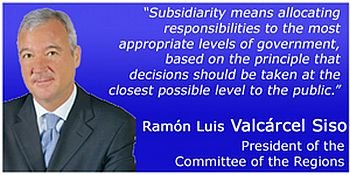
It provides the following definition of the principle of subsidiarity in Article 5(3) TEU. “Under the principle of subsidiarity, in areas which do not fall within its exclusive competence, the Union shall act only if and insofar as the objectives of the intended action cannot be sufficiently achieved by the Member States, either at central level or at regional and local level, but can rather, by reason of the scale or effects of the proposed action, be better achieved at Union level.”
It can be said that, on the basis of the above definition, the following criteria should be satisfied in order for the EU to take action in an area where it shares competences with the Member States:
The sufficiency criterion, that is, an action must be necessary in the sense that neither individuals alone nor Member States alone will achieve the objectives of the action;
The benefit criterion, that is, an action must bring added value over and above that which could be achieved by individuals or a Member State;
The close to the citizen criterion, which requires that decisions must be taken as closely as possible to the citizen;
The autonomy criterion, which requires that an action should secure greater freedom for the individual.
It is to be noted that Article 5(3) TFEU refers, for the first time, to the sub-State level, i.e.
regional and local level.
The application of the principle of subsidiarity by the EU institutions
Under Article 1 of Protocol 2 on the Application of the Principles of Subsidiarity and Proportionaliy each EU institution is required to ensure “constant respect” for both principles.
This is to be achieved as follows:
The European Commission
In order to satisfy the requirements of subsidiarity the Commission must:
Carry out wide consultations, where appropriate at regional and local level in respect of a proposed legislative act. If, in cases of exceptional urgency, the Commission fails to carry out such consultations it must give reasons for its decision in its proposal. Even prior to the entry into force of the ToL the Commission carried out wide consultations before putting forward any proposal for a legislative act. Since May 2006 the Commission has been sending new proposals and consultation papers to national parliaments with a view to inviting them to comment on whether those proposals conform to the requirements of subsidiarity and proportionality. The comments had been duly taken into consideration. When any national parliament submitted that the proposals were in breach of either or both principles, the Commission responded to these submissions individually. Under Protocol 2 a new procedure has been put in place allowing national parliaments to control the application of the principle of subsidiarity.
In the preamble to any legislation, where the EU does not have exclusive competence, the Commission has to justify the proposed legislation in the light of subsidiarity and proportionality. This justification will form part of the measure’s legal basis. The Commission must show that it is more appropriate to act at EU level then at national level, using qualitative and if possible quantitative indicators.
In accordance with the OMC, in secondary legislation the Commission gives preference to directives rather than regulations. Similarly, non-binding measures, such as recommendations, opinions and non-compulsory codes of conduct, are used when appropriate rather than binding measures. Further, the Commission relies on techniques of minimum standards and the principle of mutual recognition when appropriate. The principle of subsidiarity entails that co-operation between Member States should be encouraged by the Commission, which often supports, completes or supervises joint initiatives of the Member States.
The Commission has been simplifying and updating the EU acquis.148 Further, it has expressed its willingness to repeal legislative acts which are in breach of the principle of subsidiarity.
The Commission is required to submit an annual report to the European Council, the EP, the Council, and national parliaments on the application of Article 5 TEU. This annual report must also be forwarded to the ESC and the CoR.
The Council
The Council must examine each proposal submitted by the Commission and its own amendments to such proposals in the light of the principle of subsidiarity. However, the Council must not dissociate from its deliberations on the merits the application of the principle of subsidiarity. Both aspects must be examined at the same time.
The EP
The EP, having important legislative competences in many areas, is very much involved in the application of the principle of subsidiarity. The Inter-institutional Agreement on Procedures for Implementing the Principle of Subsidiarity provides that the EP must take into account the principle of subsidiarity and, in the light of Article 5 TEU, justify any amendment which substantially changes a proposal submitted by the Commission.
The ECJ
The principle of subsidiarity is not only a socio-political concept but also a fundamental principle of EU law. No special procedure has been established to bring an issue of subsidiarity before the ECJ, although a proposal that this should occur was made by the EP.149
The issue of subsidiarity is the most likely to arise in two types of proceedings before the CJEU:
Under Article 267 TFEU, this enables national courts or tribunals, when they are faced
with a question of interpretation of validity of EU law the resolution of which is necessary for them to give judgment, to refer that question to the ECJ under the preliminary ruling procedure; Under Article 263 TFEU, which concerns judicial review of acts of EU institutions, bodies, offices and agencies, an applicant may challenge the act itself by claiming that it was adopted in violation of the requirements laid down in Article 5 TEU. Article 8 of Protocol 2 extends the list of potential applicants under Article 263 to include the CoR in respect of legislative acts for the adoption of which the TFEU provides that it be consulted. However, national parliaments have no locus standi under Article 263 TFEU but a Member State may bring an action on behalf of its national parliament.
For the first time the issue of subsidiarity arose in Case C-84/94 United Kingdom v Council [Re Working Time Directive].150
THE FACTS WERE:
The UK Government brought an action for annulment of Council Directive 93/104 concerning certain aspects of the organisation of working time. The UK Government argued that the Directive was adopted in breach of the principles of proportionality and subsidiarity as the Council failed to demonstrate that the objective of the Directive could better be achieved at Community level than at national level.
Held:
The ECJ held that the principle of subsidiarity can be relied upon by an applicant, although in this case it was invoked to support the main claim and not as an autonomous ground for annulment.
Comment:
The Court made a clear distinction between the principle of proportionality and the principle of subsidiarity.
With regard to the principle of subsidiarity the ECJ held that:
The argument of the UK that the objective of the Directive would be better achieved at national level than at Community level concerned the principle of subsidiarity. The ECJ examined whether a measure adopted by a Member State would achieve the desired Community objective, concluding that this would not be the case and that an action at Community level was necessary since the objective of raising the level of health and safety that the Directive aimed to achieve “presupposes Community-wide action”.
Advocate General Léger emphasised that the principle of subsidiarity answers the question at which level, Community or national, the adoption of a legislative measure is more appropriate.
In respect of the principle of proportionality the ECJ held that: the argument of the UK that the Council could not adopt measures which were as general and as mandatory as those forming the subject-matter of the Directive must be examined in the light of the principle of proportionality. The ECJ examined whether less onerous, less restrictive measures adopted by the Community would achieve the aims pursued, that is, it verified “whether the means which it [the Directive] employs are suitable for the purpose of achieving the desired objective and whether they do not go beyond what is necessary to achieve it”.
On the basis of the above, the ECJ held that the measures adopted by the Directive were necessary and appropriate as they contributed directly to achieving the objective set out in the Directive and did not exceed what was necessary to achieve such objective.
While there is no doubt that the principle of subsidiarity is justiciable, it is a fact that as at the time of writing the ECJ has never annulled any EC/EU legislation on the ground that it was adopted in breach of that principle. In a judgment delivered by the Grand Chamber of the ECJ, in Joined Cases C-154/04 and C-155/04 Alliance for Natural Health,151 the Court set out its position on the matter, which is that only in extreme circumstances will the Court find that the principle of subsidiarity has been breached. This approach is understandable in that the principle is, in reality, of a political nature. The ECJ has been reluctant to clearly state what subsidiarity really means in terms of the allocation of competences between the Community and the Member States. The ECJ’s reluctance could additionally be explained by the fact that the concept of exclusive competences of the Community was manufactured by the ECJ itself as that concept had no legal basis in the original EC Treaty.
In Alliance for Natural Health the ECJ held that:
“. . . the principle of subsidiarity does not call into question the powers conferred on the Community by the Treaty, as interpreted by the Court of Justice.”
This is a reminder that the principle of subsidiarity is concerned with how power is exercised by the EU and not with the question of what powers are conferred on it. However, when the legitimacy of the decision-making process in the EU is challenged on the ground of subsidiarity, this necessarily involves the delicate task of defining areas of shared and exclusive competences. This is because subsidiarity does not apply to areas within the exclusive competence of the EU. It is submitted that the attitude of the ECJ toward the principle of subsidiarity may change under the ToL, the reason being that the ToL clearly defines areas of exclusive competence of the EU. Therefore, the threat that the principle of subsidiarity will have a radical impact on judicial determination of the exclusive competences of the EU has been removed. Further, the establishment of a list of areas of shared competences under the ToL facilitates enquiries from the ECJ as to whether a particular legislative action on the part of the EU is necessary or the best one.
Finally, the enhanced role of national parliaments and the Committee of the Regions (CoR) in the monitoring of the proper application of the principle of subsidiarity is conducive to making subsidiarity more intrusive as a general legal principle.
148. COM(2006) 690.
149. A. G. Toth, “Is Subsidiarity Justiciable?” (1994) 19 ELRev, p 268, especially p 273.
150. [1996] ECR I-5755.
151. [2005] ECR I-6451.