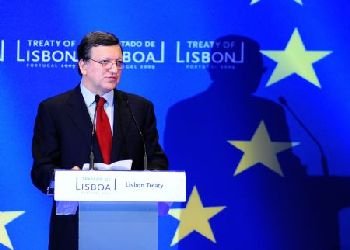
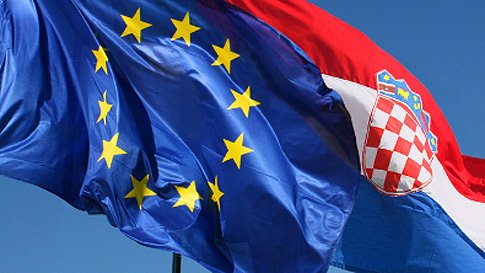
Croatia becomes newest EU member
Membership of the EU (2)
Current and future membership of the EU
By the end of April 2010 five enlargements and one mini-enlargement had taken place. At the time of writing the EU covers almost all of Western and Central Europe and a substantial part of Eastern Europe. It has 494 million inhabitants, which is more than Russia and the USA put together.
First enlargement
On 1 January 1973 the UK, Denmark, and the Republic of Ireland joined the Communities. Following a negative referendum, Norway did not accede. The reasons for accession of these three Member States were different, although the main consideration for Ireland and Denmark was to protect their existing economic links with the UK. Norway held a second referendum on the issue in 1994 and membership was rejected then too.
Ireland
In the Irish Republic 83 per cent of votes cast were in favour of accession. For Ireland membership of the EC was very attractive as it provided an opportunity to enter markets in the EC and thus reduce the traditional dependency upon the UK for export trade (70 per cent of exports were to the UK). Furthermore, as an agricultural country, Ireland could only gain from being a party to the CAP.
Denmark
Denmark, mainly an agricultural country, would clearly benefit from the CAP. Of its main commercial partners Germany was already a Member State, while the UK was about to join the EC. The advantages were carefully weighed by the Danes against the disadvantages, which would mainly be the severance of traditional links with other Nordic countries. In the national referendum, which took place after the negative vote in Norway, 63 per cent of Danish votes cast were in favor of accession.
The United Kingdom
The most controversial candidate was the UK.1 However, after the departure from power of France’s President de Gaulle, there was no opposition to UK membership. The accession negotiations lasted one year and focused on the following issues:
1. The length of the transitional period;
2. Agriculture. In the UK food was cheap due to imports from Commonwealth countries.
The Heath government had two objectives in this respect: in the short term, to slow down the impact of the CAP by phasing it in as slowly as possible; and in the long term, to obtain compensation for the negative impact of the CAP by a satisfactory budgetary arrangement;
3. The UK’s contribution to the Community budget. It was agreed that its contribution would be 8.64 per cent of the EC budget in 1973, increasing to 18.92 per cent in 1977, with limits on further increases in 1978 and 1979. There was no agreement regarding 1980;
4. New commercial arrangements with Commonwealth countries. The African, Caribbean, and Pacific (ACP) countries were offered participation in the Yaoundé Convention (which was replaced by the Lomé Conventions and in 2000 by the Cotonou Agreement 2 and more recently by the Economic Partnership Agreements). In addition, the Community General System of Preferences was extended to Commonwealth countries. The question of exports of Caribbean sugar and New Zealand dairy products to the UK required special arrangements;
5. Fisheries. The first enlargement offered an opportunity for the EC to create a Common Fisheries Policy (CFP) based on free and equal access of the Member States to each other’s waters; accordingly, UK participation in this policy was negotiated.
The accession negotiations were concluded in January 1972 when the Treaty of Accession of the four applying states was signed. The UK European Communities Act 1972 came into force on 1 January 1973. However, the UK Labour Party opposed the terms of entry and promised in its electoral campaign to “renegotiate” the Treaty of Accession. Indeed, once Labour were in power (1974-79), the question of the UK membership became a main item on the political agenda of the Labour government. 3 In the end UK membership was approved by the House of Commons (396 to 170) and by the people of the UK in a national referendum (67.2 per cent votes cast in favour).
Second enlargement
The second enlargement concerned Greece, which submitted its application on 12 June 1975. The negotiations were opened on 25 June 1975. On 23 May 1979 the Treaty of Accession and the Act of Accession were signed. Greece became a Member State on 1 January 1981. Greece was the first Eastern European country to join the EC. Its heritage, resulting from centuries of Ottoman Turkish Empire rule, combined with its Orthodox Christianity, a legacy of the Byzantine Empire, set Greece apart from other Member States. For Greece, with its inefficient agriculture based mainly on small holdings with poor soil and low rainfall, its limited natural resources, weak industry and a fragile democracy as it emerged from years of dictatorship, the attraction of being a Member State was obvious. A transition period of five years was agreed in all areas, except tomatoes and peaches which were to be included in the CAP at the end of 1987.
Third enlargement
Portugal and Spain joined the EC on 1 January 1986. Portugal applied on 28 March 1977 and Spain applied on 28 July 1977. Both signed the Treaty of Accession on 12 June 1985. The end of military dictatorship in both countries enabled them to submit their applications for accession to the Communities.
The negotiations with Spain were protracted, as its proposed accession posed three major economic problems:
1. Spanish agriculture and its competitiveness, especially against that of France and Italy, made its participation in the CAP very controversial.
2. The Spanish fishing fleet was almost equal in size to that of the entire Community and therefore placed the CFP under strain.
3. Spanish industry, especially cotton, woolen textiles, clothing and steel industries, due to low wages, threatened the position of other Member States and posed a challenge to the EC, which already had over-capacity problems in these sectors.
Portugal, a small and relatively poor country, posed no such threats to the economy of existing Member States. Its accession was delayed as a result of applying for membership at the same time as Spain. Furthermore, the negotiations with Spain and Portugal were halted when France decided that, before a new enlargement, budgetary matters within the EC should be settled. As a result, it was not until after the Fontainebleau Summit in 1984, which reached an agreement on contributions to the EC budget, that the accession negotiations with Spain and Portugal were resumed.
De facto enlargement: the case of the German Democratic Republic (GDR)
On 3 October 1990, in conformity with the West German Constitution, the former German Democratic Republic (GDR) became an integral part of the Federal Republic of Germany (FRG). On that date, by virtue of Article 299 EC, the territorial scope of application of EC Treaties was extended to the former East Germany. 4 It was not necessary to revise the EC Treaty, as the Federal Republic of Germany, the only legal government of Germany, always considered the GDR as part of its country when signing international treaties. However, Germany, taking into account the importance of the reunification and its impact on the German and EU economies, asked other Member States for approval, which was formally given by the Dublin European Council Summit on 28 April 1990. Additionally, the Dublin summit laid down transitional measures, allowing temporary derogations in the application of EC law to the territory of the GDR in certain areas such as competition policy and protection of the environment.
Fourth enlargement
On 1 January 1995 Austria, Finland, and Sweden joined the EU. 5 Norway, although accepted by the Communities, did not accede, as a result of a negative referendum (its second such result, having held a previous referendum in 1972). Austria submitted a formal application on 17 July 1989, Sweden on 1 July 1991, Finland on 18 March 1992, and Norway on 25 November 1992. Formal negotiations commenced on 1 February 1993.
All candidate states were EFTA 6 countries and Members of the European Economic Area. 7 As such; they already had considerable experience of working with the EC institutions and of the interpretation and application of EC law. Also, they had the appropriate “infrastructure,” that is, staff, procedures, and material support, to deal with negotiations with the EC. These went smoothly and the Treaty of Accession was signed on 24 June 1994. Thereupon, the candidate states had to renounce their EFTA membership and terminate all bilateral agreements between themselves and the Community, and all other international agreements incompatible with membership of the EU.
Fifth enlargement (Part I)
The fifth enlargement concerned Central and Eastern European states and Malta and Cyprus.
The enlargement took part in two stages:
On 1 May 2004 Cyprus, the Czech Republic, Estonia, Hungary, Latvia, Lithuania, Malta,
Poland, Slovakia, and Slovenia joined the EU;
On 1 January 2007 Bulgaria and Romania joined the EU. As at 1 May 2004 neither of them was, according to the Commission, ready to become a member of the EU.
The fifth enlargement was the most challenging for the EU and for the candidate states. Apart from the two Mediterranean states, Cyprus and Malta, the applicants were Central and Eastern European states. Some of them were independent states for the first time in their history, for example, Slovakia and Slovenia. All of them were establishing their freedom and independence after the collapse of Communism.
The accession process for the eight Central and Eastern European states was long, and even after their accession they were made subject to a lengthy transitional period. The most important restriction concerns the free movement of workers. Older Member States, fearing the influx of poorer, new EU citizens, were given an option to decide when, within seven years after the 2004 accession, to allow workers from new Member States to enter their labour market.
Only the UK, Ireland and Sweden, subject to some conditions relating to access to social benefits, decided to open up their job markets from the day of accession. From the same time Denmark accepted workers from new Member States on condition that they obtain a work permit in Denmark. In respect of participation in the CAP, farmers from new Member States will obtain full-scale support after a 10-year transitional period. However, the new Member States have also imposed some restrictions on older Member States. Some, fearing a massive loss of ownership of their agricultural land and property to rich nationals from older Member States, were allowed to decree a period during which sales to non-nationals would be subject to restrictions. Generally, the period is seven years, but for Poland it is 12 years.
The biggest problem for the EU related to the reconstruction and adjustment of the economies of the new Member States to the standards required by the Union. Indeed, at the time of enlargement on average the EU’s 75 million new citizens earned only 40 per cent of the income enjoyed by people living in the older Member States.8 The level of GDP for the new EU members varied from 35 per cent of the EU average in the case of Latvia to 74 per cent for Slovenia. During the accession period financial assistance to the new Member States was provided within the Phare (Poland and Hungary: Assistance for Restructuring their Economies) Programme aimed at reforming their economies; the ISPA (Instrument for Structural Policies for Pre-Accession) Programme, which provided support for the development of infrastructure; and the SAPARD (Special Accession Programme for Agriculture and Rural Development) Programme for modernization of their agriculture. In total 3 billion Euros a year was allocated among eight Central and Eastern European countries, whilst Cyprus and Malta received 95 million Euros between them for the period 2000–04. Financial assistance continued to be provided for new Member States, worth 10 billion Euros in 2004, 12.5 billion Euros in 2005, and 15 billion Euros in 2006. 9
The Iron Curtain that descended across Europe after World War II “from Stettin in the Baltic to Trieste in the Adriatic,” was finally lifted on 1 May 2004, and the new Member States have regained their rightful place in Europe, now a zone of peace, prosperity, and stability.
According to the European Commission, so far the fifth enlargement has been very successful as it has fulfilled the favorable economic expectations of the EU.10
Fifth enlargement (Part II)
Bulgaria and Romania signed Treaties of Accession on 25 April 2005. They joined the EU on 1 January 2007.
Mini-enlargements outside Europe
As a result of constitutional reforms which occurred in The Netherlands, on 15 December 2007 that country’s Caribbean islands of Bonaire, Saba and Saint Eustatius became part of The Netherlands as the Kingdom Islands (with a status similar to that of Dutch municipalities), whilst Curacao and Saint Martin became self-governing countries inside the Kingdom of The Netherlands. On that date all the above-mentioned Caribbean islands became part of the EU.
Previously, they were OCT of The Netherlands and thus EU law, apart from Part IV of the EC Treaty, did not apply to them. However, their inhabitants, being Dutch nationals, were citizens of the EU.
This was an enlargement taking place outside Europe.
In 2011, Mayotte, as a result of a referendum held in March 2009, will change its status from a French OCT to that of being France’s 101st department. At that date, Mayotte will become part of France and therefore an outermost region of the EU.
Candidate countries
It is important to note that pre-accession financial aid has been rationalized by Regulation 1085/2006 establishing an Instrument for Pre-Accession Assistance (IPA),11 which entered into force on 1 January 2007. IPA supersedes the five pre-existing pre-accession programmes: Phare, ISPA, SAPARD, Turkey instrument, and CARDS (Community Assistance for Reconstruction, Development, and Stability in the Balkans). It establishes a coherent, unitary framework for financial assistance for both candidate and potential candidate countries. Under IPA an amount of 11,468 million Euros is intended to be channeled over the period 2007-13 into helping such countries make necessary adjustments with a view to joining the EU. At the time of writing Croatia, FYR Macedonia and Turkey have the status of candidate countries.
Croatia
On 3 October 2005 the EU opened accession negotiations with Croatia, which, at the time of writing, are near the final stage. The anticipated date for the accession of Croatia is 2012.12 Croatia became Member State of the European Union on July 1, 2013
FYR Macedonia
On 22 March 2004 FYR Macedonia applied to become an official candidate. In December 2005 upon the Commission’s recommendation, the European Council approved FYR Macedonia as a candidate state. However, no date has been fixed for opening accession negotiations.
Turkey
As a Member of NATO (the North Atlantic Treaty Organization), Turkey has been patiently waiting for admission to the EU for many years. Its first application for membership was lodged in April 1987. In December 1989 the Commission issued a negative opinion. It considered that the next step in Turkey’s route to Brussels was a customs union with the Community. In January 1996 the customs union was agreed and this is in force. The main reason for the Commission’s negative opinion was Turkey’s poor human rights record. However, since a change of government in 1998, Turkey has started the process of democratization.
Turkey was recognized as a candidate state in 1999. On 3 October 2005 the EU foreign ministers and the Turkish foreign minister reached agreement regarding the opening of official accession negotiations. This agreement was achieved after Austria, where 80 per cent of voters are against Turkey’s accession, backed down from its demand for a “privileged relationship” with Turkey (meaning a second-class membership, rightly rejected by the Turks) as an alternative to membership. On 6 October 2005 the Commission, in its Communication to the Council and the EP, 13 recommended opening accession negotiations subject to some conditions. The Commission stated that Turkey sufficiently fulfilled the Copenhagen political criteria. It considered, however, that accession could not take place before 2014 and that negotiations should be carried out on the basis of a three-pillar strategy set out in the Communication. Since then negotiations have been opened on 11 chapters out of 33 chapters. The Commission, in its “Turkey 2009 Progress Report”14 noted that Turkey fulfils the political criteria although it needs constitutional reforms and more efforts to ensure the adequate protection and enforcement of human rights including the rights of minorities. In respect of economic requirements, the Commission awarded Turkey the status of a “functioning market economy,” confirming that Turkey will be able to cope with competitive pressure and market forces in the EU. It stated, though, that further steps should be taken towards structural reform of the Turkish economy in the long term.
The membership of Turkey poses great challenges to the EU.
These are:
Demographic (Turkey has 80 million inhabitants);
Cultural (it is a secular country having a mainly Muslim population);
Geopolitical (this will entail the re-evaluation by the EU of relations with the Middle East);
Turkey continues to occupy the northern part of Cyprus, with 40,000 Turkish troops stationed on the island, and refuses to recognize Cyprus, a Member State of the EU. Until a solution is found to the Cyprus dispute, Turkey is unlikely to become a Member State. Every challenge also being an opportunity, there are many arguments in favor of Turkey’s accession.
It would:
Help to transform Turkey into a modern, well-functioning democracy, and thus extend peace, stability, prosperity, democracy, human rights and the rule of law not only across Europe but also into Asia; Strengthen the EU’s external security, given that Turkey plays a moderating role in the unstable neighboring region in the Middle East;
Strengthen the EU’s economy, given that Turkey has a very dynamic and rapidly growing economy;
Ensure the security of energy supplies to the EU, since Turkey has at its border the most energy-rich regions on earth, which will thus constitute a corridor for road, rail, air and maritime pipeline connections between the EU and Turkey’s southern neighbors;
Reward Turkey for its support for NATO;
Create a more multiracial and multi-religious EU;
Reinforce secularism in Turkey (which has been a secular state since 1923); and
Given that 23 per cent of the Turkish population is under the age of 15, to some extent respond to the problem of the increasingly aging population of the current EU.
Potential candidates
These are the Western Balkan states: Albania (applied on 28 April 2009), Montenegro (applied on 15 December 2008), Serbia (applied on 22 December 2009), Kosovo, and Bosnia and Herzegovina. The last two, at the time of writing, have not formally applied. Each country has been promised the prospect of EU membership as and when they are ready. On 16 July 2009, Iceland applied for membership of the EU. Iceland is in a special position as it is a member of the EEA. On 24 February 2010, the Commission recommended the opening of negotiations with Iceland.
AIDE-MÉMOIRE ENLARGEMENTS
First Enlargement: On 1 January 1973 Denmark, Ireland, and the UK joined the Communities.
Second Enlargement: On 1 January 1981 Greece joined the Communities.
Third Enlargement: On 1 January 1986 Portugal and Spain joined the Communities.
De facto enlargement: On 3 October 1990 the former German Democratic Republic (GDR) became an integral part of the Federal Republic of Germany (FRG) and all three Community Treaties were extended to apply to the former GDR.
Fourth Enlargement: On 1 January 1995 Austria, Finland, and Sweden joined the EU.
Fifth Enlargement (Part I): On 1 May 2004 the following states joined the EU: Cyprus, The Czech Republic, Estonia, Hungary, Latvia, Lithuania, Malta, Poland, Slovakia and Slovenia.
Fifth Enlargement (Part II): On 1 January 2007 Bulgaria and Romania joined the EU.
Mini-enlargement outside Europe: On 15 December 2008 The Netherlands Antilles Caribbean islands of Bonaire, Saba and Saint Eustatius, Curacao and Saint Martin became part of The Netherlands and consequently part of the EU.
Mayotte, as a result of a change of its status in France (from an OCT to a French department), will become part of the EU in 2011.
Candidate States: Croatia, FYR Macedonia, and Turkey.
Potential Candidate States: Albania, Bosnia and Herzegovina, Montenegro, Serbia, Kosovo and Iceland.
1. The UK’s application was rejected by France in 1963 and again in 1967.
2. The Cotonou Agreement, as were its predecessors, is the main element of the EU’s development co-operation policy. It regulates trade between the EC and 79 ACP countries. Its main objectives are to reduce and eventually eradicate poverty in these countries whilst achieving sustainable development and their gradual integration into the global economy.
3. The question of “renegotiation” is examined in MSO, Membership of the European Community: Report on Renegotiation, Cmnd. 6003, and March 1975.
113. See C. W. A. Timmermans, “German Unification and Community Law,” (1990) 27 CMLRev, pp 437–49; C. Tomuschat, “A United Germany within the European Community,” (1990) 27 CMLRev, pp 415–36.
4. On the fourth enlargement see D. Booss and J. Forman, “Enlargement: Legal and Procedural Aspects”, (1995) 32 CMLRev, pp 95–130.
5. The European Free Trade Association, founded in 1960 by the UK, had established a free trade area among its member states. At the time of writing, EFTA members are: Iceland, Liechtenstein, Norway, and Switzerland.
6. See S. Peers, “An Even Closer Waiting Room? The Case for Eastern European Accession to the European Economic Area,” (1995) 32 CMLRev, p 187.
7. See
8. More Unity and More Diversity, The European Union’s Biggest Enlargement 2003. European Commission
Publication, Luxembourg: Office for Official Publications of the European Communities.
9. See: the report prepared by the European Commission: The Enlargement, two years after: an economic evaluation, http://ec.europa.eu/economy_finance/index_en.htm (accessed July 16, 2013). See also the Commission’s official website on the impact of the 2004 enlargement: Enlargement, 3 Years After, at http://ec.europa.eu/enlargement/5th_enlargement/ (accessed July 16, 2013).
10. [2006] OJ L210/90.
11. Communication from the Commission COM(2009) 595 final.
12. COM(204)656 final.
13. SEC(2009) 1334.
RECOMMENDED READING
Books
Jacoby, W., The Enlargement of the European Union and NATO. Ordering from the Menu in Central Europe, 2006, Cambridge: CUP
Prechal, S., Reconciling the Deepening and Widening of the European Union, 2008, Cambridge: CUP
Tatham, A.F., Enlargement of the European Union, 2009, London: KLI
Article
Gialdino, C. C., “Some Reflections on the Acquis Communautaire,” (1995) CMLRev, p 1089–121 77