
The South-African Genocide… a shocking testimony!
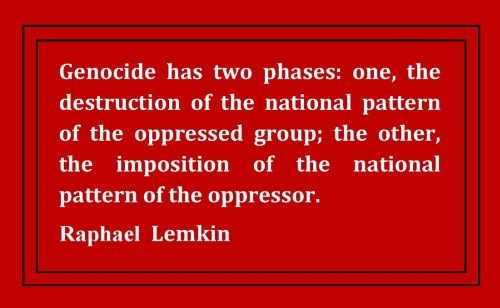
Genocide and Self-Determination
“The notion of self-determination,” wrote Ken Cmiel in an important review article, “was also part of the mid-century human rights debates. The trouble was, Westerners did not agree that this was a fundamental human right.” Western liberal thought, once mesmerized by the pacifying promise of self-determination, was now looking askance at “Wilson’s reactionary principle … inapplicable on this earth.”
The dwindling appeal of Wilsonian idealism was also felt at the level of international politics. Although in 1945, “self-determination” was briefl y mentioned in the fi rst article of the UN Charter, the Allies had clearly “lost their enthusiasm for it as anything approaching a panacea.” Despite the mobilization of Asian and African anti-colonial activists, Latin American nations and Sovietbloc countries, the Universal Declaration also fell short of equating self-determination to a right.
As an analyst of the deliberations observed, “the colonial peoples were put in the declaration in more than one place, although not in as clear a manner as their defenders wished.” Besides the uneasiness felt by representatives of European colonial powers regarding self-determination, the notion was also problematic because it referred to the entitlement of groups and not individuals, the new backbone of post-1945 human rights. Unsurprisingly, therefore, “self-determination of peoples remained off the radar screen of Western NGOs,” even after two UN covenants declared it a right in 1966.
The place of Holocaust survivors in the postwar refugee system complicates this view. The approximately 20,000 Jewish concentration camp inmates found in Germany and Austria by the Western Allies in the spring of 1945 (later joined by nearly 200,000 Jewish refugees, predominantly Polish, who had survived the war in the USSR ) did not initially elicit overwhelming compassion. U.S. Army General George Patton, for instance, let it be known that the “Jewish type of DP is, in the majority of cases, a sub-human species,” “lower than animals.” 48 Yet from being handled by American authorities “just like Nazis treated Jews, except that we do not exterminate them” (to quote the scathing report written by Truman’s envoy Earl Harrison in the summer of 1945), Jews evolved into a protected refugee population accommodated in specifi c Jewish camps.
The separation of DPs by nationality or ethnic groups rapidly became a main feature of the refugee universe: Touring Germany, the American journalist Janet Flanner reported in 1948 that “in order to maintain peace and cut down the number of fi st fi ghts, the IRO tries to arrangematters so that each camp houses only one religion or nationality.”
In the case of Holocaust survivors, however, the creation of separate Jewish camps had a broader signifi cance. It indicated that the remaining Eastern European Jews were not displaced citizens of their country of origin (Poland in most cases), but an acknowledged national entity. Jewish DPs, in short, amounted to a group anomaly in a new human rights regime increasingly geared toward individuals. They remained, even after 1945, an interwar national “minority.”
A prominent Zionist international lawyer from the Hebrew University in Jerusalem could therefore argue, not incidentally in 1948, that since the end of the First World War, “the Jewish question was raised to the level of a question involving a nation as a whole, an entity entitled to separate national existence and to the organization of its life within the framework of the State.”
The myriad of Jewish DP camps in the American and British occupation zones, with their vibrant Zionist politics, further reinforced the nationalization of Holocaust survivors. They also reflected the territorialization of Jewish history: As the historian Dan Diner pointed out in relation to Jewish DP camps in Bavaria, “it is arguable that the immediate founding of the State of Israel had its beginnings in southern Germany.”
At a time where Western Jewish organizations believed, in the wake of the Second World War, that “being singled out as a minority was itself inviting trouble” and preferred the framework of individual rights, the governance of DPs, just like the Zionist movement, viewed Holocaust survivors as a distinct national group. Jewish demands for self-determination coincided with the declared goal of the IRO: “Jewish refugees,” stated its director Donald Kingsley, were “one of the principal group for whose resettlement the Organization was established.” With the door of the United States closed until the passing by Congress of the fi rst (and restrictive) DP Act in 1948, and with the scant interest in Jewish refugees shown by other potential host countries, the main resettlement destination was Palestine before May 1948, the State of Israel afterwards.
Following the Partition Plan of November 1947, the IRO granted governmental status to the Jewish Agency for Palestine offi cially mandated to carry out “resettlement.” Later, the organization signed an offi cial agreement with the State of Israel formalizing their full collaboration in emigration matters. Although directly involved with the mass emigration of Jewish DPs to Israel (between 120,000 and 180,000), the IRO refrained from taking a straightforward political stance in favor of Jewish self-determination. Financially sponsored by both pro- and anti-Zionist contributors (the United States and the United Kingdom), its offi cial line had to reconcile confl icting positions following the outbreak of the Arab-Israeli war of 1948. Whereas the American delegate to the IRO maintained that former Jewish DPs in Israel worked only “in cooperatives and in areas where the Arabs have not lived,” the British representative argued that IRO-sponsored emigration of Jewish survivors was far from neutral: “Who could say that none of those actual persons helped in that way would not occupy a refugee’s house or land or join a strategic colony?”
Compromise was eventually reached, because most national delegations at the IRO – such as the-French- harbored sympathy for Jewish survivors without overlooking the material plight of displaced Palestinians. The IRO was to assist the humanitarian resettlement of Jews in Israel, but did not want “to become a contributor to the intensifi cation of the Arab refugee problem, or to the preemption of the return of the Arabs to their home.” It therefore legitimized migration to Israel on technical “resettlement” grounds: The proven absorption and assimilation capacities of the new country provided sufficient guarantees for what the agency called “firm reestablishment.” Jewish proponents of self-determination did not think otherwise: Nationhood, unanimously claimed the political leaders of the “Surviving Remnant,” was indeed the most desirable humanitarian shelter.
Conclusion
The “Human Rights Revolution” of the 1940s was for the most part nonbinding. The limited declarative status of the 1948 Universal Declaration, in particular, was quickly underlined even by some of the most internationalistminded lawyers of the time. This helps partially explain why human rights gained astonishing prominence in the postwar international arena: They did not fundamentally challenge the nation-state order.
The main achievement of the decade was the shaping of a promising vision for the future more than the creation of effective enforcement mechanisms. Yet Europe’s DPs already stood among the fi rst benefi ciaries of new international protections. Indeed, the governance of “Europe on the Move” by humanitarian agencies put into practice a wide array of human rights norms enunciated or declared under the aegis of the United Nations.This comes, after all, hardly as a surprise. The American, British, and French enforcers of human rights in DP camps were kin to the Western instigators of the “revolution” (even if Third World actors played a role in the drafting of the UniversalDeclaration).
The displaced persons were also part of this extended family, as European victims of events directly related to the emergence of “the idea of our time”: the Second World War, the Holocaust, and the Cold War. As the scope and language of the 1951 Geneva Convention for Refugees clearly demonstrated, the first human rights regime refl ected the historical experiences of wartime and postwar Europe. From 1945 to the early 1950s, the problem posed by non-German displaced persons and soon after, anticommunist “escapees”, strongly impinged upon the formulation and enforcement of international protections. For Hannah Arendt, stateless refugees tragically symbolized the end of the “Rights of Man”; yet paradoxically, the postwar refugee question stood at the core of the frustrating, at times hypocritical yet path-breaking “human rights revolution.”