
VIDEO
Specific objective: the creation of an area of freedom, security, and justice (FSJ)
The “Schengen acquis” (I)
Under Protocol 19 attached to the Treaties the Schengen acquis is integrated into the framework of the EU. Apart from opt-out possibilities granted to the UK, Ireland and Denmark and special arrangements for non-EU States participating in the Schengen system, the Schengen acquis applies to all Member States. There are no possibilities for opt-outs by candidate States when they join the EU.
A brief history of the Schengen system
An agreement between France and Germany in July 1984 in Saarbrücken on the elimination of frontier controls between the two countries, which was intended as a way of strengthening Franco-German relations, gave birth to the Schengen system. The Benelux countries had already abolished border checks for their nationals. They decided to join the Franco-German project. It resulted in the adoption of the Schengen I Agreement on the gradual abolition of checks at common borders, which was signed on 14 June 1985, between the Benelux countries and France and Germany in Schengen, a small town in Luxembourg. It provided that border controls should be abolished on 1 January 1990 between territories of the Contracting Parties. In order to achieve this objective, working groups were established to draw up necessary measures on the relaxation of border controls such as the introduction of mixed checks at the borders, visual checks on EU nationals (based on a system whereby EU nationals might place a green sticker in the front window of their cars) and co-ordination of measures strengthening the control of external borders to keep out undesirables by harmonizing visa controls, asylum and deportation policies.
Issues relevant to internal security such as harmonization of firearms and ammunition laws, police co-operation in combating illegal trading in drugs and serious international crimes were also addressed. The above work culminated in the adoption of the Schengen Implementing Convention on 19 June 1990 (Schengen II) between the same five Contracting States. This Convention entered into force on 26 March 1995.
In the relationship between the Schengen group and the EC, the Commission had the status of observer at the Schengen meetings. The Schengen system was subordinated to EC law by means of the compatibility requirement established in Article 134 of Schengen II, which stated that the Schengen provisions should apply only if they were compatible with EC law. For that reason it was quite easy to incorporate the Schengen system into the EC Treaty. The protocol attached to the ToA provided for the incorporation of the Schengen II agreement into the EU’s legal framework.
In order to do this, the Council of the European Union, which took over from the Executive Committee set up under the Schengen Agreement, adopted a number of decisions. On 1 May 1999 it established a procedure incorporating the Schengen Secretariat into the General Secretariat of the Council.76 The elements of Schengen II which needed to be incorporated into the EC Treaty (the Schengen acquis) were defined by a Council decision adopted on 20 May 1999.77 Member States that joined the EU after 1 May 2004 are bound by the Schengen acquis, but certain provisions will apply to them only after abolition of border controls at their borders adjacent to States participating in the Schengen system.
Such border controls will be abolished when a MemberState has passed the preparedness test in respect of four areas: air borders, visas, police co-operation and personal data protection. Experts from the EU will assess the level of preparedness by means of questionnaires and visits to selected institutions and places of the country of assessment.
The incorporation of the Schengen system into the framework of the EU means that all principles of EC law are applicable to the Schengen acquis and that EU institutions are supervising its proper implementation.
Membership of the Schengen area
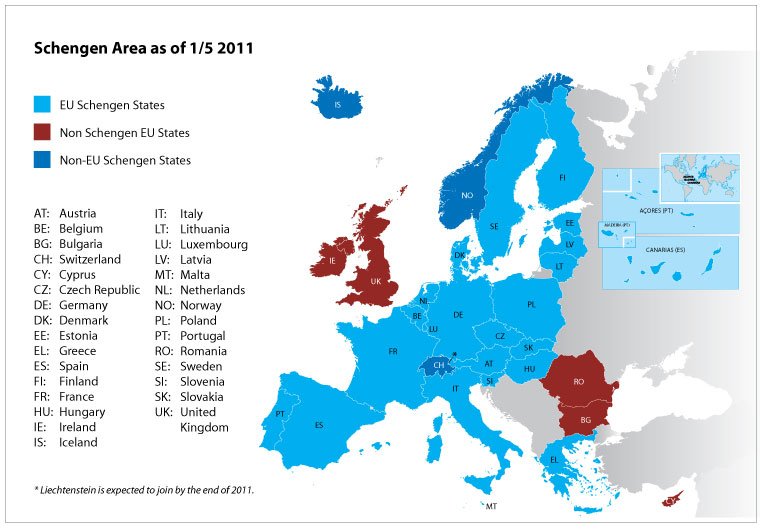
At the time of writing 25 States fully apply the Schengen acquis: 22 EU countries (Austria, Belgium, the Czech Republic, Denmark, Estonia, Finland, France, Germany, Greece, Hungary, Italy, Latvia, Lithuania, Luxembourg, Malta, Netherlands, Poland, Portugal, Slovakia, Slovenia, Spain, Sweden), and 3 non-EU countries: Norway, Iceland and Switzerland. Three Member States: Bulgaria, Cyprus and Romania have not yet met the criteria for participating although some Schengen acquis apply to them, e.g. they participate in the area of police and judicial cooperation and of external border controls. The UK and Ireland have decided to maintain border controls with other EU countries and are therefore outside the Schengen area. In March 1999 the UK asked to participate in some aspects of Schengen, namely police and legal cooperation in criminal matters, the fight against drugs and the Shengen Information System (see below). The Commission gave a favourable opinion on 21 July 1999 and the Council approved on 29 May 2000.78 Ireland, because of the existence of a Common Travel Area with no border controls between Ireland and the UK, was unable to implement the Schengen Agreement without terminating the existing agreement with the UK. Ireland asked in June 2000 to participate in the same aspects of Schengen as the UK. The request was approved by the Council in 2002.79
The main features of the Schengen II agreement
The main features of the Schengen II agreement are:
A. It creates a territory without internal borders. Between participating countries internal border posts have been closed (and often demolished). Inside the Schengen territory there are no road or rail identity checks. However, when travelling by air, passports or national ID cards must usually be shown. This is not required under the Schengen system but constitutes an international air security measure. There are passport checks between two EU Member States when one of them is a non-Schengen Member State, for example, between the UK and France. As to customs checks between Members of the EU, there are none, but between two Schengen Member States, one of which is not a MemberState of the EU, customs controls remain;
B. It introduces tight controls on non-EU nationals entering the Schengen territory. These are aimed at eliminating illegal immigration and combating crime. In this respect common rules for crossing external borders and uniform rules and procedures for controls have been adopted by the participating Member States, including harmonisation of rules regarding the conditions of entry and visas for non-EU nationals.
A Community Code on the rules governing the movement of persons across borders has been adopted. Its latest version, at the time of writing, is contained in Regulation 810/200980 which provides an opportunity for a third country national to challenge the refusal of a visa and which establishes common fees for a visa. It’s Articles 13, 14 and 15 set out numerous conditions to be satisfied by non-EU nationals when they are entering the Schengen area. A Shengen visa covers all Schengen territory. If non-EU nationals are considered to be unlawfully in one Schengen country, they are deemed to be illegally in all and will be expelled from Schengen territory;
C. It strengthens the co-operation between police (including the rights of cross-border surveillance and hot pursuit), immigration, customs, and judicial authorities of the participating Member States;
D. It provides for common rules for asylum seekers; 81
E. It provides for separation in air terminals and ports of people travelling within the Schengen area from those arriving from elsewhere;
F. It sets up a system, known as the Schengen Information System. This is referred to as SIS II. The previous system SIS I was replaced by SIS II by Regulation 1987/200682 because SIS I was designed to accommodate a maximum of 18 Member States and with the enlargement of the EU it needed a major overhaul. SIS II provides for a computerized exchange of information. SIS II allows the placing of alerts concerning persons (wanted, missing, foreign nationals banned from entering the EU and persons to be discreetly monitored by the relevant national authorities) together with a request that a specific action be taken if the person is found, and concerning lost and stolen property.
The Schengen Member States supply/receive information through national networks (NSIS II) which are connected online with a central system (C-SIS II), located in Strasbourg.
C-SIS II is a hub which provides technical support for the system, that is, it works as an intermediary in the exchange of information. Although the system is European, the information is national as each participating MemberState decides what information it wishes to enter into the alert database.
Within SIS II, N-SIS II can exchange information directly with another N-SIS II without having to go through C-SIS II and can obtain additional or supplementary information to that provided by C-SIS II via the SIRENE (Supplementary Information Request at the National Entries) system, i.e. a human interface of SIS II. The service is available 24 hours a day, seven days a week. In each SchengenMemberState there is a SIRENE – a point of contact in respect of SIS II alerts and post-hit procedure (that is, ensuring that appropriate action is taken) operated by staff that receive and transmit additional data, enforce “alerts” and assist SIS II users. The SIRENE offices are connected with each other via SISNET, a sophisticated telecommunication system which ensures that the exchanged information is adequately protected.
Requests for information through SIS II are verified and legally validated. Obviously, the electronic data exchange system is the most controversial aspect of the Schengen system as it raises issues relating to data protection and correctness of information. To answer these concerns safeguards have been put in place. First, the Schengen Implementing Convention contains very strict rules as to the categories of alerts that can be entered, the categories of persons who can access SIS II, the purpose for which personal data may be collected and the content of personal data. Second, monitoring of the proper application of the Convention’s rules has been entrusted to an independent body, the Joint Supervisory Authority for the Schengen Information System (JSA), made up of two representatives of each SchengenMemberState who are members of national bodies that are in charge of the protection of personal data. The JSA may visit sites and have access to all relevant documents.83
In respect of immigration, visas, asylum and checks at external borders many legislative acts have been adopted at EU level. It is outside the scope of this book to examine each of them. However, it must be noted that under the ToL the Member States have all necessary legal tools to develop a common asylum (Article 78 (2) TFEU) and immigration policy (Article 79 TFEU) in accordance with the principle of solidarity (Article 89 TFEU).
Judicial co-operation in civil matters having cross-border implications
Judicial co-operation in civil matters is based on the principle of mutual recognition. Its objectives are listed in Article 81(2) TFEU. Some of them have already been achieved:
-The free movement of judgments in civil and commercial matters under Brussels I Regulation; 84
– The free movement of orders on parental responsibility including orders concerning the return of the child in cases of child abduction within the EU under Brussels II Regulation; 85
– The free movement of judgments, court settlements, and authentic instruments on uncontested claims under Regulation 805/2004; 86
– The free movement of insolvency orders under Regulation 1346/2000; 87
– The possibility of a court in one Member State requesting the taking of evidence in civil and commercial matters by the competent court in another Member State under Directive 1206/ 2001.88
Effective access to justice has been improved under Directive 2003/8/EC89 which establishes minimum common rules relating to legal aid for cross-border disputes and Directive 2004/8090 relating to compensation for crime victims which complements Framework Decision 2001/220/JHA on the Standing of the Victim in Criminal Proceedings.91 Indeed for victims of crime it is vital that not only the offender is punished but also that they can obtain compensation for their suffering.
The basic rule is that a victim should sue the offender for compensation. The minimum standard in exercising this right is provided for in the Decision on the Standing of the Victim in Criminal Proceedings.92 The Decision imposes an obligation on a Member State to ensure that victims of crime can obtain a decision on compensation in the course of criminal proceedings and that the offender provides adequate compensation.
However, it may occur that the offender has not been identified, or the offender has no assets or income. In such circumstances the Directive Relating to Compensation to Crime Victims93 is of assistance. It sets up a system of co-operation among Member States to facilitate access to compensation. Under the Directive a MemberState is obliged to set up a national scheme under which victims can obtain fair, easily accessible and appropriate compensation.
A victim of crime in a cross-border situation will be compensated in accordance with the national rules of the MemberState where compensation is sought.
Direct co-operation between judicial authorities of the Member States in civil and commercial matters has been established under Decision 2001/470/EC94 as amended by Decision No 568/2009/EC95 which created the European judicial network. It consists of contact points established in each MemberState through which judicial authorities of Member States are in direct contact with each other. These contact points also provide the legal or practical information necessary to help authorities concerned to prepare an effective request for judicial co-operation.
Under the ToL the ordinary legislative procedure is used in the adoption of measures relating to civil and commercial matters with cross-border implications. However, in respect of measures concerning family law the Council is required to adopt acts by unanimity after consulting the EP (Article 81(3) TFEU). However, a passerelle clause under Article 81(3) TFEU allows the Council to switch to the ordinary legislative procedure for adoption of measures in aspects of family law to be determined by the Council. A decision by the Council to this effect must be notified to national parliaments. If none oppose it within 6 months of the date of notification, the Council may adopt the decision.
72. For the assessment of the Tampere Programme by the Commission see: COM(2004) 4002 final.
73.See: http://ec.europa.eu/justice_home/news/information_dossiers/the_hague_priorities/index_en.htm (accessed on 18 June 2013).
74. For an assessment of the Hague programme see: Communication from the Commission to the Council, the European Parliament, the European Economic and Social Committee and the Committee of the Regions – Justice, freedom and security in Europe since 2005: an evaluation of The Hague programme and action plan {SEC(2009) 765 final} {SEC(2009) 766 final} {SEC(2009) 767 final}
75. See MEMO/10/139.
76. [1999] OJ L119/49.
77. [1999] OJ L176/1.
78. [2000] OJ L131/43.
79. [2002] OJ L 64/20.
80. [2009] OJ L243/1. The regulation entered into force in April 2010.
81. The most important provisions relating to asylum are, inter alia, contained in Regulation 343/2003 (also known as Dublin II regulation) establishing the criteria and mechanisms for determining the Member State responsible for examining an asylum application lodged in one of the Member States by a third-country national ([2003] L222/3–23); Directive 2003/9 setting minimum reception conditions for asylum seekers ([2003] L31/18–25); Directive 2004/83 giving the definition of a refugee or person who may obtain subsidiary protection ([2004] L304/12–23); Directive 2005/85 on minimum standards on procedures for granting and withdrawing refugee status ([2005] L326/3–33); Regulation 2725/2000 on Eurodac, a Europe-wide fingerprint database for asylum seekers ([2000] L316/1–10) and Regulation 407/2002 implementing Eurodac ([2002] OJ L62/1–5).
82. [2006] OJ L381/4.
83. See: Schengen Information System SIS:
http://www.europarl.europa.eu/comparl/libe/elsj/zoom_in/25_en.htm (accessed on 18 June 2013).