VIDEO
The euro-zone crisis (documentary)
When Do Reforms Occur?
In addition to the adoption of the euro, other factors may create incentives for governments to adopt structural reforms. On the one hand, one needs to take such factors into account as controls, and they are interesting in their own right.
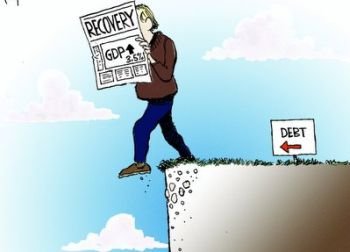
One commonly held view is that governments reform when they are in a crisis and when they have their backs against the wall. For the case of fiscal reforms, one can easily identify a crisis as a runaway deficit, and in fact, Alesina, Ardagna, and Trebbi (2006) show evidence consistent with this hypothesis. Using a large sample of OECD and developing countries, they show that fiscal adjustments and stabilization of inflation are more likely to occur when this kind of macroeconomic imbalance degenerates into a crisis of runaway (hyper) inflation or of very high budget deficits.11
The case of structural reforms is more complicated. The lack of reforms may lead to a slow decline that does not degenerate into a sudden crisis. However, when the decline, evaluated in terms of prolonged periods of low growth, begins to become front page news, then reform blockers may lose some of their political clout. Recent discussions of relative decline in Europe (and particularly of Italy) may be leading in that direction.12 However; the recent financial crisis may have generated a political movement in some countries against deregulation and in favor of a return to easy and long- term state intervention. At the time of this writing (October 2008), it is hard to predict how much the tides will move toward reregulation.
Much has also been written about the political cycle and reforms.13 Conventional wisdom suggests that governments should not introduce reforms close to elections and that in general, liberalizing and/ or fiscally conservative reforms lead to electoral losses. Thus, if a government has a chance of introducing reforms, it ought to do so soon after it is appointed, for two possible reasons: first, to take advantage of the honeymoon period, and second, because the short- term costs of reforms will be gone before the next election. We examine the timing of reforms in relation to the electoral cycle, and we do find some evidence that reforms tend to occur at the beginning of a new term. As for the likelihood that the reforming government will lose the next election, one has to maintain a healthy dose of skepticism with regard to conventional wisdom. For instance, Alesina, Perotti, and Tavares (1998) show those governments that engaged in sharp fiscal adjustments have often been reappointed.
11. See Alesina and Drazen (1991) and Drazen and Grilli (1993) for models consistent with this hypothesis, and see Drazen and Easterly (2001) for empirical evidence. See also Drazen (2000) for an extensive discussion of the political economy of stabilization policies.
12. See Alesina and Giavazzi (2006) for a recent discussion of potential European decline due to insufficient reforms.
13. See Alesina, Roubini, and Cohen (1997) for work on the political business cycles, and see Brender and Drazen (2005) for a political budget- cycle model.