VIDEO
The Causes and Effects of the 2008 Financial Crisis

Coda: The 2008 Financial Crisis
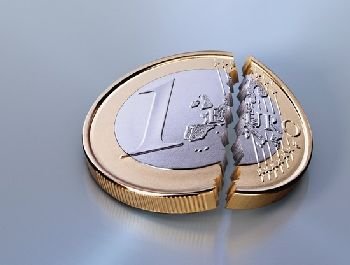
The financial crisis that spread from the United States to Europe in 2008 suggested yet another scenario for the breakup of the euro area.
58 The crisis led to suggestions that a country experiencing a severe banking crisis and incurring high costs of bank recapitalization might feel impelled to abandon the euro. If such costs were to exceed the fiscal capacity of the state, a government and its central bank might resort to the inflation tax to augment that fiscal capacity.
Levying the inflation tax at the national level presupposes the existence of a national currency. Hence, a state in these dire straits might feel impelled to abandon the euro and to reintroduce its national unit.
The basic issue is familiar to aficionados of the literature on monetary union: it is the feasibility of monetary union without fiscal union. The European Union has only a relatively small budget-less than 2 percent of EU GDP-much of which is tied up in the Structural Funds and Common Agricultural Policy. There is no federal fiscal mechanism for transferring resources to a member state suddenly confronted with high bank recapitalization costs. At the same time, economic and financial integration (as cemented by the price transparency afforded by the adoption of a common currency) has led some countries to specialize in the production of financial services.
They have grown very large formal and shadow banking systems that in extreme circumstances may require a large public capital infusion in order to survive. In the absence of federal fiscal arrangement, a member of the monetary union, prevented from resorting to the inflation tax, may lack the public resources adequate to carry this out. Countries like Belgium, where the value of short- term bank liabilities approached three times GDP in mid- 2008, illustrate the point.
The height of the crisis saw considerable discussion of this scenario: “For Europe, this is more than just a banking crisis,” Munchau (2008) wrote. “Unlike in the US, it could develop into a monetary regime crisis. A systemic banking crisis is one of those few conceivable shocks with the potential to destroy Europe’s monetary union. The enthusiasm for creating a single currency was unfortunately never matched by an equal enthusiasm to provide the correspondingly effective institutions to handle financial crises. Most of the time, it does not matter. But it matters now. For that reason alone, the case for a European rescue plan is overwhelming.” Evans- Pritchard (2008) made a similar point: “Who in the euro zone can do what Alistair Darling has just done in extremis to save Britain’s banks, as this $10 trillion house of cards falls down? There is no EU treasury or debt union to back up the single currency. The ECB is not allowed to launch bail- outs by EU law.
Each country must save its own skin, yet none has full control of the policy instruments. . . . This is a very dangerous set of circumstances for monetary union. Will we still have a 15- member euro by Christmas?” The answer depends in part on the arithmetic. On a monetary base of €1.35 trillion, the euro area would take in roughly €100 billion by running an inflation rate of 15 percent; this assumes that an interest elasticity of demand for base money is one- half and that inflation feeds through into interest rates one for one.59 From this should be deducted the additional interest payments that would have to be paid on the previously existing public debt as a result of abandoning the euro; the estimates suggest that this might amount to an additional 10 basis points. On €6 trillion of euro area debt, this would add $6 billion to debt- servicing costs. While the resulting revenue is not inconsequential, it pales in comparison with the roughly €2.5 trillion of aggregate tax receipts in the euro area.60
More important, however, would be the other adverse financial effects. The analysis of suggests that the banking- crisis- leads to-serious- discussion-of-euro-abandonment scenario would play out as follows.
The decision to reintroduce the national currency would require the passage of a law. It would also require the redenomination into that currency of domestic bank liabilities, public debt, mortgage and credit card debts, and wage contracts. The relevant legislation would be complex, and in a democracy, crafting and passing it would take time. Meanwhile, knowing what was coming-depreciation of the new national unit against the euro, the involuntary conversion of domestic assets into the new national unit, and their depreciation against euro- denominated assets-there would be an incentive to engage in asset substitution. This is precisely the banking crisis scenario previously described.
It might be objected that the country was already in the throes of a banking crisis-why worry about creating a problem that already exists? But the expectation that other domestic financial assets would be involuntarily redenominated and then devalued against the euro would surely cause additional capital flight. In response, bond markets would have to be shut down.
The stock market would have to be shut down. This policy response would require not just a bank holiday of no negligible length but also a financial holiday-all markets would have to be closed for a no negligible period.61
This would have high costs for the efficiency of resource allocation and the reputation of the country’s financial markets. Meanwhile, there exist a number of alternative approaches to dealing with the challenge of bank recapitalization. Most obviously, governments could agree to share the costs. Typically, banks whose liabilities are a multiple of GDP have large cross- border operations and multinational ownership. In Belgium, for example, the banks with such large short- term liabilities are not solely owned by Belgians.
Fortis was so highly leveraged because it had purchased Dutch Amsterdam- Rotterdam Bank operations, impelling the Dutch to help with the bailout. Similarly, Belgium, France, and Luxembourg cooperated in recapitalizing Dexia, a heavily Belgium- based mortgage lender. In the longer run, euro area countries and EU members more generally could agree on formal cost- sharing rules.
Alternatively, recapitalization might be done without resorting to public funds. Buiter (2008) has suggested an across- the- board debt equity conversion in reverse order of seniority: to resolve the crisis, existing debt would be involuntarily converted into equity, possibly preferred. Zingales (2008) advocates prepackaged bankruptcy: banks entering into this procedure would have old equity holders wiped out and their existing long- term bonds and commercial paper converted into equity.
To protect the shareholders of solvent institutions against expropriation, they would be allowed individually to decide whether to buy out debt holders at the face value of their debt. If access to ECB credit was limited to banks that had undergone this procedure, solvent banks with no need for ECB funds would not undergo the procedure, but others would.
Third, recapitalization could be carried out using already- available fiscal resources. It is not obvious that 10 percent of GDP, which is what it typically takes to resolve a banking crisis, is beyond the fiscal capacity of European states. Adding 10 percent of GDP to the public debt at a 2 percent real interest rate makes for two- tenths of a percent of GDP of additional debt service. One should add ancillary costs-notably, higher interest rates on outstanding debt and crowding out of private investment-but these numbers are still not unreasonable.
Be this as it may, if the euro area survives the stresses roiling financial markets in the latter half of 2008-a series of events that are increasingly referred to as the most serious financial crisis of our lifetimes-then the hypothesis can be said to have passed its ultimate test.
58. As readers who have gotten to this point will have inferred, most of the present papers was drafted prior to those events.
59. Readers can prorate this country by country as they wish.
60. It also is small relative to the €1.5 trillion that euro area members devoted to recapitalization of their banking systems in mid-October 2008, at the height of the financial crisis.
61. One can also imagine resorting to the parallel-currency scenario previously discussed.
Euros would still be used for most transactions, while the parallel domestic unit would be used to recapitalize banking system. Banks (and other eventual holders) could then exchange the new parallel currency for Euros as they wished on the foreign exchange market. The parallel domestic currency would presumably quickly begin to trade at a discount. The “bad” money would promptly begin driving out the “good” one. In other words, there would be additional capital flight on the part of those holding euro- denominated claims. This approach would similarly seem to lead ultimately to the imposition of a moratorium on all financial transactions.