VIDEO
The Treaty of Nice (ToN)
The European Council Summit held in Nice (December 2000) finally resolved the complicated legacy of the 1997 ToA.
The “leftovers” of the 1997 Amsterdam Summit, that is, the long overdue changes to institutions and decision-making procedures (the most difficult areas to reform), had become of vital importance and urgency in the light of the then future enlargement of the EU.
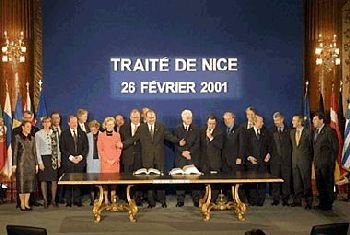
After 350 hours of negotiations in the IGC and five more days of hard bargaining within the Summit Meeting, the 15 heads of state or government agreed on the provisional text of the Treaty of Nice. The final text was signed on 26 February 2001 and the Treaty entered into force on 1 February 2003.
The most important changes to the ToA introduced by the ToN
These were:
Reform of the institutions of the EU, including the redistribution of votes in the Council of the EU. The ToL has further reformed the EU institutions;
Revision of the enhanced co-operation procedure which has been further revised by the ToL;
The establishment of a new mechanism aimed at preventing infringements of human rights.
Issues not dealt with until the IGC of 2004
Irrespective of the vitriolic attack of the EP on the Treaty for being unambitious and shaped by narrow national interests, it is incontestable that the ToN paved the way for future enlargements of the EU. However, important issues were put off until 2004 when a new IGC was convened to deal with them. These issues were:
The status of the Charter of Fundamental Rights of the European Union. Should it have
binding force? If so, in what manner should this be achieved?
Simplification and consolidation of the existing Treaties (the EU, EC and EA Treaties) into one Treaty, in order to make them clearer and more readable;
The clear delimitation of competences between the EU and theMemberStates. This matter was raised by Chancellor Gerhard Schröeder. Indeed, this matter was of vital importance for powerful German Länders. (This issue had previously been highlighted by the Laeken Declaration in 2001);
The role of national parliaments in the European system.
The constitution that never was
The Laeken Summit held in December 2001 adopted a “Declaration on the Future of the European Union”, which committed the European Union to become more democratic, transparent and effective and to pave the way towards a Constitution of the European Union. The task of preparing a form of Constitution was conferred on a novel body – the Convention. The Laeken Summit appointed Mr Valéry Giscard d’Estaing, the former French president, as chairman of the Convention. Its 105 members represented governments and national parliaments of theMemberStatesand candidate states, the European Parliament and the European Commission, that is, the main parties involved in the debate on the future of the European Union. The status of observers was given to 13 representatives of the European Economic and Social Committee, the Committee of the Regions, the European social partners (that is, bodies representing labour, such as the European Trade Union Confederation, and management, such as the European Confederation of Industries) and the European Ombudsman.
The Laeken Declaration posed some 60 questions to be debated and considered by the Convention. These questions focused on the following topics:
-Better division and definition of competences in the European Union;
-Simplification of theUnion’s instruments, and assessment of their influence;
-Different aspects of the perceived democratic deficit of EU institutions;
-More democracy, transparency, and effectiveness;
-Simplification of the existing treaties.
The opening meeting of the Convention took place on 28 February 2002. A draft of a Treaty establishing a Constitution forEuropewas ready in July 2003. Subsequently it served as a basis for the 2003/2004 IGC. The final draft was approved by the Brussels Summit (June 2004) and signed inRomeon 20 October 2004 by the heads of state or government of the 25MemberStatesand the three candidate states (Bulgaria,RomaniaandCroatia). In order for the EU Constitution to enter into force, all Members of the EU had to ratify it either using the parliamentary method, that is, the treaty must be approved by the national parliament of a Member State, or by a referendum, in which case the treaty is submitted directly to citizens who vote for or against it.
The method of ratification was left to theMemberState. According to the EU Constitution, it was to enter into force on 1 November 2006. The deadline was not met because the peoples of France and The Netherlands rejected the Constitution on 29 May 2005 and 1 June 2005 respectively. In this context the Brussels Summit held on 16 and 17 June 2005 decided that the date envisaged for the entry into force of the Constitution was not tenable, but the process of ratification was not abandoned. A year later the Vienna Summit agreed on “a period of reflection” with a view to deciding the best way forward with regard to institutional reforms. The Brussels Summit held in December 2006 decided to continue the period of reflection into 2007. By June 2007, the EU Constitution had been ratified by 18 Member States; others had put ratification on hold.
The European Council Summit held in June 2007 decided to abandon the constitutional project; however, as institutional reforms of the kind envisaged by the Constitutional Treaty were necessary, given that the EU, then comprising 27 Member States, could not function properly under the then current rules on governance, the European Council decided to convene an IGC and entrusted it with the preparation of a new treaty called the Reform Treaty. It is submitted that the proposed Constitution was not a “tidying up exercise.” It was a very ambitious piece of work that, for the first time, clearly defined the division of power between the EU and Member States, and in doing so gave the EU greater powers, enhanced the role of the EP, bolstered democratic accountability and transparency by giving national parliaments an important role in the adoption of EU legislation, assigned to the Charter of Fundamental Rights its rightful place, and “melted” the EU’s three Treaties into one.