
VIDEO
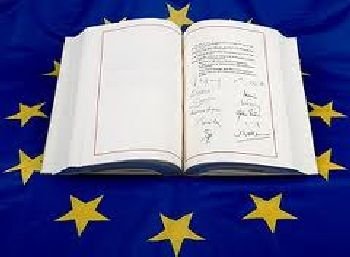
The Treaty of Maastricht and the European Union
To examine the main features of the TEU is not an easy task. As McAllister said: “Maastrichtis like Janus. It faces both ways: towards inter-governmentalism, and towards some kind of ‘federal vocation’.
It is as ambiguous as the oracle of Delphi; as the Community itself. It reflects the extent to which the States are, and are not, able to agree.” 55 The Treaty itself was a lengthy document, badly drafted. It was divided into seven Titles, and there were 17 legally binding Protocols and 33 Declarations attached. The latter have an interpretive function, although declarations of this kind are generally not relied on by the ECJ in its interpretation of the Treaties.56 The Economist reported, half jokingly, that the negative referendum in Denmark and a very narrow majority vote in France regarding the ratification of the TEU could be explained by the fact that the governments of those countries gave their people the original version to read. The Economist contrasted this withIreland, where the Irish Government published a booklet summarizing the Maastricht Treaty in plain language and consequently won a two-thirds vote in favour.57 The only justification for producing such a confusing legal document was that the TEU was a transitional treaty. It established a procedure for its own revision.
The TEU was based on the so-called “Temple” structure, which consisted of the following elements:
The roof of the Temple
The roof of theTempleconsisted of common provisions which laid down the objectives of the EU. The main purpose of the TEU was to “establish the foundations of an ever closer union among the people ofEurope.” To attain this purpose, the TEU set the following general objectives for the EU:
The promotion of economic and social progress and a high level of employment with a view to achieving balanced and sustainable development, through the establishment of an area without internal frontiers, through the strengthening of economic and social cohesion and through the establishment of economic and monetary union;
The establishment of a single currency within the framework of economic and monetary union;
The promotion of an international identity for the EU through implementation of a common foreign and security policy (CFSP) which might lead to a common defence policy;
The establishment of citizenship of the EU;
The development of closer co-operation in the fields of justice and home affairs (JHA);
The improvement in the effectiveness of the EU institutions mostly by extending the legislative powers of the EP;
The extension of EU competences to new policies while reinforcing the existing ones;
The affirmation of the commitment of the EU to the protection of human rights;
The introduction of the principle of subsidiarity.
Three Pillars, each Pillar dealing with one of the three main areas of EU policy
Pillar 1
Pillar 1, or “The Community Pillar”, covered all policies existing under the previous Treaties and introduced fundamental amendments to the EEC Treaty.
TheEuropean Economic Communitywas renamed by the TEU. The name “European Economic Community” was replaced by “European Community” (the EC) in order to underline the fundamental changes in objectives. The most important changes concerning the EC Treaty were:
The recognition of the principle of subsidiarity, which operates to restrict the Community’s involvement in national matters;
The establishment of European citizenship, which creates new rights for the nationals of
Member States;
The redefinition of the objectives of the Community in areas such as health, education, training, industrial policy, telecommunications and energy networks, research and development, consumer protection, trans-European networks, and culture;
The extension of EC competences in environmental protection and development aid for poor countries;
The deepening of the Commission’s accountability to the EP while extending the EP’s participation in decision-making procedures;
The establishment of European Economic and Monetary Union depending on the extent to which Member States’ economies converge in terms of inflation, interest rates and other criteria laid down in the EC Treaty;
The extension of the ECJ’s powers in relation to Member States that refuse to comply with its judgments.
Pillar 2
Pillar 2, or “The Common Foreign and Security Policy Pillar”, concerned inter-governmental co-operation on common foreign and security policy (CFSP).
Pillar 3
Pillar 3, or “The Justice and Home Affairs Pillar”, covered inter-governmental co-operation in the fields of justice and home affairs (JHA) (see Chapter 2.4). Under the TEU Pillar 3 consisted of determination of nine areas listed in Article K1 EU regarded as “matters of common interest” to the Member States. These essentially covered co-operation in criminal justice (and some civil justice matters) and co-operation in asylum, immigration, and visa matters. Co-operation in these areas was enumerated as follows in the Treaty:
Asylum policy (Art. K1 (2));
Rules governing the crossing by persons of the external borders of the Member States and
the exercise of controls thereon (Art. K1(2));
Immigration policy; policy regarding the conditions of entry, movement, and residence of nationals of third countries; policy regarding combating illegal immigration, residence, and work (Art. K1 (3));
Policy regarding combating drug addiction (Art. K1(4));
Policy regarding combating fraud on an international scale as far as this is not covered by points 7–9 below (Art.K1(5));
Judicial co-operation in civil matters (Art. K1 (6));
Judicial co-operation in criminal matters (Art K1 (7));
Customs co-operation (Art K1 (8));
Police co-operation for the purpose of preventing and combating terrorism, unlawful drug trafficking and other serious forms of international crimes, including, if necessary, certain
aspects of customs co-operation, by way of the organization of a Union-wide system of exchanging information within the European Police Office (Europol) (Art. K1(9)).
Under Article K9, the so called “passerelle” or “bridge” provision, the Council, acting unanimously on a proposal from the Commission or a Member State, was allowed to transfer items mentioned in Articles K1(1)–(6) from Pillar 3 to Pillar 1. The Council exercised this option. Apart from matters relating to police and judicial co-operation in criminal matters all matters relating to these areas were transferred to the EC Treaty. The ToL completed this process. It abolished the Pillar structure with the consequence that the entirety of Pillar 3 has become Title IV of the TFEU.
The Plinth of the Temple
The base of the Temple (its “plinth”) consisted of the final provisions.
The difference between the Pillars
The difference between Pillar 1, on the one hand, and Pillars 2 and 3, on the other, is that Pillar 1 was based on the so-called “Community method” (now called “EU method”),58 while Pillars 2 and 3 were based on inter-governmental co-operation. That is, as a matter of principle, unanimity was required for any measure adopted under Pillars 2 and 3.
55. R. McAlister, From EC to EU, A Historical and Political Survey, 1997,London: Routledge, p 225.
56. L. Senden, Soft Law in European Community Law, 2004,Oxford: Hart Publishing, pp 374–80.
57. Quoted by P. Demaret, “The Treaty Framework”, in D. O’Keeffe and P. M. Twomey (eds), Legal Issues of the Maastricht Treaty, 1994,London: Wiley Chancery Law, p 3.
58. The EU glossary provides the following definition of the “Community/EU method”: “The Community method is based on the idea that the general interest of Union citizens is best defended when the Community institutions play their full role in the decision-making process, with due regard for the subsidiarity principle” see http://europa.eu/scadplus/glossary/communitisation_en.htm (4/16/2013).