VIDEO
Human Rights Topics for Preschool and Lower Primary School
Confidence and social respect
In preschool and lower primary education, teaching for human rights is aimed at fostering feelings of confidence and respect for self and others. These are the basis for the whole culture of human rights.
This makes the teacher’s “teaching personality” highly important. A supportive approach at all times will make every activity meaningful, even those not specific to human rights teaching.
Stories are invaluable. Young children can learn lessons and morals and remember them vividly if they are associated with a much-loved character in a well-told tale. Such stories can be obtained from published literature on children’s’ tales, from parents and grandparents or even by using one’s imagination. A classroom library where resources are available may be useful. In selecting books, it is important to obtain attractive volumes that feature both females and males as multicultural, active, and non-stereotyped characters. When reading to the class or showing picture books, point out the good things they show or tell.
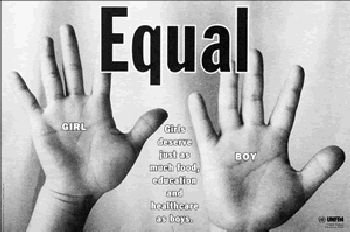
Where the resources exist, students can participate in cooking, a wood-work bench, or potting plants. These can be done as imagination games also. All activities should involve both boys and girls. If disagreement arises concerning activities, the class may need to make rules to equalize the situation and break down discriminatory behaviour. Such rules become unnecessary with regular use. Equality can also be improved by changing the way the classroom is arranged or how students line up. It is important to avoid grouping children in ways that reinforce obvious differences. Try to facilitate friendships between students as well as awareness that differences are acceptable and natural.
Resolving conflicts
Conflicts often arise, and teachers need to develop a consistent strategy to address them. It is imperative that a teacher remain open to discussion of conflict at all times. Emphasize that a solution can be found to any problem. However, children need to think about a problem in order to find a solution. The following shows a more systematic approach to problem-solving:
1. Identify a problem and acknowledge it. Stop any physical or verbal activity and ask the children involved to discuss their behavior together.
2. Get a description of what happened. Ask the children involved and any bystanders about the events that took place. Give everyone a turn to speak without interruption. Positive encouragement, such as a touch or a hug where appropriate, can also ease feelings of anger or guilt. However, it is essential to remain neutral at all times.
3. Explore a range of solutions. Ask those directly involved how this problem can be solved. If the children cannot suggest solutions, the teacher can offer some ideas.
4. Reason out the solutions. Point out how more than one fair solution may often exist. Encourage the children to think of the physical and emotional consequences of these solutions and recall past experiences of a similar nature.
5. Choose a course of action. Seek a mutual agreement on one of the solutions presented.
6. Carry out that action.
Confronting discrimination
In cases of discriminatory behavior, solutions are not so easy to find. Usually neither the insulted child nor the offending child has a clear understanding of discrimination. The teacher’s actions are especially important in this situation. The teacher should first strongly criticize the discriminatory behavior and make clear that it is definitely unacceptable.
The teacher may offer clear support to the child who was the object of the offence without criticism of his or her anger, fear, or confusion, and be firm yet supportive with the child who engaged in the discriminatory behavior. Teachers should help victimized children realize that negative responses to their gender, appearance, disability, language, race or other aspects are due to unacceptable prejudices; they should also examine with children who were involved and who witnessed the situation the issues at stake. Discuss such incidents also with parents, staff, and members of the local community.
This method can be used at all school levels as well as in critical situations outside the school environment. It can be applied to all discriminatory behavior. Where possible, ethnic diversity in the classroom should be acknowledged, understood, and even celebrated at every opportunity. It should be remembered that racism and sexism are usually present in children at a very young age, so this method may be remedial. Teachers should also be aware that they too may harbor discriminatory attitudes and strive diligently to recognize and overcome them. Care should also be taken to make the classroom and school accessible and welcoming to children with disabilities. The following strategies and activities offer ways to introduce human rights concepts into early childhood education.