
Jean Monnet – film from the EU archives
Early postwar attitudes in Europe to integration: federalism v. functionalism
Among the enthusiasts for European cooperation, there were differing theories about the ways in which European unity might progress. Essentially the conflict was between the federalists and the functionalists.
At different times in the postwar era, proponents of either approach have had the upper hand. Between them, however, they provided the impetus for integration. Federalists viewed nationalism as the major threat to a peaceful continent. They wanted more than the creation of a series of functional economic agencies. They wanted to move swiftly towards unification, arguing that all layers of government – local, regional, national and European – should cooperate with and complement each other.
Federalists were inspired by the phraseology of Churchill4 in his Zurich Speech, in which he promoted the idea that the nations of Europe should join forces and work together. Most famously, he sought to remedy a situation in which ‘over wide areas a vast quivering mass of tormented, hungry, care-worn and bewildered human beings gape at the ruins of their cities and homes, and scan the dark horizons for the approach of some new peril, tyranny or terror’.
He went on to point to the remedy which, if it were generally or spontaneously adopted, would as if by miracle transform the whole scene . . . and re-create the European family, or as much of it as we can, and provide it with a structure under which it can dwell in peace, in safety and in freedom. We must build a kind of United States of Europe.
The drive for European unity to 1973 7 Functionalists believed that greater unity in Europe would develop through a more piecemeal and gradual approach of which moves towards economic union would be the first stage. The organizations which were to be formed were seen not as an end goal in themselves, but rather as steps on the way towards building a new Europe. Such an approach would involve a more gradual transfer of national sovereignty to a European level.
There were also intergovernmentalists, representatives of those states which wished to retain as much of their national sovereignty as possible. Supporters believed that governments of major states had a key role to play in the evolution of the continent. They could see the merits of cooperation in specific areas, but had no wish to see any supranational body take policy decisions in key areas of political life, such as national defense and foreign policy. In their view, such integration as might occur would only take place as a result of individual governments pursuing their national interests, interests which might on occasion overlap.
In the early days after 1945, there was much idealism in Europe. Statesmen sought to create new structures which would enable cooperation and union to flourish. In those days it was the rhetoric of the federalists which carried the day. From I948 to 1954 their ideas inspired the bold moves that were initiated, from the Council of Europe (1949) through to the creation of the European Defence Community and the European Political Community (both 1954) which between them would look after political and military union. But already by the early fifties, concrete steps were being taken which were much more in the functionalist mould. They were more cautious in their immediate goals, but more practical and achievable. The plan to pool French and German coal and steel supplies was the first of these and this functionalist phase was to culminate in the signing of the Treaty of Rome (1957).
The outlook and approach of Jean Monnet
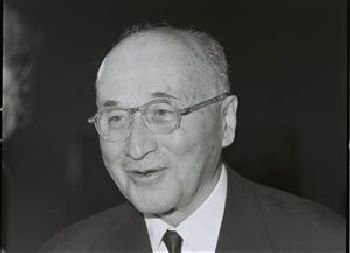
Jean Monnet was noted for his belief in carefully coordinated planning in France. Unhampered by any concern for the faded glories of the past, he was intent on the modernization of his country, to be achieved by coordinating the plans for individual industries and launching new ones. He placed France’s need for reconstruction in a European context. As he wrote in his Memoirs: ‘The countries of Europe must turn their national efforts into a truly European effort. This will be possible only through a “federation of the West” ’.5 He was clear about the end target which he wished to achieve in his European project, but recognized that there was scope for disagreement on the means by which the goal might be reached. In a broad sense, he is usually described as a federalist and indeed his writings are littered with references to the term, although he rarely spelt out what this might mean in practice. The ambiguity and vagueness were deliberate, because his preferred approach was to take concrete steps towards ultimate unity.
To arrive at the ultimate goal, Monnet was concerned with what was politically possible at the time. If appropriate, it might sometimes be wise to adopt an intergovernmental approach, for progress had to reflect what was possible ‘at that time and that stage in men’s thinking’. Generally, he favored a pooling of sovereignty in a particular area, for this would sublimate national rivalries and tensions.
The hope was that eventually, via such closer economic integration, there might develop closer political union if the results seemed good. As he put it at the time: Little by little, the work of the Community will be felt . . . Then the everyday realities themselves will make it possible to form the political union which is the goal of our Community and to establish the United States of Europe . . . Political Europe will be created by human effort when the time comes on the basis of reality.6
Because of his commitment to a step-by-step method of building European Union and his willingness to accept a variety of approaches en route towards the federal goal, some commentators find it difficult to locate Monnet firmly in the federalist camp. In particular, Burgess7 is critical of Monnet’s contribution, noting its ‘contradictory and diverse principles’ which were sufficiently elastic that they could embrace ‘incrementalism and intergovernmentalism’. He argues that despite the language the Frenchman sometimes employed, it is unrealistic to see him as a ‘champion of the federalist cause in Europe’, even if some form of federation was his ultimate object. He describes him as an ‘economic functionary first and only secondly as an incremental federalist’. The phrase ‘incremental federalist’ has some merit. Monnet was certainly not a mere economic functionalist, for there was always a political objective to which he aspired, even if it was not one which was clearly formulated and elaborated.
In an interesting essay on the contribution of Monnet to the creation of modern Europe, Duroselle8 detects four themes in his approach:
• He was not a nationalist and wanted to see the force of nationalism in Europe set aside.
• He believed in a Europe of concrete institutions.
• He wanted an ‘open Europe’ in which Britain would play a leading part.
• In particular, he wanted a Europe linked with the USA. He felt the transatlantic partnership was vital and noted that American governments were keen to see the European continent get its act together.
Essentially, Monnet was a visionary, albeit a very practical one. Without being obsessed with too many details, he had a sense of mission and of history. His approach was not one which allowed much room for the expression of popular feeling. He worked with and through small elite, taking the view that when the beneficial results of new initiatives became apparent then the public would willingly offer their support for any venture which the elite conceived. His paramount concern was to achieve a common approach between the leaders of opinion in the various countries concerned.