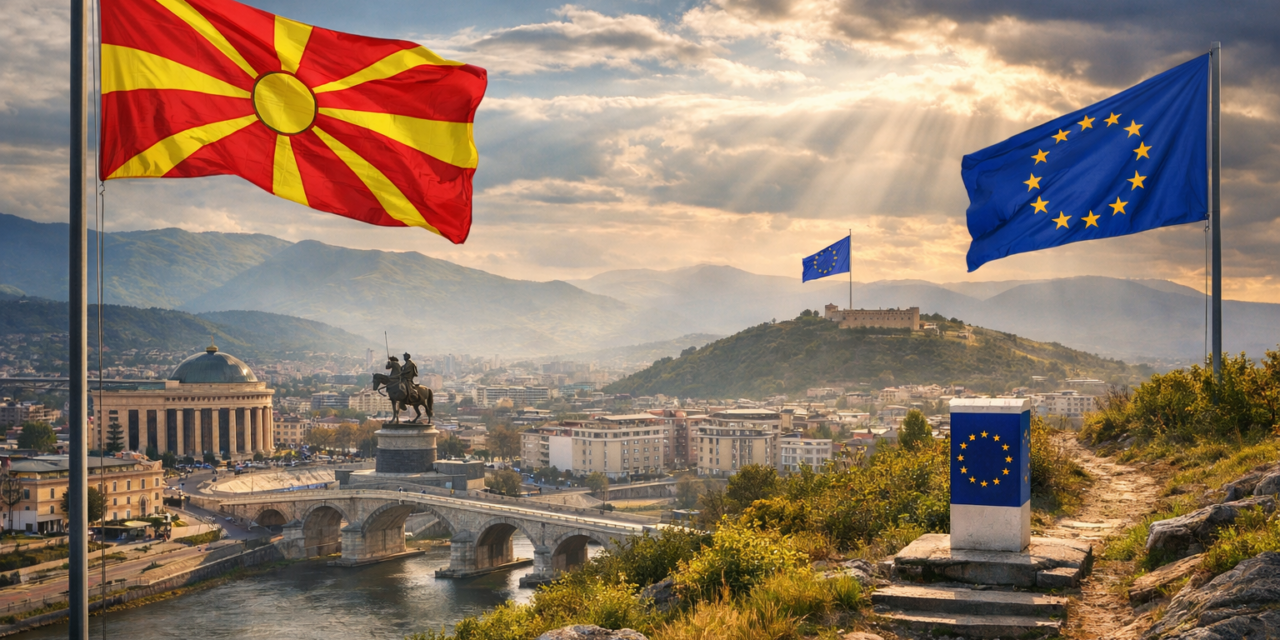
North Macedonia’s road to European Union membership is among the most intricate and long-running diplomatic projects in contemporary Balkan history. The country has aimed for more than twenty years to bring its legal, political, and economic systems in line with the demanding criteria needed for entrance into the European family. This course has been shaped by internal structural changes, regional geopolitical maneuvering, and the careful resolution of historical conflicts with adjacent countries. The condition of North Macedonia as of July 15, 2026, shows a story of ongoing ambition balanced by the complex reality of European diplomacy. The historical course of this admission process is investigated in this essay together with the major legislative turning points, the settlement of long-running bilateral conflicts, and the particular challenges that have defined the road toward membership.
The Early Years of Association and Stabilisation
North Macedonia started its official interaction with the European Union in the late 1990s, which was formalised by the Stabilization and Association Process. The official Stabilisation and Association Agreement signed in 2001 provided the framework for political and economic cooperation. The main goal for the government in Skopje during these early years was to create democratic institutions capable of withstanding the strains of a changing economy. The government concentrated on applying the Ohrid Framework Agreement, without which internal stability would have been jeopardized following the ethnic turmoil of 2001. The European Council made North Macedonia an official candidate country by 2005. This marked a great source of national pride and indicated a definite course toward eventual membership. But the hope of the middle two thousands soon crashed with the reality of international political friction.
The Name Dispute and Regional Impediments
A protracted quarrel with Greece over the constitutional name of the nation successfully stopped the accession process for many years. Greece contended that the name Macedonia suggested territorial claims over its own northern region, sharing the same name. North Macedonia was prevented from starting official accession negotiations for over ten years by this conflict. Many residents who saw the European viewpoint as the main engine for development found the deadlock irritating. The breakthrough came only with the signing of the Prespa Agreement in 2018. Formally changing its name to the Republic of North Macedonia under this historic agreement was a trade-off that opened the way for NATO membership and strengthened ties with the European Union. Even with this enormous sacrifice, the road was not straight since fresh difficulties sprang from other neighbors inside the European Union.
Screening Processes and Institutional Reforms
Once the name disagreement was resolved, attention turned to the technical requirements of the acquis communautaire. The European Union requires candidate countries to harmonize their domestic laws with the vast body of European legislation across thirty five distinct chapters. North Macedonia committed substantial funds to capacity development to guarantee that its administrative personnel grasped the complexities of EU directives. The screening process, which started in earnest after the European Council gave its political green light, necessitated a thorough assessment of the judiciary, the fight against corruption, and the operation of the market economy. These changes aimed to restructure the nation’s governance rather than being simply administrative endeavors. Changes in legislation were introduced to enhance court independence and foster openness in governmental purchases. But the rate of these changes was frequently determined by the political stability of the local administration as well as the availability of European finance and technical assistance.
The Bulgarian Veto and Its Consequences
Although the Prespa Agreement opened the way, the accession process ran into a fresh roadblock in the shape of a veto from Bulgaria. Beginning in 2020, the Bulgarian administration expressed worries about cultural and historical concerns, particularly in reference to the interpretation of national identity and language. This change showed how delicate the accession process is when historical grudges between two nations are included into European policy. For several years, the veto essentially stopped the official inauguration of negotiation clusters, therefore leaving North Macedonia in a diplomatic uncertainty. The European Union sought to resolve the conflict using several frameworks, including the French proposal of 2022. This plan sought to establish a route for eliminating the veto in return for constitutional changes that would formally include the Bulgarian minority inside the North Macedonian constitution. The need for these constitutional revisions became a major topic of heated political controversy inside the nation, splitting those who argued for quick compliance to advance the accession process and those who worried that such compromises jeopardized national sovereignty.
Geopolitical Dynamics and the Western Balkans
North Macedonia’s accession must be considered in the larger context of Western Balkan geopolitics. Though the European Union has often declared its support for the integration of the area, the apparent lack of advancement in the accession process has resulted in exhaustion among the local populace. China, Russia, and the Gulf States among other global powers have strengthened their economic impact in the region, therefore offering alternative investment sources free from the rigorous democratic requirements connected with the European Union. This makes it hard for the government in Skopje to strike a balance. On the other hand, the preferred course for most political parties is still strategic alignment with Western ideals. Conversely, the inability to obtain a definite membership date makes it harder to keep the public behind challenging and sometimes unpopular changes. The regional context, distinguished by the continuous instability in Bosnia and Herzegovina and the unclear situation of Kosovo, further challenges the European Union’s aim to grow since member states are hesitant to bring regional unrest into the Union.
The Progress Toward July 2026
The condition in North Macedonia is distinguished by a combination of institutional readiness and political uncertainty by the summer of 2026. The government has effectively finished several chapters linked to economic policy and environmental standards by repeatedly interacting with the European Commission. The use of digital government solutions has raised the effectiveness of public services; the nation has kept a steady macroeconomic framework despite international inflation. Still, the need for constitutional changes continues to be the main impediment. Debates over how to satisfy the requirements established by the European Union without endangering the national identity of the people define the political scene in Skopje as of July 2026. The European Commission has kept up upbeat technical progress reports, which has encouraged the opposition and the government alike to reach an agreement. With many parliamentarians pushing for a faster route fearing that a prolonged delay will erode the credibility of the European project in the Balkans, the support of the European Parliament remains robust.
The Role of Civil Society and Public Opinion
The contribution of civil society has been essential throughout the accession process in keeping governmental pressure on to guarantee openness and responsibility. Monitoring the execution of EU-funded initiatives and emphasizing gaps in the rule of law have been much helped by non-governmental organizations. But over the last ten years, public perception has changed. Although joining the European Union is still a common ambition, the lengthy wait has raised doubts about the sincerity of the European commitment. Many people think they have satisfied every criteria just to face fresh, unanticipated demands. A decreased interest has been spurred by this view of changing goals. The difficulty for both the European Union and the national government is to close this communication gap, therefore demonstrating that the accession process is ultimately a road to improved living standards, better quality education, and more strong democratic safeguards for the people.
Conclusion
North Macedonia’s path to the European Union offers a clear example of how complicated modern integration is. It emphasizes that the intricacies of regional historical sensitivities and bilateral diplomacy frequently outweigh technical advances in administration, legal alignment, and governmental capacity. The nation finds itself at a turning point as of July 15, 2026. It has shown great perseverance in negotiating the requirements of the Prespa Agreement and working to fulfill the criteria established by the French proposal and subsequent bilateral discussions. The path has been everything but simple, exposing the major challenges that might surface even in a nation completely devoted to the ideals and norms of the European community. Looking ahead, the outcome of this accession process will rely as much on the legislative agility of the North Macedonian state as on the ongoing readiness of the European Union to offer a fair and straightforward way forward. Although the path is erratic, the integration aim is still a strong engine for stability and innovation in the heart of the Balkans. North Macedonia’s future is inextricably linked to the success of this European project, and the events leading up to this point demonstrate a country that has continually opted for reform, dialogue, and collaboration in its quest to become a full member of the European family. The devotion exhibited by the populace and the unrelenting work of its politicians will probably determine the course of this protracted and important path.
Bibliography
- European Commission (2023). North Macedonia 2023 Report. Brussels: European Commission.
- European Commission (2022). EU Enlargement Strategy and Main Challenges 2022–2023. Brussels: European Commission.
- Council of the European Union (2020). Council Conclusions on Enlargement and Stabilisation and Association Process. Brussels: Council of the EU.
- European Parliament (2022). North Macedonia: EU Accession Process – EPRS Briefing. Brussels: European Parliamentary Research Service.
- International Crisis Group (2023). North Macedonia’s EU Path: Between Hope and Uncertainty. Brussels: ICG.
- Freedom House (2024). Nations in Transit: North Macedonia. Washington, DC: Freedom House.
- OECD (2022). OECD Investment Policy Review: North Macedonia. Paris: OECD Publishing.
- World Bank (2024). North Macedonia Country Economic Memorandum. Washington, DC: World Bank.
- Bieber, F. (2020). The Rise of Authoritarianism in the Western Balkans. London: Palgrave Macmillan.
- Kmezic, M. (2021). Rule of Law and Democracy in the Western Balkans. Berlin: Friedrich Ebert Stiftung.
- Bechev, D. (2022). Turkey and the Balkans: Strategic Ambiguities. London: Routledge.
- UNDP (2023). Human Development Report: North Macedonia. New York: UNDP.
- Marusic, S. J. (2023). North Macedonia’s Political Landscape and EU Aspirations. Balkan Insight.
References:
www.atlanticcouncil.org. Retrieved from https://www.atlanticcouncil.org/in-depth-research-reports/report/north-macedonia-a-reform-agenda-on-the-path-to-eu-integration/
(2004). Accession of North Macedonia to the European Union – Wikipedia. en.wikipedia.org. Retrieved from https://en.wikipedia.org/wiki/Accession_of_North_Macedonia_to_the_European_Union
(2022). Safeguarding peace and stability in the Western Balkans demands the EU’s full involvement – European Movement. europeanmovement.eu. Retrieved from https://europeanmovement.eu/member-update/safeguarding-peace-and-stability-in-the-western-balkans-demands-the-eus-full-involvement-2/
iacajournal.org. Retrieved from https://iacajournal.org/articles/10.36745/ijca.532
Dauti Bardhyl & Bardhyl Bodo & Bodo Herzog (2009). Economic Convergence between Macedonia and European Monetary Union Member States. The Five Maastricht Criteria. ideas.repec.org. Retrieved from https://ideas.repec.org/p/pra/mprapa/21222.html
The Western Balkans and the European Union: Group enlargement as a strategic response to the crisis of credibility and geopolitical uncertainty » Researches » Ifimes. www.ifimes.org. Retrieved from https://www.ifimes.org/en/researches/the-western-balkans-and-the-european-union-group-enlargement-as-a-strategic-response-to-the-crisis-of-credibility-and-geopolitical-uncertainty/5725