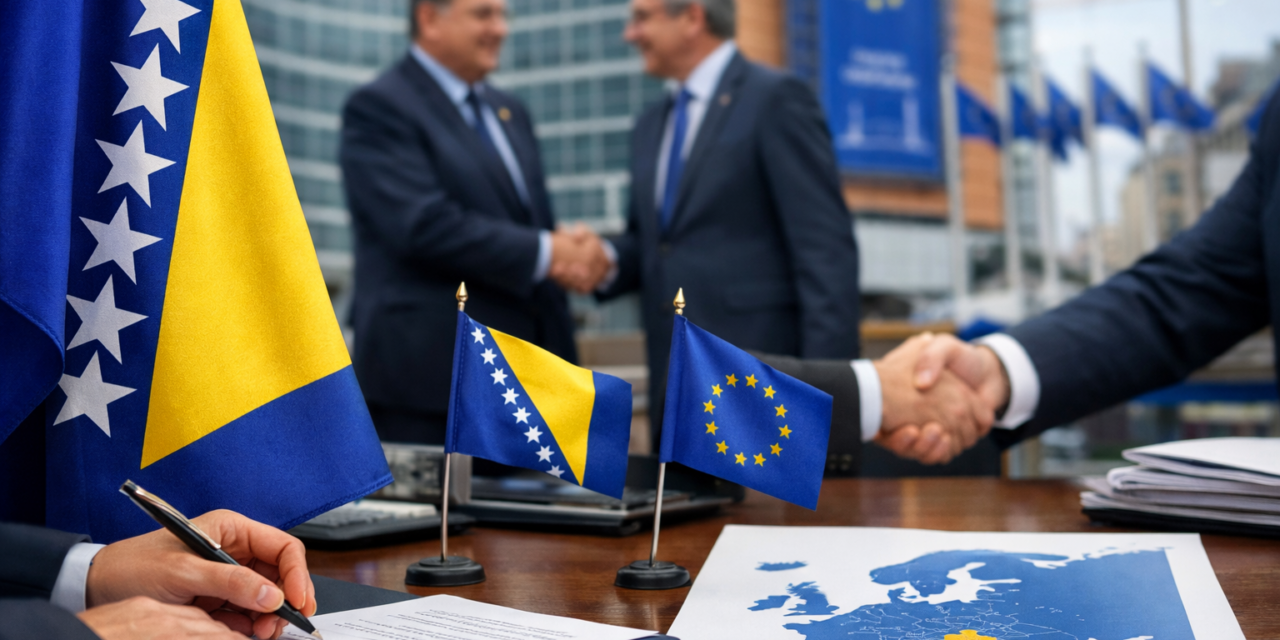
The journey of Bosnia and Herzegovina towards European Union membership is a complex and protracted one, marked by significant political, economic, and social challenges. As of May 15, 2026, the process remains ongoing, with the country having made progress in some areas while facing persistent obstacles in others. This essay will explore the key milestones, the driving forces, and the impediments that have shaped Bosnia and Herzegovina’s path to EU accession up to this point, examining its current standing and the outlook for the near future. The aspiration for EU membership is deeply rooted in the desire for stability, economic prosperity, and democratic reform, but the intricate post-war political structure and the slow pace of necessary reforms have made the integration process a formidable undertaking.
Historical Context and Initial Aspirations
Following the Dayton Peace Agreement in 1995, which ended the devastating war, Bosnia and Herzegovina inherited a complex state structure designed to prevent further conflict but often hindering effective governance. The initial post-war years were largely focused on stabilization and reconstruction, with EU integration emerging as a long-term strategic goal. The European Union, in turn, saw the Western Balkans as a region requiring careful attention and engagement to ensure lasting peace and prevent instability. The Stabilization and Association Process (SAP), launched in 1999, provided a framework for the Western Balkan countries, including Bosnia and Herzegovina, to move towards closer relations with the EU, ultimately with the prospect of membership. This process involves meeting strict political and economic criteria, often referred to as the Copenhagen criteria, which include a stable democracy, a functioning market economy, and the adoption of the EU’s acquis communautaire – the body of laws and regulations that make up the EU. For Bosnia and Herzegovina, the initial steps were slow, hampered by internal divisions and the sheer scale of post-conflict rebuilding. However, the promise of EU membership served as a powerful incentive for reform.
The Stabilization and Association Agreement (SAA) and Visa Liberalization
A significant step forward in Bosnia and Herzegovina’s EU path was the signing of the Stabilization and Association Agreement (SAA) in June 2008, which entered into force in June 2015. The SAA established a contractual relationship between Bosnia and Herzegovina and the EU, aiming to promote regional cooperation, facilitate free trade, and encourage political dialogue. It set out a roadmap for Bosnia and Herzegovina to align its legislation and policies with those of the EU. However, the implementation of the SAA proved to be a slow process, often delayed by political disagreements and a lack of political will among the country’s leadership. Another crucial milestone was visa liberalization, which came into effect in December 2010. This allowed citizens of Bosnia and Herzegovina to travel visa-free to the Schengen Area, fostering people-to-people contacts and demonstrating tangible progress in meeting EU requirements. Visa liberalization was a significant achievement, boosting public confidence in the EU accession process, but it also highlighted the uneven progress in other areas of reform.
The Path to Candidate Status
The formal application for EU membership was submitted in February 2016. This application triggered a rigorous assessment by the European Commission, which then issued its Opinion on the application in May 2019. The Opinion outlined 14 key priorities that Bosnia and Herzegovina needed to address before accession negotiations could be opened. These priorities covered a wide range of areas, including the rule of law, judicial reform, the fight against corruption and organized crime, freedom of expression and media, economic reforms, and the functioning of public administration. The European Commission’s assessment was critical, emphasizing the need for significant improvements in democratic institutions and the rule of law. The 14 key priorities became the central focus of Bosnia and Herzegovina’s reform agenda, guiding its efforts towards meeting the pre-accession benchmarks. Progress on these priorities has been slow and often stalled due to political complexities. The country’s complex constitutional setup, with its high degree of decentralization and ethnic power-sharing, often leads to legislative gridlock and difficulty in reaching consensus on necessary reforms. For example, reforms related to the judiciary, such as ensuring the independence and efficiency of courts and prosecution services, have been particularly challenging to implement effectively.
The Challenge of the 14 Key Priorities
Addressing the 14 key priorities has been the cornerstone of Bosnia and Herzegovina’s EU accession process in recent years. These priorities are not merely technical adjustments; they demand fundamental changes in governance, institutional capacity, and the political culture. For instance, a key priority concerns the reform of the electoral law to ensure fair and democratic elections, particularly in addressing the complex ethnic representation issues. Progress on this front has been severely hampered by deep political divisions. Another critical area is the fight against corruption and organized crime, which requires strengthened investigative and prosecutorial capacities, as well as the implementation of effective asset recovery mechanisms. Despite legislative efforts, concrete results have been limited, and corruption remains a pervasive issue. The reform of the public administration and the decentralization of competencies also present significant challenges. The EU expects a more efficient and coordinated approach to public service delivery across the country. Furthermore, issues related to freedom of expression and media pluralism are closely monitored, with concerns often raised about political influence and economic sustainability of independent media outlets. The reform of the judiciary is another paramount priority, focusing on ensuring its independence, impartiality, and efficiency. This involves addressing issues such as appointments, accountability, and the backlog of cases.
The European Council Decision of March 2024
A significant development occurred in March 2024 when the European Council granted Bosnia and Herzegovina candidate status. This decision was a crucial political signal of the EU’s commitment to the Western Balkans and its recognition of the efforts made by Bosnia and Herzegovina, despite the challenges. However, it is important to note that candidate status does not mean accession is imminent. It signifies that the country is now on a more formal path towards membership, but the real work of opening accession chapters and negotiating the acquis communautaire lies ahead. The granting of candidate status was accompanied by a recommendation that the European Commission report on the progress made in implementing the 14 key priorities. This reporting mechanism ensures continued scrutiny and provides a basis for future decisions by the Council regarding the opening of accession negotiations. The decision was a morale booster for the citizens and reformists within Bosnia and Herzegovina, but it also brought renewed pressure to accelerate the reform agenda. The international community, including the EU and its member states, has reiterated the importance of tangible progress on the ground, beyond political declarations.
The Road Ahead: Towards Accession Negotiations
As of May 15, 2026, Bosnia and Herzegovina is still a candidate country, and the focus remains on meeting the conditions for opening accession negotiations. The European Commission will continue to assess the country’s progress, particularly concerning the 14 key priorities. The opening of accession negotiations is a complex process, involving the screening of Bosnia and Herzegovina’s legislation against the EU acquis and the subsequent negotiation of individual chapters, each representing a specific policy area of the EU. These negotiations can take many years, and they require Bosnia and Herzegovina to fully adopt and implement the vast body of EU law. For instance, negotiating the chapter on justice, freedom, and security, which is fundamental for Bosnia and Herzegovina, will involve extensive reforms in the judiciary, police, and migration management. Similarly, the chapter on environment requires significant investment and legislative alignment with EU standards. The economic reforms, particularly those related to establishing a fully functioning market economy and strengthening the rule of law, are also critical for successful negotiations. The political will to implement reforms across all levels of government, from the state to the cantons and municipalities, is paramount. Without a sustained commitment and a cooperative approach among political actors, the pace of progress will likely remain slow.
Key Factors Influencing the Pace of Accession
Several factors will continue to influence the pace of Bosnia and Herzegovina’s accession process up to and beyond May 2026. Firstly, the internal political dynamics within Bosnia and Herzegovina remain a significant determinant. Deep-seated ethnic divisions and the complex governance structure can easily lead to political paralysis, hindering the adoption and implementation of crucial reforms. The commitment and cooperation of all political entities, including those representing Bosniaks, Serbs, and Croats, are essential for progress. Secondly, the economic performance of Bosnia and Herzegovina will play a vital role. The EU expects applicant countries to have functioning market economies capable of withstanding competitive pressure within the Union. This requires sustained economic growth, investment in infrastructure, and a favorable business environment. Thirdly, regional cooperation is also an important aspect. Bosnia and Herzegovina’s engagement with its neighbors, particularly in areas of trade, infrastructure, and security, is viewed positively by the EU. Furthermore, the broader geopolitical context and the EU’s own internal dynamics will also shape the accession process. The EU’s commitment to the enlargement process, particularly in light of the evolving security landscape in Europe, will be a key factor. The willingness of EU member states to support further enlargement and to facilitate the integration of new members will also be crucial. The financial and technical assistance provided by the EU through pre-accession instruments, such as the Instrument for Pre-Accession Assistance (IPA), will continue to be instrumental in supporting Bosnia and Herzegovina’s reform efforts.
Conclusion
The process of Bosnia and Herzegovina’s accession to the European Union up to May 15, 2026, is characterized by a blend of significant progress and persistent challenges. The granting of candidate status in March 2024 marked a pivotal moment, acknowledging the country’s aspirations and efforts. However, the journey from candidate status to the opening of accession negotiations and, ultimately, full membership is arduous. The country must demonstrate sustained and tangible progress in addressing the 14 key priorities set by the European Commission, focusing on strengthening the rule of law, combating corruption, reforming its judiciary, and ensuring the effective functioning of its democratic institutions. The complex political landscape, coupled with the need for deep-seated structural reforms, means that the path ahead requires unwavering political will, societal consensus, and dedicated implementation. While the precise timeline for full accession remains uncertain, the EU integration process continues to serve as a powerful catalyst for reform and a beacon of hope for a more stable, prosperous, and democratic future for Bosnia and Herzegovina. The coming years will be critical in determining whether Bosnia and Herzegovina can navigate the remaining hurdles and move closer to its ultimate goal of becoming a member of the European Union.
Bibliography
- European Commission. Bosnia and Herzegovina 2024 Report. Brussels: European Commission, 2024.
- Delegation of the European Union to Bosnia and Herzegovina. EU Integration Process Overview. Sarajevo: EU Delegation, 2025.
- Council of the European Union. Conclusions on Enlargement and Stabilisation and Association Process. Brussels: Council of the EU, 2024.
- European Parliament. Resolution on Bosnia and Herzegovina’s Progress Towards EU Membership. Strasbourg: European Parliament, 2025.
- European External Action Service (EEAS). EU–Western Balkans Relations: Strategic Outlook 2026. Brussels: EEAS, 2026.
References:
https://link.springer.com/article/10.2478/s13374-011-0040-6
https://link.springer.com/article/10.1007/s40803-020-00148-w
https://carnegieendowment.org/research/2024/06/rethinking-eu-accession-criteria
https://wiiw.ac.at/convergence-or-disintegration-of-eu-countries-n-424.html
https://ecfr.eu/publication/how-europe-and-the-us-can-take-bosnia-beyond-dayton-25-years-later/
https://ec-europa-eu.libguides.com/bosnia-and-herzegovina/research/journals
https://www.epc.eu/publication/unlocking-bosnia-and-herzegovinas-eu-accession-path/