

The landscape of European security has undergone a profound transformation in the early decades of the twenty first century. As the geopolitical environment becomes increasingly volatile, the European Union has recognized that its ability to project strength is inextricably linked to the state of its physical infrastructure. By the year 2026, the concept of military mobility has evolved from a secondary logistical concern into a central pillar of the collective defense posture of the bloc. Military mobility refers to the ability of armed forces to move personnel, equipment, and supplies across the continent rapidly and without bureaucratic or physical obstacles. This capacity is critical for ensuring that NATO and EU member states can respond to threats with the speed necessary for effective deterrence. The resilience of the infrastructure supporting these movements, including roads, bridges, railways, ports, and airfields, is now viewed through the prism of national and regional security. This essay examines how the European Union has addressed the challenges of military mobility and infrastructure resilience, exploring the strategic imperatives, the barriers to progress, and the significant advancements made by 2026.
The Strategic Necessity of Rapid Deployment
At the heart of the movement toward enhanced military mobility lies the realization that geography remains a decisive factor in warfare. A defense force is only as capable as its ability to reach the theater of operations in time to make a difference. In a crisis scenario, the speed of reinforcement determines the difference between de escalation and catastrophe. By 2026, the European Union has deeply integrated the Action Plan on Military Mobility into its broader defense initiatives, recognizing that a fragmented continent is a vulnerable one. Historically, the European transport network was designed primarily for civilian and economic utility, often ignoring the specific technical requirements of heavy military assets. Modern main battle tanks and specialized transport vehicles possess weight profiles that many civilian bridges and road networks cannot support. Furthermore, bureaucratic hurdles, such as complex customs regulations and varying national transport permits, previously hindered the movement of troops across borders. The European Union has worked to harmonize these disparate regulations, creating a streamlined framework that allows for the swift transit of military assets across the internal borders of the union. This shift reflects a new maturity in European defense cooperation, where the focus has moved from abstract policy debates to the concrete realities of logistics and transport.
Infrastructure Resilience as a Security Prerequisite
Infrastructure resilience is not merely about maintenance; it is about survivability in the face of diverse threats. By 2026, the definition of infrastructure security has expanded to include not only physical durability but also digital robustness. The rise of hybrid threats, including cyber attacks on critical transport hubs and disinformation campaigns aimed at destabilizing logistical supply chains, has forced a recalibration of how the European Union views its infrastructure. Resilience today implies that transport networks must be able to withstand kinetic strikes, sabotage, and systemic cyber disruptions simultaneously. Major ports and airports, serving as gateways for international reinforcement, have undergone significant security hardening. This includes the implementation of redundant digital control systems to prevent hackers from paralyzing transit operations. Additionally, the focus has shifted toward dual use infrastructure. This policy promotes the development of transport projects that serve civilian economic needs during peacetime while meeting military standards for heavy traffic during a crisis. By embedding military specifications into civil transport investments, the European Union has successfully optimized the use of limited financial resources. This approach ensures that the European road and rail networks are physically capable of carrying the massive weight of modern armored divisions, bridges are strengthened to handle increased load bearing capacities, and railway gauges are standardized where historical differences once impeded fluid movements.
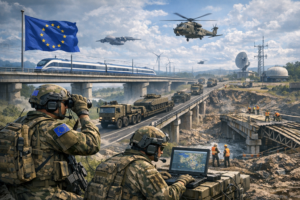
The Role of European Union Funding and Policy
The realization of an effective military mobility architecture requires immense capital investment. By 2026, the Connecting Europe Facility has become the primary vehicle for financing these dual use infrastructure improvements. This financial instrument allows the European Union to bridge the gap between national budgets and the large scale requirements of continental defense. The allocation of funds is prioritized based on the Trans European Transport Network, identifying corridors that are strategically significant for the rapid deployment of forces. This strategic prioritization has led to the modernization of critical nodes across Eastern and Central Europe, regions that serve as the frontline for potential security challenges. Member states have engaged in extensive collaboration to identify bottlenecks, such as low clearance tunnels, outdated rail tracks, and narrow bridge spans, and have systematically addressed them through collective funding initiatives. Beyond direct investment, the policy framework has evolved to encourage long term maintenance and modernization strategies. This includes the development of clear standards for weight, height, and cargo dimensions that must be met for new infrastructure projects to receive funding. This standardized approach prevents the creation of new logistical silos and ensures that the European transport grid acts as a cohesive whole rather than a collection of disconnected national segments.
Addressing Regulatory and Administrative Barriers
Infrastructure is only one half of the equation. Even the most robust bridge is useless if a military convoy is halted at a border by administrative red tape. Before 2026, the European Union faced a fragmented landscape of national transport rules that acted as significant deterrents to rapid movement. Every border crossing presented a potential logistical nightmare, with different documentation requirements, notification timelines, and vehicle standards. The European Union has made significant strides in simplifying these processes. By creating a unified notification system for military movements, the union has drastically reduced the time required to secure transit permissions. This digital transition allows for pre authorized movements along pre approved corridors, ensuring that troops and equipment can traverse the continent with minimal friction. This bureaucratic streamlining has been supported by the military mobility permanent structured cooperation project, which has fostered a high degree of trust and coordination among participating nations. Through regular exercises, member states test these new procedures under realistic conditions, identifying potential points of failure and adjusting their policies accordingly. The progress made in harmonizing these administrative procedures represents a monumental shift in how European nations view their internal borders, moving from a paradigm of sovereignty based caution to one of collective security based efficiency.
Geopolitical Context and Future Challenges
Despite the successes achieved by 2026, the journey toward total military mobility and infrastructure resilience remains fraught with challenges. The geopolitical context continues to shift, with new threats emerging from various directions. The vulnerability of maritime supply routes and the dependence on specific energy pipelines that often run parallel to critical transport nodes create new layers of risk. Moreover, the integration of new technologies, such as autonomous transport vehicles and drone monitoring systems, requires constant updates to the existing framework. There is also the persistent challenge of ensuring that member states remain committed to the long term maintenance of these investments. As domestic political priorities shift, the impetus to invest in defense related infrastructure can sometimes wane. The European Union must continue to maintain a high level of political will, ensuring that military mobility remains a top priority even in times of relative stability. Furthermore, the reliance on external supply chains for the components and raw materials needed for infrastructure repairs poses a long term strategic vulnerability. To mitigate this, there is a growing push for greater industrial autonomy within the European Union, encouraging the development of indigenous solutions for the maintenance and repair of critical transport systems. This ensures that the union is not reliant on third parties for the basic survival of its transport grid during a period of sustained conflict.
Conclusion
The pursuit of military mobility and infrastructure resilience in the European Union has become a defining characteristic of its security policy by 2026. Through a combination of strategic investment, regulatory harmonization, and a renewed focus on the physical requirements of modern warfare, the union has significantly bolstered its ability to project power and ensure collective defense. The shift toward dual use infrastructure reflects a pragmatic approach that maximizes efficiency while acknowledging the reality that civilian and military interests are inextricably linked in an era of complex threats. The progress made has not only enhanced the operational capabilities of member states but has also served as a powerful signal of unity and resolve to external actors. As the European Union continues to refine its logistical architecture, it must remain vigilant in addressing the emerging challenges of the digital age and the ongoing need for sustainable investment. The infrastructure of 2026 stands as a testament to the fact that while technology and strategy are vital, it is the tangible, ground level ability to move that ultimately secures peace and stability. The foundation laid during these years will undoubtedly shape the defense posture of Europe for decades to come, providing a robust framework capable of adapting to the unforeseen crises of the future. The integration of civil and military logistics has successfully turned the transport network into a strategic asset, proving that when the states of Europe act in concert, they can transform the physical reality of their continent into a formidable barrier against aggression. The ongoing commitment to this vision ensures that the union remains prepared to defend its sovereignty and its citizens in an increasingly unpredictable world.
Bibliography
- European Commission. Action Plan on Military Mobility 2.0. Brussels: European Commission, 2022.
- European Defence Agency. Military Mobility: Strategic Progress Report. Brussels: EDA, 2025.
- European Court of Auditors. Transport Infrastructure for Military Mobility: Gaps and Readiness in the TEN‑T Network. Luxembourg: ECA, 2024.
- Deterrence and Defence in the Euro‑Atlantic Area. Brussels: NATO Publications, 2023.
- European Parliament. Dual‑Use Transport Infrastructure and EU Security Policy. Brussels: Policy Department for External Relations, 2025.
- Council of the European Union. PESCO Military Mobility Project: Implementation Overview. Brussels: Council Secretariat, 2024.
- ENISA – European Union Agency for Cybersecurity. Cybersecurity of Transport and Logistics Infrastructure in the EU. Athens: ENISA, 2025.
- European Investment Bank. Financing Resilient and Strategic Transport Corridors in Europe. Luxembourg: EIB, 2025.
References:
https://journals.sagepub.com/doi/10.1177/1781685818764813
https://www.sciencedirect.com/science/article/pii/S2210539524000038
https://www.suerf.org/publications/suerf-policy-notes-and-briefs/europe-in-the-new-nato-era/
https://www.epc.eu/publication/eu-defence-series-military-mobility-a-critical-enabler/
https://www.europeanproceedings.com/article/10.15405/epsbs.2022.12.02.2
https://scienceij.com/index.php/sij/article/view/387
https://pmc.ncbi.nlm.nih.gov/articles/PMC11790481/
https://www.researchgate.net/publication/400188309_Military_Mobility_as_a_Challenge_for_Europe
https://www.researchgate.net/publication/400188309_Military_Mobility_as_a_Challenge_for_Europe
https://cepa.org/comprehensive-reports/the-cepa-military-mobility-project/