
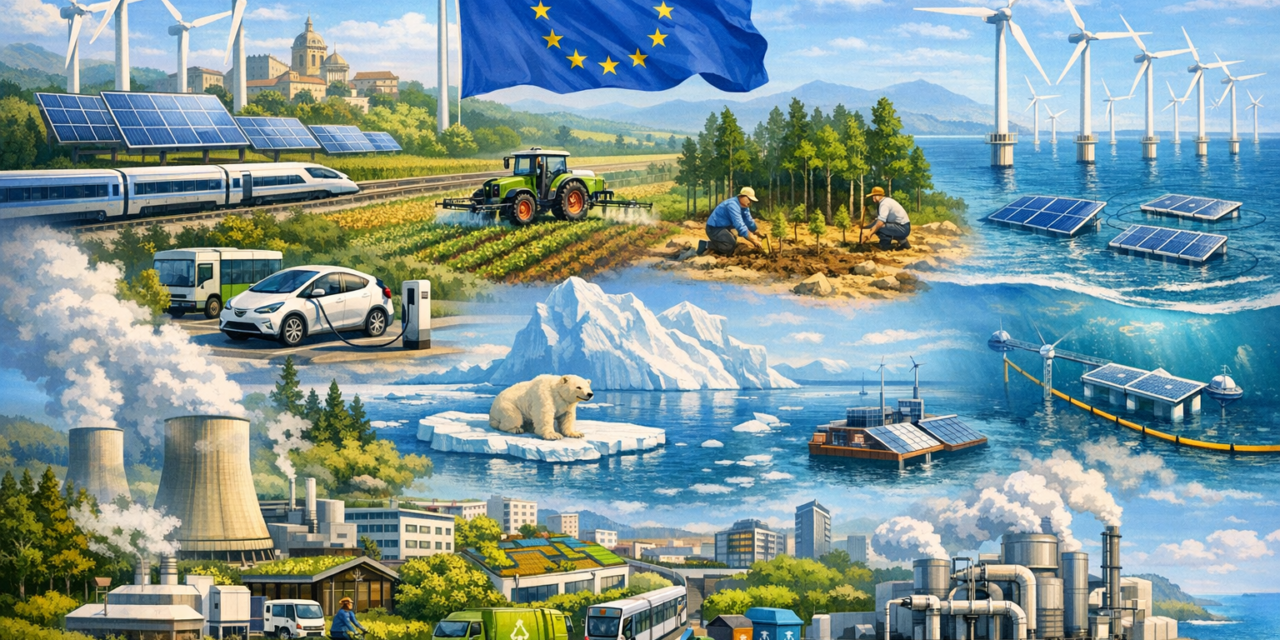
The Eurpean Union stands at a critical juncture in its commitment to combating climate change. By 2026, the urgency of the climate crisis, underscored by increasingly severe weather events across the continent and globally, necessitates robust and accelerated action. The bloc’s foundational strategy, the European Green Deal, has matured into a comprehensive legislative framework aimed at achieving climate neutrality by 2050. In 2026, the focus is shifting from merely setting targets to rigorously implementing and enforcing these ambitious policies across all member states. This essay will detail ten significant ways the European Union is addressing climate change in 2026, ranging from legislative mechanisms and energy transition milestones to innovative financial tools and international leadership roles. These ten approaches collectively illustrate a multifaceted strategy designed to decarbonize the economy while ensuring a just and resilient transition for all Europeans.
- Full Implementation of the ‘Fit for 55’ Package
By 2026, the European Union is deeply engaged in the operational phase of the revised ‘Fit for 55’ legislative package. This set of proposals, central to the 2030 emissions reduction target of at least 55 percent below 1990 levels, has transitioned from political agreement to national transposition and enforcement. Key components being aggressively implemented include updated directives on Renewable Energy Sources (RED III), requiring a mandatory renewable share across the economy and specific sectoral targets. Furthermore, the enforcement mechanisms for the revised Effort Sharing Regulation (ESR) are fully active, placing legally binding annual emission reduction targets on member states for sectors not covered by the EU Emissions Trading System, such as transport, buildings, and agriculture. The success of the 2026 climate strategy heavily relies on the rigorous monitoring and compliance reporting mandated under this package.
- The Expansion and Tightening of the EU Emissions Trading System (ETS)
The EU ETS, the cornerstone of the EU’s carbon pricing mechanism, continues to evolve significantly in 2026. The system has been expanded to cover maritime transport, and critically, the new separate ETS 2 for buildings and road transport is fully operational. This dual-ETS approach subjects a far broader swathe of the economy to carbon costs. Furthermore, the Market Stability Reserve (MSR) adjustments ensure that the supply of allowances remains tight, driving carbon prices upward. In 2026, this higher, more predictable carbon price acts as a powerful incentive for heavy industry, such as steel and cement producers, to deploy nascent zero-emission technologies like green hydrogen, thereby accelerating structural industrial transformation.
- Decarbonization of Heating and Transport via ETS 2 and Social Climate Fund
The introduction of ETS 2 addresses the highly politically sensitive areas of heating and road transport fuels. Recognizing the potential for energy poverty, the EU has simultaneously activated the Social Climate Fund (SCF) in 2026. This fund, financed by revenues generated from ETS 2, is essential for ensuring a socially equitable transition. Member states are actively deploying SCF resources to support vulnerable households through direct income support, energy efficiency renovations in residential buildings, and investments in zero-emission mobility infrastructure, such as public transport and charging stations, mitigating the regressive impact of carbon pricing on lower-income groups.
- Massive Scaling Up of Renewable Energy Deployment
2026 marks a critical year for reaching renewable energy deployment milestones established under RED III. The focus is on streamlining permitting procedures for solar and wind projects, which had previously acted as a major bottleneck. The EU has pushed for the designation of “Go-to Areas” where permitting is fast-tracked, aiming to unlock significant gigawatts of new capacity. Moreover, substantial EU cohesion funds and the Recovery and Resilience Facility (RRF) grants are channeled directly into grid modernization and energy storage projects necessary to handle the increased intermittency of a system heavily reliant on solar and wind power.
- Implementation of the Carbon Border Adjustment Mechanism (CBAM) in Full Effect
The Carbon Border Adjustment Mechanism (CBAM) moves beyond its transitional reporting phase in 2026 to its definitive implementation phase for covered sectors, including iron and steel, cement, aluminum, fertilizers, and electricity. This mechanism requires importers to purchase certificates corresponding to the carbon price that would have been paid if the goods had been produced under the EU’s carbon pricing rules. In 2026, CBAM is fulfilling its dual role: preventing carbon leakage by ensuring European industry remains competitive against producers facing less stringent climate policies elsewhere, and simultaneously encouraging global trading partners to raise their own climate ambition to avoid EU tariffs.
- Mobilization of Green Finance Through the EU Taxonomy
The EU Taxonomy for sustainable activities, functioning as a standardized dictionary for what constitutes environmentally sustainable economic activity, is proving increasingly influential in 2026. Financial institutions are mandated to disclose their alignment with the Taxonomy. This clarity is vital for channeling private capital away from high-carbon investments and toward genuine green projects, such as sustainable infrastructure and climate adaptation technologies. Furthermore, the regulatory pressure encourages corporations to embed climate risk analysis into their core business strategies, driven by both financial regulation and investor demand for transparency.
- Advancing the Hydrogen Strategy and Infrastructure
By 2026, the focus of the EU Hydrogen Strategy has shifted toward scaling up the production and use of renewable (green) hydrogen, primarily for hard-to-abate sectors like heavy industry and long-haul transport. Significant progress is evident in the development of transnational hydrogen backbone infrastructure. Projects supported by the Connecting Europe Facility (CEF) are moving from planning to active construction, creating necessary pipelines and import terminals. The regulation surrounding renewable and low-carbon hydrogen guarantees supports the creation of a secure, cross-border market essential for decarbonizing European heavy industry.
- Enhancing Climate Resilience and Adaptation Strategies
While mitigation remains paramount, the EU recognizes the inevitability of further warming and is strengthening its focus on adaptation. In 2026, member states are submitting updated National Adaptation Strategies, often supported by EU funding mechanisms that prioritize climate proofing critical infrastructure, such as coastal defenses, water management systems, and agricultural land against increasingly frequent heatwaves and floods. A key development is the increased use of European climate data and modeling tools provided by the European Environment Agency (EEA) to inform local and regional adaptation planning with high precision.
- Phasing Out Fossil Fuel Subsidies and Promoting Energy Efficiency
A sustained political effort in 2026 is dedicated to the complete removal of environmentally harmful subsidies, particularly those pertaining to fossil fuels. Simultaneously, the revised Energy Efficiency Directive (EED) drives aggressive action on the demand side. This includes setting stricter binding annual energy efficiency improvement targets for member states, focusing particularly on public sector buildings, which must lead by example through deep renovation mandates. The emphasis is not just on installing renewables but fundamentally reducing overall energy demand across the continent.
- Climate Diplomacy and International Leadership
The European Union continues to leverage its economic and diplomatic weight in 2026 to push for global climate ambition. Through its role as a major trading bloc, the EU champions high ambition in international forums like the UNFCCC process. The operationalization of CBAM serves as a major diplomatic tool, signaling that access to the EU market is increasingly contingent upon environmental performance. Furthermore, significant financial and technical assistance is provided to developing nations through mechanisms like the Global Gateway initiative, aimed at supporting their clean energy transitions and fostering global alignment with the Paris Agreement goals.
Conclusion
In 2026, the European Union’s approach to climate change is characterized by comprehensive integration, regulatory enforcement, and significant financial mobilization. The ten discussed pathways demonstrate a mature policy architecture where mitigation efforts (ETS, Fit for 55) are reinforced by economic levers (CBAM, Taxonomy) and social considerations (SCF). The transition is systemic, touching energy production, industrial output, transport, building renovation, and international trade. While challenges remain in ensuring uniform implementation across all 27 member states and securing the pace of necessary infrastructure buildout, the EU’s commitment, enshrined in law and backed by substantial funding streams, positions it as the leading global entity actively working to meet the critical climate imperatives of this decade. The year 2026 is less about setting new goals and more about delivering on the complex, interconnected framework already established to secure a climate-neutral future.
Bibliography
- European Commission. European Green Deal. Brussels: European Commission, 2019.
- European Commission. Fit for 55 Package. Brussels: European Commission, 2021–2024.
- European Commission. EU Emissions Trading System (EU ETS) – Revision for 2026 Implementation. Brussels: European Commission, 2023.
- European Commission. Carbon Border Adjustment Mechanism (CBAM) Regulation. Brussels: European Commission, 2023.
- European Commission. EU Taxonomy for Sustainable Activities. Brussels: European Commission, 2020–2024.
- European Parliament and Council. European Climate Law (Regulation (EU) 2021/1119). Brussels, 2021.
- European Commission. Social Climate Fund Regulation. Brussels: European Commission, 2022.
- European Investment Bank. Climate Bank Roadmap 2021–2025. Luxembourg: EIB, 2020.
- European Environment Agency. Trends and Projections in Europe 2025. Copenhagen: EEA, 2025.
References:
https://www.frontiersin.org/journals/political-science/articles/10.3389/fpos.2026.1732679/full
https://sdg-action.org/is-the-european-green-deals-vision-still-intact/
https://rnseria.com/article/556722/en
https://www.nature.com/articles/s44168-025-00319-1
https://www.nature.com/articles/s44168-025-00319-1
https://ije-pyc.org/IJE/article/view/285
https://www.sciencedirect.com/science/article/pii/S2211467X25003116
https://link.springer.com/article/10.1007/s11615-026-00650-0
https://www.sciencedirect.com/science/article/abs/pii/S0301421525003994
https://www.tandfonline.com/doi/full/10.1080/1523908X.2026.2614540
https://www.mdpi.com/1996-1073/16/6/2764
https://iopscience.iop.org/article/10.1088/1748-9326/ad5743
https://www.sciencedirect.com/science/article/pii/S2212095524004474
