Progress to integration: 1. new initiatives
The 1970s and early 1980s were in many respects a dismal era for the Community, because of the combination of economic stagnation and the preoccupation with Britain’s budgetary difficulties. Yet this period was not without positive initiatives. One of the first was the signing in 1975 of the Lomé Agreement, which introduced a programme of development assistance and trade preferences for many African, Caribbean and Pacific (ACP) countries.
In 1976, the Belgian Leo Tindemans produced a report entitled The High Road to European Union, in which he argued for a common foreign policy; moves to develop a monetary and economic policy; and reform of the institutions including a provision for direct elections to the European Parliament. The proposals had little immediate effect, for in the mid-1970s European leaders were preoccupied with the aftermath of the oil crisis and this had prevented any creative thinking about the future. The one important change that occurred in line with the Tindemans paper was the introduction of direct elections to the Strasbourg Parliament in 1979, a move towards greater democracy in a Community not known for carrying the peoples of Europe along with it.
In other respects too, 1979 was a significant year for the Community. As we have seen, it saw the return of the Thatcher administration which was to have a major impact on relations between Britain and Europe. Also in that year, the European Monetary System (EMS) came into operation. With an Exchange Rate Mechanism intended to regulate currency fluctuations at its core, the formation of the EMS represented the first step in a process intended to lead to a single currency and economic and monetary union.
Within a couple of years of the first direct elections, Parliament established a Committee on Institutional Questions with the purpose of drafting proposals for a European Union. It was chaired by Altiero Spinelli, the longtime federalist and past commissioner. He was keen to see definite progress to closer integration.
The European Parliament accepted his report and in February 1984 voted overwhelmingly in favour of the Draft Treaty establishing the European Union.
In the early 1980s, Community enthusiasts in the Commission and the most supportive member states were also beginning to contemplate bold initiatives. Inevitably there were divergent views as to how the EC should develop. The Germans and the Italians were especially active in devising plans to carry the EC forward into a closer union with more distinctive political objectives.
The attempt to do so at a rapid pace had received a setback with the failure of the EDC, and thereafter it was apparent to most politicians and diplomats involved that progress would be made via economic cooperation. Yet whenever there was the opportunity to advance the cause of integration there were some statesmen only too willing to seize their chance. This could be done by extending the powers of the European Parliament in the budgetary area, as had happened in 1970 and 1975. However, there were plans afoot for more substantial changes.
By the middle of the 1980s, the future of the Community was under serious consideration. After nearly a decade and a half of stagnation (eurosclerosis), the issues of monetary, economic and political union came once more to the fore.
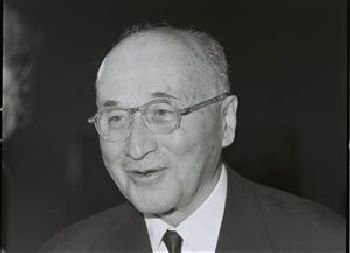
The breakthrough came with the assumption of the presidency of the Commission by Jacques Delors and the agreement on the content of a Single European Act in the second half of 1985. The Delors presidency and the SEA between them generated momentum not only for the creation of the internal market but also for the moves to closer cooperation to be resolved at Maastricht in December 1991.
Progress to integration: 2. the Single European Act (SEA) and its aftermath
The original concept of the European Economic Community was that there should be a common market: a free-trade area without any restraints to trade.
The idea of a unitary market governed by a single set of rules was set out in Article 2 of the Treaty of Rome, which read:
The Community shall have as its task, by establishing a common market and progressively approximating the economic policies of the Member States, to promote throughout the Community a harmonious development of economic activities, a continuous and balanced expansion, an increase in stability, an accelerated raising of the standard of living and closer relations between the States belonging to it.
The language employed in Article 2 illustrates the high expectations of the benefits that might flow from such a common approach. Yet by the early 1980s, there remained some regulations and barriers that had never been eliminated and others had developed as the Community expanded.
By the mid-1980s, discussion of the merits of a single internal market had been in the air for a few years. The idea had strong support from many businessmen and from some national political leaders and members of the Commission.
The driving force who gave the proposal a higher priority was Jacques Delors. He recognised that the Community was in need of a bold and imaginative idea which would focus its energies and impart a new sense of direction.
Under Delors’ leadership, the Commission produced a White Paper in 1985 on the completion of the single market, written by the new commissioner for trade, Lord Cockfield, a Thatcherite appointee. Cockfield and his team were given the task of working out what measures would be needed to enable the single market to be ready for the date for its introduction set by the European Council. He identified nearly 300 legislative measures that would be necessary if physical barriers (e.g. concerned with frontiers), technical barriers (concerned with product standards) and fiscal barriers (concerned with differing rates of duty and VAT) were to be overcome.
Cockfield was never in doubt about the political importance of the single market. As was explained in the concluding section of the White Paper: Europe stands at the crossroads. We either go ahead – with resolution and determination – or we drop back into mediocrity. We can now either resolve to complete the integration of the economies of Europe; or, through a lack of political will to face the immense problems involved, we can simply allow Europe to develop into no more than a free trade area.
Importance of the SEA
The changes urged by the White Paper were embodied in the Single European Act. Before it could be implemented, the SEA required the agreement of each member country and had to be formally ratified in all of the national legislatures, because it amended the Treaty of Rome. Margaret Thatcher felt able to go along with the measure, for her Conservative government had a very market-oriented approach to economic policy. Her ministers had worked for open trading conditions and had since 1979 allowed the free movement of currency into and out of Britain. There was some opposition in Parliament to the measure, not least among the Labour Party, which had yet to embrace the European cause with any enthusiasm. There was an initial threat of a rebellion in the House of Lords, for as in other countries, there was some unease about the loss of sovereignty involved. Because of these constitutional implications, Denmark and Ireland held referendums prior to ratification.
The passage of the SEA greatly extended the scope of the Community. The Act provided for the completion of the single market by the end of 1992. What this meant was that all technical, physical and fiscal barriers to intra-Community trade were to be eliminated, as were all barriers to the free provision of professional and other services. The Act became effective from mid-1987.
In signing the Single European Act, the Twelve committed themselves to move towards monetary union, a goal to be progressively realised. The phrase is to be found in the Preamble, rather than in the main legally binding clauses of the Act. As part of the main text, there was – in addition to details of the operation of the single market – a commitment to lessen disparities between the richer and poorer areas of the Community (known as the policy of ‘cohesion’); an obligation to allocate more resources to the ‘structural funds’ for regional and social expenditure; provision for closer cooperation in the area of foreign policy and security; and an acknowledgement of the need to work for environmental improvement.
The Single European Act and the single market
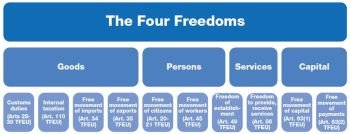
The purpose of the Single European Act was to create a single internal market among the Twelve by the end of 1992. This would fulfill the original version of a tariff-free trading area without obstacles to the free movement of goods, services and capital.
Among other things, this involved:
1. The creation of a single market for services such as banking, insurance, credit and securities
2. The creation of a single legal framework for business
3. The standardization of differing national technical requirements for products
4. The gradual harmonization of indirect taxes so as to remove the need for tax adjustments at the border
5. The easing of restrictions on living and working in another member state, with mutually recognized qualifications and diplomas.
The Objectives and Principles of the Treaty of Rome were amended by the new Act. The Preamble agreed by the High Contracting Parties set out the new version:
Determined to lay the foundations of an ever closer union among the peoples of Europe. Resolved to ensure the economic and social progress of their countries.
Four main innovations in Community procedure were agreed:
1. The extent of majority voting was widened so that unanimity was required only for sensitive issues on which there were strong national interests.
2. Matters concerning aspects of energy, environmental, research/technological and social policy were brought within the authority of the EC.
3. A new decision-making procedure was introduced. For matters concerned with the single market there was in future to be a ‘cooperation procedure’ which would allow the Parliament a greater say in the development of policy.
4. Parliament gained two important new rights – to give or withhold assent when asked by the Council for its view on the entry of new members into the Community and when agreements were made for association status with the EC.
The single-market programme was a success. The target date was met, business and commercial leaders responding positively to the challenge of gearing their operations to fulfil the new requirements. As countries prepared for the implementation of the 1992 arrangements, the Community attained a high level of popularity. As Bomberg and Stubb7 put it, ‘1992 unleashed a wave of Europhoria’.
Work left undone
There was inevitably disappointment with the SEA among those Europeans who wanted to hasten the pace to integration, for it was a compromise. Some member states were not too keen to see any further moves, whilst others wanted to see faster progress. All could agree on the desirability of this one measure, but there was doubt about what would follow. Enthusiasts for a more federal Europe were keen to see the Community develop more boldly, and for a combination of reasons, both internal and external, the period from the mid-1980s onwards was to witness a burst of euro-activity along the lines they wished to see.
Several issues had not been finally resolved by the new Act, although some partial steps had been taken. In the Preamble, there was the reference to economic and monetary union as a desirable goal. Several integrationists felt that such a policy – and in particular a single European currency – would be a useful adjunct to a single market and would allow it to work more effectively. There was mention (in a new Article 102a made part of the Treaty of Rome) of the possibility of a new intergovernmental conference to achieve any necessary changes in this field. Such a possibility was also mentioned in Article 30(12), a part of the
Act dealing with political union.
Others were more concerned with the possible side effects of deregulation. In a free market, the weakest peoples and the weakest countries might suffer – hence the need for cohesion to protect the interests of the ailing regions. But what about the peoples of Europe whose livelihood could be adversely affected by the absence of controls? Did not the SEA need to be accompanied by social measures to protect the living and working standards of the member states?
Again, there was the worrying question about the possibility – if frontier controls were abolished on travelers – that ‘undesirables’ might be able to move freely throughout the Community. Drug-trafficking, international crime and terrorism were potential growth areas and in addition there was the fear of an influx of Eastern European migrants entering into the EC who might then find a safe haven in one of the member states.
Institutional reform had not been addressed, with many issues in need of attention. The role of the Parliament had been enhanced, but other than increasing the powers of an elected body nothing had been done to tackle the ‘democratic deficit’ in the decision-making process. Lack of accountability was seen as a major weakness, and both supporters and critics of the EC could agree that there was an absence of effective democratic control over the work of the Commission.
Outside the Community, the face of Europe was undergoing dramatic change by the late 1980s. The fall of the Berlin Wall and the subsequent reunification of Germany created a country of such a size and potential strength that it could dominate the continent if it was not fully ‘locked in’ to the EC. To the East, communism was collapsing in many countries of the old Soviet bloc. By 1991, the USSR itself was to be no longer in existence.