A Brief Summary of the history of European Union enlargement
From Community to Union, 1973–1993
By the end of the Gaullist era, the European Community was an established economic success. Political progress was less obvious. However, there was a key development at the beginning of the period covered in these texts. This was the First Enlargement, which was to be followed by two further ones within the next decade or so.
We shall see that in many respects, the 1970s were a dismal decade in the history of the Community, an era often referred to as one of eurosclerosis. Economic recession, the British accession and in particular the election of the Thatcher government all posed problems. But once the budgetary problems of the early 1980s were resolved, the Community was ready to move forward once again. The impact of the Delors initiatives on the process of integration was to be considerable. By the end of our period, the EC had become the European Union.
The years up until the early 1970s were good ones for the Six. Europe was peaceful and business was thriving. Since then, things have been more problematic, with periods of tension and difficulty alternating with periods of creative activity.
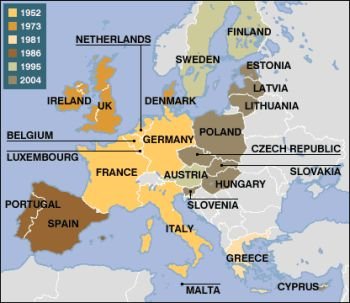
The period covered in these texts begins with the First Enlargement, which took place in 1973 and increased membership of the Community from six to nine members. By the end of the period, the Union was on the verge of becoming the Fifteen.
Further enlargement
Greece had long hoped to become a member of the EEC and in the early I960s had made an Association Agreement. Any chance of full membership received a serious setback in 1967 when a military junta seized power and began what became known as the Rule of the Colonels. The Community froze the Agreement for the period in which democracy was suspended. When the Colonels were brought down in 1974, the Agreement was reactivated and within a year the new government applied for full membership. Member states were keen to encourage the democratic regime. Accordingly, in 1979 Greece signed the Accession Treaty and entered the EC two years later. With this Second Enlargement, there was now a community of the Ten.
Spain and Portugal were also unacceptable as members of the Community as long as they had authoritarian regimes. Both disappeared in the mid-seventies and the EC was keen to recognize the new situation and in so doing extend its influence in the Mediterranean region. The negotiations took much longer to conclude than they had done with other countries, so that although applications were made in 1977 they were not able to become members until January 1986. This was mainly because of internal problems within the EC, which for several years in the early 1980s was preoccupied with consideration of its own budgetary arrangements. As a result of the accession of two new members, this Third Enlargement increased the Community to twelve. There was a modest setback to the process of enlargement when Greenland, a Danish territory, voted to leave the Community in a referendum held in 1982. Greenlanders were unhappy about the application of EC fisheries policy and felt remote from the Brussels bureaucracy. The territory officially left in January 1985.
Inevitably enlargement was bound to transform the character of the Community. This made it necessary to review the methods by which it conducted its business. It was also important to ensure that measures were taken to improve the position of less developed states, so that they would not become a permanent drain upon the EC budget. Living standards varied considerably. Of the Twelve, some were clearly more economically successful than others. Luxembourg, Germany, Denmark, France, Belgium and Holland had the highest average incomes per head, then came Britain and Italy, followed by Spain, with Ireland, Greece and Portugal at the bottom.
Division and stagnation
The widening of membership in the First Enlargement coincided with the energy crisis and a developing recession in the Western world. In October 1973, the Organization of the Petroleum Exporting Countries (OPEC) quadrupled the price of crude oil. The EEC, which imported 63 per cent of its energy requirements, was badly hit. In its reaction to the oil crisis, it was torn by schism, as individual countries began to make separate deals with Arab states. There was little sense of a Community interest, but rather a situation in which members thought primarily in terms of defending their national position. This was to be the pattern of the 1970s and early 1980s, which saw a number of internal disagreements.
The late 1970s and early 1980s were a period of stagnation and disappointment for those anxious to promote closer European cooperation. There was little sign of progress towards integration, so that in 1983, in a skeptical analysis of European decision-making, Paul Taylor could write that ‘the challenges to sovereignty were successfully resisted, and the central institutions failed to obtain the qualities of supranationalism’. The Economist was gloomier, its cover for an edition in March 1982 showing a tombstone on which were inscribed the words: ‘EEC born March 25th, 1957, moribund March 25th, 1982, capax imperii nisi imperasset’ (‘It seemed capable of power until it tried to wield it’).
Budgetary problems
A new Conservative government took over in Britain in 1979, led by Margaret Thatcher. The question of Britain’s contribution to the European budget arose at her first European Council meeting (Dublin, November 1979) and thereafter dominated discussions in the Council for five years, much to the despair of the Commission and its British president, Roy Jenkins, and of the other members of the EEC. The issue was known in Brussels as ‘the BBQ’ which, according to Jenkins, meant ‘the British Budgetary Question’, but was more usually referred to as ‘the Bloody British Question’.
The point was that, despite economic difficulties, Britain was making net contributions to Community funds quite as large as those being paid by Germany. Overall, it was paying into the EC vastly more than it got out of it. At the time, nearly three-quarters of the EC budget was being used to support agriculture.
Britain did not greatly benefit from this, for its agriculture was smaller and more efficient than that in most of Europe. Payments to Britain out of CAP funds were comparatively so low that British taxpayers were heavily subsidizing inefficient farmers in France. To make matters worse, EEC rules forced Britain, which imported more food from outside the Community than the others, to pay a much higher import levy than they did. What would have helped Britain was assistance for its ailing regions and for the modernization of traditional industries. But compared to the 74 per cent of the Community budget spent on farming, only 4 per cent was spent on the Regional Fund whose purpose was to make grants to areas of low income, chronic unemployment or declining population.
Mrs Thatcher presented her demand for a £1m reduction in the British contribution to the Dublin Summit. She rejected the offer of one-third of that sum out of hand. At this point she succeeded in shocking both her European colleagues and her own advisers, with constant demands for what she called ‘her money’. She made it clear that the sum she wanted was not negotiable and she would do no deals. She accused other European states of the outright theft of British money, an accusation that horrified Foreign Office advisers who knew the rules of the European game. Under those ‘rules’, negotiations would improve on the £350m offered by a potential deal on oil, or fishing rights, or the price of lamb. However, there was to be no deal. Experienced negotiators were lost in what for them was an unprecedented situation.
Among Britain’s partners there were many who, while originally sympathetic, were subsequently alienated by the prime minister’s behavior. As Jenkins said, ‘on the merits Mrs Thatcher had right broadly on her side although she showed little sense of proportion, some of her favorite arguments were invalid and her tactical sense was as weak as her courage was strong’. Thatcher continued to demand her money throughout dinner and after. The Europeans retaliated: Giscard ignored her, Schmidt pretended that he was asleep and Jorgensen, the Danish prime minister, shouted insults. The complete breakdown of the Council was only prevented by postponing a decision on the BBQ until the next year.
That Dublin meeting set the tone for Britain’s relationship with Europe throughout the Thatcher years. Her behavior was deplored by the other Community members and indeed, at one point led French Prime Minister Jacques Chirac to call for Britain’s expulsion from the Community. The issue dragged on over several Council meetings, against a background of much behind-the-scenes work by Foreign Office officials. Eventually, it was resolved at the Fontainebleau Summit (June 1984). An eleventh-hour agreement was reached, by which Britain would receive a permanent rebate worth 66 per cent of the difference between what it paid into the Community and the amount it got back. The same agreement increased Community resources by raising the levy on VAT from 1 per cent to 1.4 per cent. The matter was finally settled after five years; Britain could be said to have ‘won’ and indeed was said to have ‘obtained much more than was reasonable’. The agreement, however, was only achieved at considerable cost to future relations between Britain and Europe.
The insistent demands made by Mrs. Thatcher, and her domineering and insulting treatment of her supposed partners, had at times almost turned Britain into a pariah in European circles.
The disagreement over the ‘budgetary imbalance’ used up an enormous amount of EC time, being endlessly discussed in gatherings of the Council of Ministers and in the European Council. Everything else assumed secondary importance, so that the questions of enlargement and of the future shape of the Community never received the attention which many statesmen wished to give them.