THE COLD WAR – From World War to Cold War
POSTWAR WESTERN EUROPE
By 1949, Berlin was divided, Germany was divided, and Europe was divided-into East and West, communist and noncommunist. Both halves of the Continent faced enormous problems of postwar recovery. The wartime damage, both human and material, had been enormous, and virtually all countries suffered economic collapse and political instability.
These problems were compounded by territorial changes and the largest population movements in history up to that time. The largest population transfers were caused by the shifting of Poland’s borders about one hundred miles to the west, thus vacating territory in the east that Poland had taken from the Soviet Union after World War I and compensating Poland with German territory to the west. Some nine million Germans were forced out of Poland’s new western territories and into Germany, and some two to three million Poles migrated from the east (now part of Soviet Ukraine) into Poland, many of them moving into the homes and farms left behind by the fleeing Germans in the west. Millions of other Germans fled the Sudetenland part of Czechoslovakia into the Western or Soviet zones of Germany. The new German governments had to cope with all of these refugees, as well as with millions of other displaced persons, including the survivors of Nazi concentration camps.
Given the economic and social chaos of the immediate postwar period, the speed of recovery in Western Europe was remarkable. Almost every Western country quickly resumed democratic politics; only Spain and Portugal remained under dictatorships until the 1970s. Parliamentary elections in Britain in 1945 ousted Winston Churchill and the Conservative Party and voted in a Labour government committed to democratic socialism and the modern welfare state. France wrote yet another constitution and inaugurated the Fourth Republic, with socialists and communists winning the most seats in the first elections. The Italians abolished the monarchy and wrote a new constitution for a parliamentary republic.
In that country, too, the Communist Party did well in elections, regularly winning the second-largest number of seats in Parliament but always excluded from any of the coalition governments. The strong showing of communist and socialist parties in these countries worried some people, given what was happening in Eastern Europe, but these parties were part of a democratic political process in England, France, Italy, and elsewhere and never threatened democratic institutions.
Economic recovery was also swift and sustained in Western Europe. Most countries had achieved prewar levels of industrial production by 1947, and U.S. Marshall Plan funds helped stimulate the recovery. Over the next twenty-five years, the region experienced an “economic miracle” of unprecedented and uninterrupted economic growth, fueling rising living standards and widespread prosperity. Germany played a key role in this growth, becoming the leading industrial country in Western Europe by 1958. Economic policy was governed by the theories of the British economist John Maynard Keynes (1883-1946), who had published an influential book in 1936, The General Theory of Employment, Interest and Money. Keynes had argued that government planning and spending was often necessary to “prime the pump” of the capitalist economy, particularly in difficult economic times. In the 1950s and 1960s, European governments used their fiscal and monetary powers to promote investment, production, and employment and to control inflation. These policies, in combination with the strong role of democratic socialist parties on the Continent, contributed to the development of strong welfare states, with nearly full employment, social security, subsidized or free health care and education, and the redistribution of wealth through progressive tax systems. In some ways, by the 1970s, the nations of Western Europe had achieved the goals of Karl Marx, but without Marxism. Equality between men and women steadily expanded throughout the region, prompted by a new wave of feminism and increasingly reinforced by the European Union.
The combination of decolonization and Cold War tensions rendered the European states more dependent on each other and on the United States for both national security and trade. As noted above, the NATO alliance, signed in 1949 by the United States, Canada, Britain, and most Western European countries, obligated the United States to defend the European member states and provided a U.S. “nuclear umbrella” over Europe.
Washington’s commitment was made real and visible to both Europe and Moscow by the permanent stationing of U.S. troops in several European countries, including, eventually, three hundred thousand in Germany. These were seen as a “trip wire” that would trigger a larger (and perhaps nuclear) response from the United States if the Soviet Union ever attacked Western Europe.
Europe also embarked, after the war, on a major project of economic integration and community building. The first steps in this direction came from French foreign minister Robert Schuman, who in 1950 proposed an international organization to coordinate the iron and steel industries, particularly between France and Germany. Schuman’s primary intent was to achieve reconciliation between these two countries after they had fought three wars against each other in the previous seventy-five years.
He also saw it as “a first step in the federation of Europe.” Out of this was born the European Coal and Steel Community (ECSC) in 1951, which was so successful at promoting trade and cooperation that its principles were extended to the entire economy in 1957 with the establishment of the European Economic Community (EEC), which itself evolved into the European Union. Over the years, the membership of these organizations grew from the original six to twenty-seven, including some former communist states.
EASTERN EUROPE AFTER THE WAR
During and after World War II, eleven European countries with one hundred million people came under communist rule. Moscow seized Latvia, Lithuania, and Estonia during the war and incorporated them into the USSR. Yugoslavia and Albania (neither one adjacent to Soviet territory) adopted communism but pursued their own paths more-or-less independently of Moscow. Poland, East Germany, Czechoslovakia, Hungary, Bulgaria, and Romania were gradually converted into “people’s democracies” with political leaders subservient to Moscow and Soviet-style political and economic institutions. A series of purges between 1948 and 1952 removed any Eastern European Communist Party leaders whom Moscow considered too nationalistic.
The policies of the communist regimes had both benevolent and oppressive elements. At first, the new governments seized most of the large landed estates and redistributed the property to ordinary peasants and farmers, a policy that fostered considerable goodwill toward the regimes.
They also initiated socialist social policies of subsidized housing, health care, education, and guaranteed employment, which were also popular. On the other hand, the communist governments adopted the restrictive apparatus of the Soviet state: an increasingly powerful secret police; restrictions on independent organizations, media, and foreign travel; and censorship. Except in Poland, most churches were destroyed or shut down.
Economically, each of the Eastern European states pursued the twin policies of rapid industrialization and collectivization of agriculture (the linchpins of Stalin’s first five-year plan begun in the Soviet Union in 1928). Many farmers who had only recently been given land by the government resisted collectivization, but the consequences were not nearly as horrendous as they had been in the Soviet Union twenty years earlier. In economic policy, as in the Soviet Union, emphasis was placed on heavy industry (such as metallurgy and machine tools) at the expense of light industry and consumer goods. Government agencies planned investments, output, and distribution and fixed prices and wages. Virtually all workers in agriculture, industry, or service became employees of the state.
Soviet influence over the region was reinforced by a common foreign policy of socialist internationalism and a number of international organizations that tied the region together and insured conformity. Partly in response to the U.S. Marshall Plan, Moscow sponsored the Council for Mutual Economic Assistance (CMEA, or Comecon) to coordinate trade among the European communist states and tie them more closely together economically. After West Germany joined NATO in 1955, the Soviets responded with the creation of an Eastern European military alliance, the Warsaw Treaty Organization (or the Warsaw Pact). The Soviet Union placed troops and nuclear weapons in Warsaw Pact states (especially East Germany), just as the United States did in NATO countries. With the establishment of these organizations, the Eastern European states became increasingly cut off from the rest of Europe.
Churchill’s statement about the Iron Curtain dividing Europe was even truer in 1955 than it had been in 1946. From the end of the war through the 1960s, all of the Eastern European states experienced high degrees of economic growth and rapid social changes. All except Albania were transformed from primarily rural, agricultural societies to industrial, urban ones. Average annual growth rates of gross national product for the region were over 7 percent in the 1950s and over 5 percent in the 1960s, even faster than such growth rates in Western Europe. Literacy, health, and living standards improved dramatically for most people in the region.
Despite these accomplishments, there was much restiveness in Eastern Europe. The countries were under the thumb of Moscow and limited in their sovereignty, and their citizens were restricted in their freedoms of speech, press, assembly, religion, and travel. Almost from the beginning, there were demonstrations, riots, or strikes against communism or against the Soviet Union, but the army or the police put them all down, sometimes with assistance from Moscow. Not until 1985, with the accession of Mikhail Gorbachev to the leadership of the Soviet Union, did Moscow begin to loosen the reins of control in Eastern Europe. When Gorbachev did so, the whole system began to unravel.
FROM COLD WAR TO PERESTROIKA
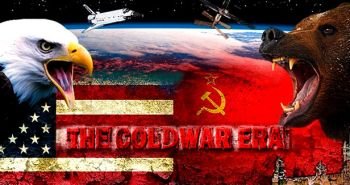
The end of World War II resulted in the division of Europe, the controlling presence of the United States and the Soviet Union, and the increasing domination of world politics by these two superpowers and ideological enemies. In some ways, this was a strange turn of events, when a close wartime alliance between these two countries had brought Nazi Germany to its knees. But a history of distrust and suspicion had existed between the United States and the Soviet Union dating from the beginning of the communist state, and hard-nosed realists like Winston Churchill had fully expected tensions to reemerge after the war. The United States had always been suspicious about the intentions of Lenin and Stalin and the Universalist goals of communism. The United States refused to recognize the new communist state for sixteen years after the Russian Revolution, and during World War II American leaders like Senator Harry Truman, the future president, expressed the hope that the Nazis and the Soviets would kill each other off in their epic confrontation. Stalin and the Soviet leadership took note of such sentiments and found confirmation of U.S. hostility in the country’s long delay in opening a second front against the Germans in Europe, all through 1942 and 1943 until June of 1944.
The division of Europe and Germany was a consequence of these emerging postwar tensions, and the metaphorical symbol of that division, Churchill’s Iron Curtain, became concrete (literally) with the erection of the Berlin Wall in 1961. All across Europe, barbed wire fences, guard posts, and minefields separated Eastern from Western Europe. Eastern European citizens required special permission from the authorities to travel to the West, and Westerners required visas issued by the Eastern European governments to travel or study in those countries.
On both sides of the Iron Curtain, countries recovered from the ravages of World War II, rebuilt their economies, modernized, and flourished economically.
Some of the better-off Eastern European countries, such as East Germany and Czechoslovakia, had living standards that exceeded those of some of the poorer Western countries, such as Greece or Portugal. But by the 1970s, the Eastern European economies had begun to stagnate, burdened by the heavy hand of rigid central planning and cut off from much trade with the West. Increasingly, Eastern Europeans began to chafe at their lack of freedoms, the unavailability of consumer goods, and their subordination to the Soviet Union.
In the 1980s, the Gorbachev leadership in the Soviet Union began a series of reforms called perestroika and encouraged the Eastern European communist leaders to do the same. These reforms, sanctioned from above, opened the floodgates of revolution and within a few years led to the collapse of communist regimes first in Eastern Europe, then in the Soviet Union itself. The Cold War was over and the way was open, once again, for a united Europe.