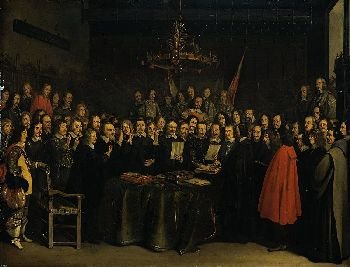
The Luxembourg Accord
The first disagreement among the Member States occurred in 1965. It is known as the “empty chairs” crisis, as France refused to attend Council meetings from July 1965 to January 1966.
The then president of the French Republic, Charles de Gaulle, was in favor of intergovernmentalism and thus against increasing the powers of the Community. The immediate cause of the crisis was the Commission’s package of proposals aiming at increasing the competencies of the Commission and of the EP.
The Commission’s proposal on the adoption of the financing arrangements for the Common Agricultural Policy (CAP) was accepted by France. The two remaining proposals were rejected. The first concerned new methods of financing the Community, aiming at ending national contributions towards the budget and replacing them with a system of “own resources” of the Community, mainly provided by the revenue from the common external tariff.
This proposal was considered as essential by the Commission to give the institutions more independence from the Member States. The second proposal concerned increasing the involvement of the EP in decision-making procedures in general, and in budgetary matters in particular. It was supported by the EP and by The Netherlands.
The proposals were used by France to express its dissatisfaction in two areas.
They were:
- First, that of the role of the Commission, which, under the presidency of Walter Hallstein, was accused by France of exceeding its competence by acting more like a supranational rather than an inter-governmental body;
- Second, that of the proposed major change in decision-making within the Council, which consisted of replacing unanimity with qualified majority voting. The EC Treaty provided that at the beginning of the final stage of the transitional period, which was approaching, the new voting system should apply.
- In order to dramatize the situation, France decided not to attend the Council meetings (hence the empty chairs). Under pressure from French farmers, de Gaulle decided to negotiate with other Member States (the Commission was not invited). In January 1966 an informal agreement was reached, known as the Luxembourg Accord, which provided that:
“Where, in the case of a decision which may be taken by majority vote . . . the Council, will endeavor . . . to reach solutions which can be adopted by all the Members of the Council . . . the French delegation considers that where very important interests are at stake the discussion must be continued until unanimous agreement is reached.”
Accordingly, unanimous voting was the main way of adopting EC legislation from 1966 until the adoption of the 1986 SEA. The Luxembourg Accord marked a clear confirmation of inter-governmental co-operation and thus constituted a serious blow to supranationality, although the Accord has never been given any legally binding status in EC law.21 It was the main reason for years of stagnation of the Community, as it prevented progress towards further integration by giving priority to the national interests of the Member States.