VIDEO
Human Rights Topics for Preschool and Lower Primary School
Appreciating similarities and differences
Attributes
Children are seated in a circle. One child stands in the middle of the circle and makes a statement that describes him or herself. For example: “Is wearing a belt” or “Has a sister”.
Everyone who shares that attribute must change places, including the child in the middle. Whoever is left without a seat becomes the person in the middle and names the next attribute. Children will quickly see that they can be similar and different in many ways. An interesting ending would be to choose a more intangible attribute, such as: “People who are kind.” The game usually breaks down at this point because it becomes more difficult to identify such attributes at a glance. Teachers may wish to discuss how people usually recognize such behavioral attributes. (UDHR articles 1, 2; CRC article 2)
In the same boat
The teacher explains that people sometimes don’t recognize ways in which they are alike. Then the teacher names a category (e.g. month of birth, number of siblings, kind of pet, favourite toy, or game) and asks children to form a group with others who share that category with them. Older children can respond to more complex categories (e.g. number of languages spoken, career aspiration, hobby, favourite school subject).
The game concludes with the question “What did you learn from this activity?” and a discussion of people’s unrecognized similarities and differences. (UDHR article 2; CRC article 2)
Fostering confidence and self-esteem
1. Who am I and what am I like?
(a) A “Who Am I?” book
Children begin a book about themselves, with a self-portrait on the cover. Personal pictures prose and poems can be collected in this book. As children learn to write, they can put personal details, questions about themselves and answers to questions in it too. If resources are limited, a book can be made for the whole class with a page or two for each child. (UDHR articles 3, 19; CRC articles 6,7,8,12,13, 30)
(b) A circle for talking
Children sit in a circle that includes the teacher and any visitors. The teacher makes an open-ended statement and each student answers in turn. Questions might be one or more of the following:
What I like best about myself is…
I’d like to be…
My favourite game is…
I think my name means…
I would like to learn about…
I feel happy when…
I feel sad when…
I want to become more…
Some day I hope….
Listening without interrupting and sharing time equally are very important. Children can “pass” if they do not wish to speak. Each person remains seated until the activity is over. Answers can be included in the “Who Am I?” book(s). (UDHR articles 18,19; CRC articles 8,12,13,14,17,31)
The lifeline
Each child stretches out a piece of yarn that represents his or her own life. Children then hang on their yarn drawings, stories and objects that convey the important things that have happened to them. This can be done in chronological sequence, or in any order that the child may want. It can also be extended into the future. (UDHR articles 1,3,19; CRC articles 6,8,12,13,14,27,30,31)
Me on the wall/ground
Trace the outline of each child on a large piece of paper (best done lying down) or on the ground. Have the student draw/paint in physical details, and then write around personal and physical qualities (e.g. name, height, and weight, what the child would most like to learn or do at school or in adulthood). If you have used papers, pin them up around the wall. Allow all students to learn about each other as well as themselves. (UDHR articles 3, 19, 24; CRC articles 6, 7, 8, 12, 13, 28, 29, 31)
Me and my senses
Have children discuss in the circle, or use a role-play to explore the following statements:
Hearing helps me to…
Seeing helps me to…
Smelling helps me to…
Touching helps me to…
Tasting helps me to….
Rephrase the questions, where appropriate, to suit the needs of children with disabilities (e.g. “Not being able to see (very well? at all?) I’m still me, and I can . . .”). Get each child to invent an instrument to help them hear, smell, or touch better. Have them describe, draw, or dramatize it. (UDHR articles 22, 25, 26; CRC articles 23, 26, 28, 29)
Wishing-circle
Arrange the students in a circle. Propose that each child in turn makes the following wishes (this can also be done in small groups or pairs):
If I could be any animal, I’d be ___ because…
If I could be a bird, I’d be ___ because…
If I could be an insect, I’d be ___ because…
If I could be a flower, I’d be ___ because…
If I could be a tree, I’d be ___ because…
If I could be a piece of furniture, I’d be ___ because…
If I could be a musical instrument, I’d be ___ because…
If I could be a building, I’d be ___ because…
If I could be a car, I’d be ___ because…
If I could be a street, I’d be ___ because…
If I could be a town/province/region, I’d be ___ because…
If I could be a foreign country, I’d be ___ because…
If I could be a game, I’d be ___ because…
If I could be a record, I’d be ___ because…
If I could be a TV show, I’d be ___ because…
If I could be a movie, I’d be ___ because…
If I could be a food, I’d be ___ because…
If I could be any colour, I’d be ___ because….
(UDHR article 19; CRC articles 13, 14)
How do I live with others?
My puppet family
Each child makes a family of puppets that includes one of him or herself. These can be very simple, like cardboard cut-outs coloured and fixed to sticks or clay or mud figures. The figures are named and their relationships described and explained. Each child then devises a ceremony (a wedding, for example) or a festival, which is shown to the others in the class. The puppet family can be extended to include other people who live nearby. Children can dramatize something they do regularly with those people in order to bring them together. Extend the activity to include individuals from anywhere in the world.(UDHR articles 16, 20, 27; CRC articles 9, 10, 15, 31)
Imaginary friend
The children sit or lie down quietly with their eyes closed. Tell them to breathe in deeply and then breathe out slowly. Repeat two more times. Now tell them to imagine a special place, a favourite place, anywhere in the world (or even in outer space). Say that they are walking in that place – in their imagination – feeling and hearing and seeing what is going on there. Lead them to a house or building they can visualize, where they go in to find a special room. The room has a door in one wall that opens by sliding up. The door slides up slowly, and as it does so, it reveals a special friend they have never met before – first feet, and finally the face.
This friend can be old or young – anything. This friend is always there, and whenever they need someone to talk to, to turn to, they can visit him or her again if they wish. Close the door, leave the house, and come home to the class. Let the children share what they have imagined in a speaking circle or in pairs or groups. (UDHR article 20; CRC article 15)
Letters and friends
Set up a letter or electronic mail exchange with another class in another school or even another country. Initiate this exchange by sending poems or gifts from the class. This may lead to a visit later if the distance allows, and a chance to meet the children of the other community. Investigate the twin school:
• How big is it?
• What games are played there?
• What do the parents do?
• What are the differences and similarities? (UDHR articles 19,20, 26; CRC articles 13, 17, 29)
Buddy
Teachers should arrange for their students to have an older buddy from an upper class. An activity should be arranged to encourage children to seek out the help of their buddy if they have a problem. Ways should be devised to encourage the senior buddy to take an interest in his or her small colleague by showing games and helping with activities. (UDHR article 20; CRC article 15)
People around me
Ask children in a talking circle to think of a good quality in themselves or ask “What are some qualities we admire in people?” Then lead a discussion on these topics:
• Do you respect in others the quality you like about yourself?
• Do you respect good qualities in others that you do not have?
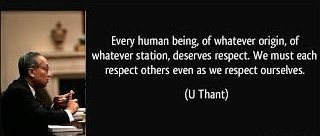
• Do all human beings deserve respect? Why?
• How do you show respect for others?
Next ask children to think of a time when they felt hurt because someone did not respect them.
• How did disrespect feel?
• Why do people sometimes act disrespectfully to others?
• What is dignity? Is your dignity hurt when others do not respect you?
• What can you do when others do not respect you?
Finally,
• Ask “What does it mean if we say that all human beings deserve respect?”
• Ask for examples of how life in their community could be more peaceful if people showed greater respect for each other.
• Ask children to think of one way they could show respect for someone. (UDHR articles 1, 2, 12; CRC articles 2, 12, 13, 14, 16, 29)
The washing machine
Have the children form two parallel lines close together, and facing each other. Send a child from one end between the lines (“through the wash”). Everyone (where this is culturally appropriate) pats him or her on the back or shakes his or her hand while offering words of praise, affection, and encouragement. The result is a sparkling, shining, happy individual at the end of the “wash.” He or she joins a line, and the process is then repeated for another child. (Running one or two people through daily is more fun than washing everybody in one big clean-up.) (UDHR articles 1, 2; CRC article 2)