What is Europe? (Video)
EXPANSION TO EASTERN EUROPE
This intensive “deepening” of the EU was accompanied by a renewed debate within the community about its “widening,” with the emergence from communism of a dozen new democratic, market-oriented states in Eastern Europe. Virtually all of the post communist European governments applied for membership in both NATO and the EU, seeing membership in these Western organizations as a source of security (primarily against Russia) and economic assistance, but also as a symbol of their return to Europe.
For existing EU members, the expansion posed a dilemma. Creating a Europe without borders, as the Maastricht Treaty called for, was difficult enough for fifteen countries, ranging from relatively poor countries like Portugal and Greece to prosperous ones like Germany and Sweden.
The Eastern European candidate countries had standards of living less than half the EU average, and many of them were still wrestling with the establishment of democratic customs and institutions. An expansion eastward was going to be costly for the EU, which provides “structural adjustment” funds for poorer countries and regions to bring them closer to the EU average. All of these Eastern European states would qualify for such support. In addition, with many new member states, changes would have to be made in the whole process of decision making and voting in the European Commission and other EU institutions.
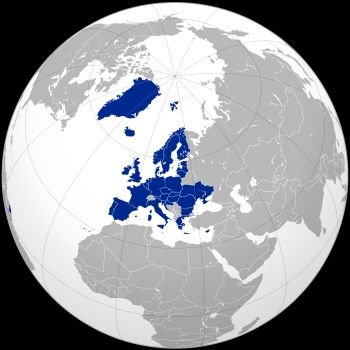
Despite these potential problems, the existing fifteen EU members agreed to bring ten new countries into the organization in 2004, and two more in 2007: the three former Baltic republics of the USSR (Estonia, Latvia, and Lithuania); seven post communist East European States (the Czech Republic, Slovakia, Hungary, Poland, Slovenia, Romania, and Bulgaria); and the two island nations of Cyprus and Malta.
THE EUROPEAN SUPERPOWER?
The EU, now with 27 member states, had a combined population of 495 million (only China and India are larger) and an economy bigger than that of the United States. This new “European Superpower” had become “the biggest and richest capitalist marketplace in the world.” The EU accounts for about a third of the world’s gross domestic product (GDP) and contains about half of the industrial world’s consumer population. It is also, by far, the world’s biggest trading power, accounting for about 40 percent of global exports (compared to less than 10 percent for the United States). Europe had also become the world’s biggest magnet and biggest source for investments.
Europe’s economic heft is complemented by the world’s best living standards and most developed system of social welfare. Many EU countries have less poverty, more equality, and cheaper and better health care, and produce better-educated students than the United States. Most have much more generous unemployment assistance, parental leave programs, and child allowance benefits than does the United States. The various EU treaties provide the world’s strongest guarantees of gender equity. The European system of social welfare has come to be known as the “European social model” and is a source of envy and imitation all over the world. Indeed, Europe’s size, economic strength, and social welfare have contributed to Europe’s reemergence as an imposing force in the world economy and international politics. The titles of recent books show which way the wind is blowing: The United States of Europe: The New Superpower and the End of American Supremacy by the journalist T. R. Reid; The European Superpower by political scientist John McCormick; and The Next Superpower? by former U.S. ambassador to the EU Rockwell Schnabel.
The book The End of the American Century, sees a united Europe, along with China, as two major contenders for global predominance following the decline of the United States. To be sure, the expansion and development of the EU have entailed growing pains. At the same time that the union was expanding, it was trying to finalize a new constitution that would integrate new members and strengthen the supranational political institutions of the organization. But, at the last moment, voters in France and Holland rejected the constitution, temporarily halting the integrationist trend. Some French and Dutch voters were worried about surrendering national sovereignty to the EU; others were concerned about potential negative impacts of expansion and globalization.
Most of the principles of the constitution were revived, however, in a less grandiose document called the Lisbon Treaty, which was finally approved by all 27 member states in 2009. The treaty aimed to give the EU a stronger international role, and to update the voting and decision-making procedures for its larger membership. It creates a full-time presidency and foreign minister, supported by a network of EU diplomats around the world. A new voting system reflects a country’s population size, and the directly elected European Parliament is given more power. With expanded membership encompassing most of Europe, the Lisbon Treaty was yet another step on the path to a single, united Europe. The initial defeat of the EU Constitution highlighted the tension between the processes of “broadening” and “deepening” that bedeviled the organization. The expansion of membership to countries that were generally poorer and less experienced with both democracy and capitalism made it more difficult to harmonize policies across all twenty-seven member states. Most of the new members were not sufficiently prepared economically to adopt the euro.
The EU’s policy of free movement of labor across borders was strained to the breaking point when hundreds of thousands of east Europeans flooded into wealthier EU countries seeking jobs. Immigration from one EU country to another increased by 10 percent a year from 2002 to 2006. When I visited Ireland in 2005, for example, almost all service workers we encountered-waiters in restaurants, clerks in stores, dock hands on ferries-were Polish, Czech, or Romanian rather than Irish. In 2006 alone, nearly 300,000 Poles migrated to other EU countries. This flood of immigrants helped fuel economic growth in the host countries, but also caused ethnic tension and fanned anti-immigration sentiment in some countries.
Immigration from new EU countries into “old” ones came on top of a longer-term trend of immigration from the former European colonies into the “old” colonial states. Almost every country in Europe was becoming more ethnically heterogeneous, so that issues of immigration, integration, and ethnicity were increasingly entering the political process. The most contentious of these involved the status of Muslims living in European countries. Their numbers were growing quickly all over Europe, but especially in France (whose former colonies in Africa were mostly Muslim), where Muslims now made up about 10 percent of the total population. France’s rigorously secular culture, dating from the time of the French Revolution, often runs up against public manifestations of religiosity. In 2004, the government banned the wearing of overtly religious garb or symbols in public schools, including the headscarf (or hijab) that many Muslim women wear. This caused a furor both in France and worldwide, which, however, effected no change in the policy. Indeed, six years later, the French cabinet voted a total ban on the Muslim full-face veil (the burqa) from public spaces. “Identity politics” was pulling against the broader trends of globalization and integration in Europe, as elsewhere in the world.
Europe faced another big challenge in 2010, when EU member Greece was faced with a budget and financial crisis that threatened to destabilize Greece, disrupt the European economies, and undermine the euro. As the Greek government wrestled with its debts, it announced cuts in social services and government programs, sparking widespread and sometimes violent protests throughout the country. All the benefits of the euro zone also brought with them the prospect of recessionary contagion from one country to another. Fearing especially the destabilization and weakening of the euro, the EU authorized 80 billion Euros ($105 billion) to meet Greece’s borrowing needs. The bailout was eerily similar to the U.S. government’s rescue of that country’s collapsing financial sector in 2008–2009. It raised questions, once again, about the viability of an expanded EU and a common currency. But the muscular response to the Greek crisis by the European Central Bank also suggested the possibilities for a further strengthening of the Union.
WHAT IS EUROPE?
The collapse of the Berlin Wall, the reunification of Europe, and the expansion of the EU raised new questions about just what constitutes Europe. Is it defined only by geography (and if so, where?) or also by history, traditions, culture, or religion? These issues became concrete and very political in the debate over expansion. For example, can Turkey really be considered part of Europe as an Islamic (though secular) state that is only partly in Europe and mostly in Asia Minor? And what about Russia? If Poland, Bulgaria, and the Baltic republics can be part of the EU, could Russia too? Indeed, of the twenty-seven EU member states, none are Muslim and only two, Cyprus and Greece, are Orthodox Christian. The rest are all Western Christian, so is this the unifying element of the new Europe?
The issue became even more sharply focused in the 2003–2004 debate over a new EU constitution. The biggest controversy was over references to religion, reflecting a tension that dates all the way back to the Enlightenment. An early draft of the preamble referred to the Christian and Jewish heritage of European society, but countries with strict separation of church and state, such as France and Belgium, objected to this language, and it was later excluded. The drafters of the constitution had also suggested references to the legacy of Greco-Roman civilization and the Enlightenment. But some of the more religious countries, like Ireland, Spain, and Poland, objected to the secular implications of that. As the official Vatican newspaper, L’Osservatore Romano, proclaimed in a headline, “Either Europe Is Christian or It Is Not Europe.”
In the end, references to both Christianity and to the Enlightenment were left out of the draft Constitution, and out of the Lisbon Treaty that replaced it. The Lisbon Treaty, implemented in 2009, instead refers to “the cultural, religious, and humanist inheritance of Europe” from which have developed “the universal values of the inviolable and inalienable rights of the human person, freedom, democracy, equality, and the rule of law.” Although not directly mentioning the Enlightenment, this language and these principles trace back to that era and reflect the enduring legacy of the Enlightenment in European society. On these principles, at least, almost all Europeans could agree.
Although the issue of religious identity was, finally, skirted in the treaties, it promised to be one of the more divisive issues in the new, united Europe, just at it had been a source of conflict and division in the eighteenth century. Enlightenment ideas of rationalism, secularism, and human rights had come to dominate Western Europe more so than any other place on the planet. Although a majority of people in most European countries believe in God, only one in five say religion is “very important” to him or her, and only small minorities of the European populations regularly attend religious services. In France, which is predominantly Catholic, but very secular, only one in twenty people attend religious service every week, compared to about one in three in the United States.
This has caused some tension among EU members, and also between Europe and the United States. Some of the new Eastern European members of the EU, especially overwhelmingly Catholic ones like Poland and Lithuania, are discomfited by the fervent secularism of Western Europe, as demonstrated in the debate over the EU Constitution. This has already caused problems in trying to harmonize social policies across the twenty-seven members of the community, especially on religiously sensitive is- sues like divorce, euthanasia, and abortion. The widening of Europe has reopened these issues that have mostly been settled in the western part of the Continent.
Religion has also sharpened the divide between Europe and the United States. As noted above, Europeans in both the east and west are far more secularized than Americans, and religion plays a much stronger role in political life in the United States than it does in Europe. From the European point of view, Americans are more likely to think in terms of good and evil or right and wrong, which Europeans see as reckless and dangerous. After the terrorist attacks of September 11, 2001, most European citizens and leaders alike were uncomfortable when U.S. president George Bush so frequently invoked morality and religion in talking about the war on terrorism. His decision to attack Iraq in 2003 seemed more a matter of missionary zeal than hard evidence of weapons of mass destruction or Iraqi links to terrorism. Thus, European members of the United Nations Security Council, especially Germany and France, were reluctant to endorse the war, leading to the chilliest relations between the United States and Europe in a century. Bush’s secretary of defense, Donald Rumsfeld, brushed aside these objections from what he called “old Europe” and implied that the future lay with the new democracies of Eastern Europe. This snub was not received well in Berlin and Paris. The election of Barack Obama in 2008 was welcomed all across Europe, and U.S.–European relations improved markedly in the first years of the new administration. The tensions between the United States and Europe reflected a growing independence and assertiveness on the part of the European countries and a certain measure of the success of the European project. In the dispute about the Iraq war, Germany and France were allies against the United States, rather than adversaries of each other as they had been in World War II. The ECSC, the EEC, and the EU had brought these two countries together, as well as much of the rest of Europe, not only in a web of economic exchange, but in a community of shared values that included democracy, market economics, social welfare, human rights, and peace.