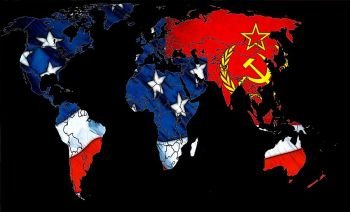
Stabbing the Empire: Last Day of Soviet Union
The Breakup of Yugoslavia, 1990–1992
THE DISINTEGRATION OF THE SOVIET UNION AND YUGOSLAVIA
Nationalism and liberalism played a big part in bringing democracy and sovereignty to the Eastern European states in 1989, and they also contributed to the disintegration of the two multinational states of the region, the Soviet Union and Yugoslavia. In the Soviet Union, the changes that Gorbachev had unleashed in Eastern Europe came boomeranging back to the country where they started. The USSR was a union of fifteen “republics,” each representing a different nationality, many of which were brought forcibly into the Russian Empire before 1917 or into the Soviet Union afterwards.
As centralizing controls were weakened during the Gorbachev era, nationalism flourished in all of them. When the Eastern European states broke away from communism and the Soviet bloc in 1989, many of the Soviet republics saw similar opportunities. In the course of 1990 and 1991, every one of the fifteen republics declared independence, although Moscow did not recognize those declarations.
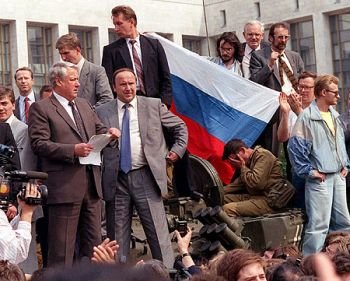
In the spring and summer of 1991, Gorbachev and the leaders of a number of the republics, including Boris Yeltsin of the Russian Republic, attempted to hammer out a formula to create a more decentralized union with greater autonomy for each of the republics. Shortly before the treaty was to be signed in August, though, a hard-line group representing the Communist Party, the army, and the security agencies attempted to oust Gorbachev from power. Russian President Boris Yeltsin managed to rally opposition to the coup and face down the plotters. But, in the aftermath of the coup attempt, the country’s fragmentation accelerated. At the end of the year, Yeltsin and the presidents of Ukraine and Belarus signed a treaty formally dissolving the USSR. Gorbachev resigned and retired.
After seventy-two years, the Soviet Union was no more. Yugoslavia, like the USSR, was a multinational federal state held together by a single political party, the League of Yugoslav Communists. With a total population of only twenty-four million, it was an extraordinarily heterogeneous country with no majority population. The Serbs were the largest group, but they constituted only about a third of the total. As communism disintegrated in Eastern Europe and the Soviet Union, Yugoslavia also began to fall apart. Elections in Yugoslavia’s republics in 1990 brought nonsocialist and independence-minded governments to power in Slovenia, Croatia, Bosnia-Herzegovina, and Macedonia. But the government of Serbia, under President Slobodan Milosevic´, remained committed to maintaining the integrity of the state under predominantly Serbian influence.
Serbia clashed at first with both Slovenia and Croatia, but the biggest problem came in Bosnia, where about 43 percent of the population was Muslim (from the days of Ottoman influence in the region) and a third was Serbian. With the declaration of independence by the Bosnian government, Serbian guerrillas, backed by Serbia and the Yugoslav army, began seizing Bosnian territory for the creation of a Serbian state. This led to a brutal and horrifying civil war that caused almost a quarter of a million deaths, the worst violence in Europe since World War II. Finally, after a two-week bombing campaign by North American Treaty Organization (NATO) forces against Serb positions, the parties were brought to the negotiating table in Dayton, Ohio. The Dayton Accords of 1995 provided for a single Bosnian state divided into two roughly equal entities: a Muslim-Croat federation and a Serb republic. A NATO peacekeeping force of nearly sixty thousand troops, including about twenty thousand Americans, monitored the cease-fire and supervised implementation of the accord.
Other problems of nationalism and ethnic conflict were unleashed with the collapse of the centralizing power of communism. Czechoslovakia, three years after the Velvet Revolution, was peacefully dissolved and replaced by two separate states: the Czech Republic and Slovakia. Russia, after the breakup of the Soviet Union, was itself a federation of many nationalities and faced a grueling separatist insurgency from the Muslim region of Chechnya. And in Yugoslavia, another round of conflict erupted between Serbs and Albanian Muslims in the region of Kosovo, requiring yet another military intervention by NATO (primarily U.S.) forces. Yugoslavia finally disappeared altogether, fragmented into six small sovereign countries that had been its constituent republics, in much the same way that the Soviet Union had earlier collapsed.
Nationalism, which had played a positive role in delivering Eastern Europe from the Soviet bloc, also had its negative side, expressed in ethnic rivalry, hostility, and conflict.
With all these changes, the borders of Eastern Europe were redrawn in a manner even more thoroughgoing than after World War I, with the emergence of panoply of new states. From the former USSR, all fifteen constituent republics became sovereign and independent countries. Six new states, including Croatia, Slovenia, Bosnia, and Serbia, emerged from Yugoslavia. Germany’s reunification made it the most populous and economically powerful country in Europe. All of these new countries, as well as the newly independent ones of Eastern Europe, wrestled with questions of identity and their relationships with the rest of Europe.
TRANSITION FROM COMMUNISM TO MARKET DEMOCRACY
The new post communist governments in Eastern Europe and the former Soviet Union faced a daunting complex of tasks: the re-creation of democratic politics, the construction of market economies, and a reorientation of foreign policy toward the West. These changes required a fundamental transformation of each country’s social and economic systems and even a psychological reorientation for much of the population. In many respects, these changes turned out to be more wrenching and traumatic than the relatively quick and painless political revolutions.
Nevertheless, most of the Eastern European states made remarkably speedy progress toward both democracy and capitalism. Within a few years, most had been through several sets of free elections, had adopted new constitutions, and had established representative legislatures, competitive party politics, the rule of law, and a free press. Some of them had even voted back into power, in free elections, representatives of the former communist parties!
In the economic realm, the task was not so smooth or easy. Dismantling the old system of central planning and full employment disrupted almost everyone’s life. Building a market economy based on private ownership, entrepreneurship, and investments would also take time in countries without such experience or traditions and without any capital.
The tasks of economic restructuring included price deregulation, currency rationalization, the elimination of government subsidies to consumers and producers, the creation of a modern banking system and a stock market, and a large-scale program for the privatization of state enterprises and farmland.
In both Eastern Europe and the former Soviet Union, all countries experienced sharp economic declines in the early years of the transition, with plummeting output, surges in unemployment, and skyrocketing inflation. Russia’s problems were more severe than most, with an economic depression that rivaled that of the Great Depression in the United States and Germany during the 1930s. But, by about 1994, most countries had begun to recover, the private sector was taking hold, and consumer goods and services were more available. They were increasingly looking like typical Western consumer societies. The dawn of capitalism, though, brought with it the usual share of problems. Unemployment, which had been nearly nonexistent in the communist era, reached near double-digit rates in many countries at the end of the 1990s. The number of people in the region living in poverty increased tenfold between 1989 and 1996. Increases in unemployment and poverty contributed to worsening health indicators, especially in the countries of the former Soviet Union, where mortality and morbidity rates were without peacetime precedent. There were also big increases in inequality. The growing gap between rich and poor was particularly galling for many citizens because many of the nouveau riche was their former oppressors, members of the old Communist Party apparatus. In many post communist countries in the 1990s, large percentages of the populations expressed the view (in public opinion surveys) that they had been better off in the communist era than they were in the democratic one.
Nevertheless, most people in the post communist states were glad to be free of the restrictions and privations of the communist era and welcomed the return of “normal lives” and the chance to rejoin Europe. Most Eastern European countries reoriented their trade from East to West, and many citizens of the region took advantage of new opportunities to travel to or work in Western Europe. With the dissolution of the Warsaw Pact, most former members of that alliance rushed to affiliate with NATO-an organization originally set up to oppose communism-and by 2009, twelve of the twenty-eight members of NATO were post communist countries. The former communist states were even more anxious to join the European Union (EU), for both symbolic and economic reasons. Eight of them joined the EU in its 2004 expansion of membership, and two more in 2007.
Twenty years after the 1989 revolutions, almost all of the former communist states had successfully navigated the path to democratic politics and capitalist economics. What had been “Eastern Europe” was thoroughly heterogeneous, with some people very wealthy and others quite poor, but not too different in that respect from “Western Europe.” Slovenia and the Czech Republic, for example, had overtaken the living standards in Portugal, the poorest country in the western camp. Some of the ex-communist countries had better credit ratings, and less corruption, than some of the older EU members. And, the opening up of national borders led to a flood of immigrants from east to west Europe, boosting economic growth but also compounding issues of immigration prompted by decolonization a generation earlier.
THE IMPACT OF 1989
The causes of the 1989–1991 revolutions, like those of 1789, 1848, and 1917, were both systemic and immediate. In the long term, the Soviet and Eastern European governments had suffered declining economies; growing popular dissatisfaction, political dissent, and nationalism; and declining legitimacy. Given the apparatus of repression possessed by the communist governments, the system could probably have limped along even with these disabilities but for the appearance of Gorbachev, glasnost, and perestroika. Perestroika encouraged change and reform, and glasnost uncorked the genie of public opinion. Once the masses took to the streets, political changes could not be stopped without the application of force.
Fortunately, Gorbachev would not countenance the use of force. For this, he won the 1990 Nobel Peace Prize. The magnitude and speed of the changes in this revolution were unprecedented: In the course of only two years, nine authoritarian governments collapsed, and twice that many new states were born out of the rubble. In some ways, the breakup of the multinational states of the Soviet Union and Yugoslavia and the reunification of Germany were a culmination of the post–World War I process of creating nation-states, the goal enunciated at that time so forcefully by President Woodrow Wilson in his Fourteen Points. But, just as in that earlier time, when nationalism proved to be double-edged, in the 1990s it showed its intolerant and violent side in Bosnia, Croatia, Kosovo, Chechnya, and elsewhere.
Mostly, however, the anticommunist revolutions were peaceful, and this was another remarkable aspect of 1989. Past revolutions, even ones that failed had been violent to one degree or another. In Eastern Europe, one country after another relied on “people power” to bring down their governments without resort to arms. It seemed that even staunchly authoritarian governments could not stand in the face of popular disaffection publicly expressed. This form of regime change became a model for other peoples and countries as well, most notably in South Africa, which began its own form of perestroika in 1989, leading to black majority-rule government.
The revolutions of 1989 did not simply destroy governments; they also ended an ideology. Although communism may have come from within Russia in 1917, it was imposed on Eastern Europe from without in the years after World War II, and it never did take very well. Stalin once observed that “communism fits Poland like a saddle fits a cow.” Although many Eastern Europeans welcomed the communist governments at first, this support waned over the years. By the 1980s, although many people favored socialism, hardly any supported Soviet-style communism. With the overthrow of communist governments, the communist ideology also faded. The end of communism in Europe also ended the Cold War. What had begun in Berlin ended there? The conflict between capitalism and communism had been an important factor in European and world affairs since the Russian Revolution of 1917 and had dominated international politics since World War II. The ideological element in international politics faded away, at least temporarily. One U.S. State Department official, Francis Fukuyama, wrote an essay and a book entitled The End of History, in which he proclaimed “the end of mankind’s ideological evolution and the universalization of Western liberal democracy as the final form of human government.” This assessment was overly simplistic and optimistic, but in the United States, it reflected the widespread view that the United States had won the Cold War.
There is no doubt, though, that the rise of liberal democracy in Eastern Europe offered the best chance yet for a Europe “united and free.” From the Baltic states through Poland, the Czech Republic, and Hungary, to Slovenia and Croatia, governments were committed to democracy, market economies, and membership in the European Community. The “iron curtain” had lifted, and if there was still a division in Europe, it was much farther to the east.