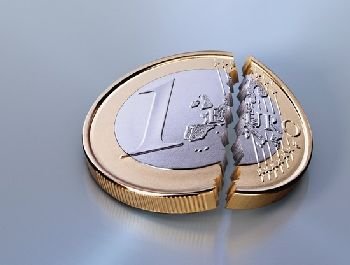
Political Barriers to Exit
More generally, a country that abandoned the euro and reintroduced its national currency because of problems of inadequate international competitiveness, high unemployment, and slow growth might suffer political costs by being relegated to second- class status in negotiations over other issues.
One interpretation of the process of monetary integration that culminated in the advent of the euro is that monetary integration is a stepping stone to political integration, which is the ultimate goal of the architects of the European Union. As the point was once put by Jacques Delors, “Obsession about budgetary constraints means that the people forget too often about the political objectives of European construction.
The argument in favor of the single currency should be based on the desire to live together in peace.”17 Like the European Union’s blue flag with twelve yellow stars, the single currency is a visible symbol that fosters a sense of European’s among the continent’s residents.
As suggested by the theory of neofunctionalist spillovers (Haas 1958), the existence of the euro and the European Central Bank generates pressure for a more powerful European Parliament to hold the ECB democratically accountable for its actions.18
A country that unilaterally abandons the euro, something for which there is no provision in the Treaty on European Union, would deal a setback to these larger political ambitions. It would signal that it did not attach high value to the larger process of political integration.
On both grounds, such a country would be unlikely to be regarded as a respected interlocutor in discussions of how to push the process forward. An Italy that abandoned the euro would have a diminished role in discussions of how to strengthen the powers of the European Parliament. It would have less sway in discussions of how to revise and ratify the European constitution.
Other member states would be less likely to grant it a seat at the table in discussions of whether to formulate a common foreign policy or to create a European army. For better or worse, the common European position on such issues has grown out of discussions among a core of countries centered on France and Germany that first develop a common position and then sell it to the other members. For a country like Italy that has participated in this larger process of European integration from the foundation of the European Economic Community half a century ago, precisely as a way of elevating itself to the status of a first- tier European country, these political costs would be substantial. In turn, this constitutes a major barrier to exit.
What about Germany? If Germany abandoned the euro out of dissatisfaction with excessively inflationary ECB policies, this would significantly diminish the prospects for political integration. Germany would be indicating that it regarded the experiment with a supranational institution with real powers-in this case, the power to make monetary policy-as a failure. The idea that Germany would then cede to other supranational institutions at the EU level the power to make its security policy, its foreign policy, or its fiscal policy, these being three of the key prerogatives of a sovereign state, would become less plausible.
Germany has always been a strong proponent of the larger European project. Reflecting memories of World War II, it continues to feel limits on its ability to formulate an assertive foreign policy, to maintain a standing army, and to deploy troops abroad; at a basic level, its interest in political integration is to regain a foreign policy voice in the context of an EU foreign policy. And without German support, European political integration is unlikely to display the same momentum. Given this, Germany will presumably attempt to fix the problems it perceives with the ECB in order to salvage its vision of political integration rather than concluding that further integration is infeasible and abandoning the euro-or at least it will invest more in seeking to fix perceived problems than another member state with a weaker commitment to the larger European process.
It will choose voice and loyalty over exit, complaining publicly about the inflationary stance of ECB policy and lobbying to change it, precisely in order to demonstrate that supranational European institutions can work and that its integrationist vision is still viable.
This is not to deny that there could come a point where the German government and its constituents conclude that voice and loyalty have failed. But this argument does suggest that Germany may be prepared to suffer with a monetary policy not to its liking and that it will work to change that policy, rather than abandoning the euro, for longer than other member states less committed to the larger process.
Not everyone will agree that a monetary union process that adds to momentum for political integration is desirable on these grounds. Some would argue that the European Union should concentrate on economic integration while shunning aspirations of political integration. For them, if a failure of monetary union means a failure of political union, then the latter is not a cost.19 But for influential political elites, political integration remains a valued goal. For them, exits from the euro area that set back its progress would be a significant cost.
17. Cited in Prior- Wandesforde and Hacche (2005, 23).
18. See section 1.5.
19. This is not to say that the opponents of political union necessarily see the failure of monetary union as desirable, as the latter may have other benefi ts, including the impetus it provides to economic integration.