The Schuman Plan
Robert Schuman, the French minister for foreign affairs, followed the advice of Winston Churchill, who emphasized in his speeches that France should take Germany back into the community of nations.
Schuman was well qualified to take the first step in the normalization of relations with Germany as, on the one hand, he took part in the First World War on the German side in a civilian capacity, his mother tongue was Luxemburgish (at the time considered a German dialect) and his language of education was standard German, and on the other hand, he became a French citizen in 1919 and during the Second World War fought in the French Resistance, was interrogated by the Gestapo and by extraordinary luck avoided being sent to the concentration camp at Dachau.
He believed that Europe was facing three problems:
- Economic dominance by the USA;
- Military dominance by the Soviet Union; and
- A possible war with rejuvenated Germany.
The Americans supported the idea of political and economic integration in Europe since it would, in the long term, reduce the cost of their obligations and commitments in Europe. Robert Schuman considered that the best way to achieve stability in Europe was to place the production of steel and coal (then two commodities essential to conduct a conventional war) under the international control of a supranational entity.
The creation of a common market for steel and coal meant that interested countries would delegate their powers in those commodities to an independent authority.
On 9 May 1950 Robert Schuman announced his Plan, based on proposals put forward by Jean Monnet, an eminent French economist and the “father of European integration”. Although in Schuman’s Plan only France and Germany were expressly mentioned, Schuman invited other European states to join, in particular Britain, Italy and the Benelux countries.
The Schuman Plan was enthusiastically accepted by Germany, and Konrad Adenauer, the Chancellor of Germany saw it as a breakthrough towards the beginning of German statehood and independence. Personally, Adenauer was in favor of closer relations with the West and of the abandonment of traditional German policy, which for centuries had concentrated on the East.
The Schuman Plan was advantageous to both Germany and France, as for Germany it offered a way of regaining international respectability, and in the immediate future the opportunity to gain access to the Saarland, and for France, the opportunity to control the German economy.
The Schuman Plan attracted attention in many European countries. As a result, an international conference was held in Paris on 20 June 1950, attended by France, Italy, West Germany and the Benelux countries, to consider the Plan. Following from this, a Treaty creating the European Coal and Steel Community was signed on 18 April 1951 in Paris and it entered into force on 23 July 1952.
The Contracting Parties were: Belgium, France, Italy, Luxembourg, The Netherlands and West Germany. The institutional structure of the ECSC was original in that it consisted of: The High Authority.
This was made up of representatives of the Member States acting independently in the interests of the ECSC. The High Authority was in charge of the production and distribution of coal and steel, and was entrusted with supranational competencies, including the power to make legally binding “decisions” and “recommendations”, directly applicable in Member States; A Special Council of Ministers, a partly legislative, partly consultative body representing the interests of the Member States; The Common Assembly made up of MPs from Member States, with only supervisory and advisory functions; and The Court of Justice responsible for ensuring “that in the interpretation and application of this Treaty . . . the law is observed.”
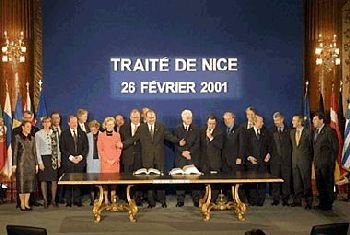
The Treaty was concluded for a period of 50 years and expired on 23 July 2002. After its expiry the ECSC ceased to exist. To deal with the consequences of its disappearance a Protocol on the Financial Consequences of the Expiry of the CS Treaty and on the Research Fund for Coal and Steel was attached to the ToN (under the ToL it has become Protocol 37 attached to the Treaties).
Pursuant to this Protocol the Council adopted a number of decisions to deal with the liquidation of the ECSC. On completion of liquidation, the net worth of the assets of the ECSC was transferred into “Assets of the Research Fund for Coal and Steel”, the revenue from which is used to finance research in sectors related to the coal and steel industry. Since the expiry of the ECSC, coal and steel (being goods) are subjected to the rules in the Treaties.
Initially, the ECSC was very successful, and by 1954 all barriers to trade in coal, coke, steel, pig iron and scrap iron were eliminated between Member States. Trade in those commodities rose spectacularly and the common pricing policy and production limits set up by the High Authority, as well as common rules on competition, merger controls and so on, rationalized the production of steel and coal within a wholly integrated market. However, since 1980, for many reasons, the ECSC slowly declined.
The CS Treaty put into practice the neofunctionalist theory (a variation of functionalism), implicit in the Schuman Declaration, and advocated by both Robert Schuman and Jean Monnet.