Competences of the EU
1. The ToL clarifies the distribution of power between the EU and the MemberStates. This is an important element in the democratization of the EU and a clear response to theMember States complaints about “creeping competences drift” in favor of the EU.
2. The principal of conferral. The principle of conferral is contained in Article 5(2) TEU which provides that the EU can “act only within the limits of the competences conferred upon it by the Member States in the Treaties to attain the objectives set out therein. Competences not conferred upon the Union in the Treaties remain with the Member States.” The principle of conferral guarantees that the EU cannot extend its competence at the expense of the Member States without their prior consent. Articles 3-6 TFEU provide lists of policy areas which are allocated either exclusively to the EU, or shared between the EU and the MemberStates or in which the Member States have exclusive competence and the EU can only provide support or co-ordination.
3. Exclusive competences of the EU. Article 3 TFEU provides a list of exclusive competences of the EU. It endorses the doctrine of implied powers established by the ECJ in the ERTA case in respect of external competences of the EU. Under this doctrine the EU’s external competences extend to “the conclusion of an international agreement when this is within the framework of one of the Union’s legislative acts or when it is necessary to help it exercise an internal competence or if there is a possibility of the common rules being affected or of their range being changed” (Article 3(2) TFEU). Under Article 47 TFEU the legal personality of the EC has been replaced with a new, single personality attributed explicitly to the EU. This will facilitate the conduct of external relations by the EU and enhance its external profile.
4. Competences shared between the EU and the MemberStates. Article 4 TFEU provides a no exhaustive list of competences shared between the EU and the MemberStates. Areas not mentioned in Article 4 are within the shared competences if they are neither mentioned in Article 6 TFEU (which lists supporting, co-coordinating or supplementing competences of the EU) nor in Article 3 TFEU (which lists the exclusive competences of the EU).
For the exercise of shared competences two principles are vital:
- The principle of subsidiarity under which in the areas of shared competences the EU can only intervene if certain objectives set out by the Treaties cannot be attained by the Member States and only if the EU can attain them with greater efficiency than the Member States; and
- The principle of proportionality according to which the EU’s action, its content, and form shall not exceed what is necessary to achieve the objectives of the Treaties.
Protocol 2 on the Application of the Principles of Subsidiarity and Proportionality attached to the Treaties establishes not only the conditions for the application of these principles but also a system for monitoring their application. Under the Protocol, national parliaments have been granted extensive powers to police the application of the principle of subsidiarity through the “yellow and orange cards” procedure.
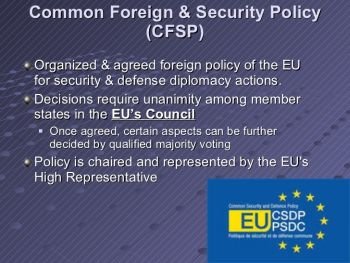
5. Supportive competences. These refer to areas in which the Member States have not conferred competences on the EU but have decided to act through it. In these areas the EU supports, co-ordinates, encourages or complements measures taken at national level. Article 6 TFEU provides a list of areas in which the Member States have exclusive competence but the Union can provide support or co-ordination. It is to be noted that special rules are applicable to three areas, i.e. economic and employment policies and the CFSP.
6. The “flexibility clause” contained in Article 352 TFEU. The clause can be used to achieve the objectives of the Treaties as listed in Article 3 TEU but not to objectives of the CFSP. Its role has been marginalized by the facts that for the adoption of a measure under Article 352 TFEU the Council is required to obtain the EP’s consent (previously under Article 308 EC the Council was required to consult the EP) and that its use is subject to the “yellow and orange cards” procedure available to national parliaments.
7. The exercise of Union competences by a limited number of Member States: the enhanced cooperation procedure. The ToL has further reformed the enhanced co-operation procedure to make it more attractive to the Member States, mainly by providing that when an enhanced procedure is in progress, the Council acting unanimously may adopt a decision, stipulating that it will act by QMV where the Treaty stipulates that the Council shall act unanimously. The only constraint imposed on the Council is that it must consult the EP. However, a new restriction is imposed as to initial authorization in that the EP has to consent to this. In the past, the EP has not been very enthusiastic about the enhanced procedure.
8. The nature of the EU. The issue here is to determine whether the EU is an international organization of a type similar to a confederation or an embryonic federal state or of a sui generis nature.
The term “competence” refers to the responsibility for decision making in a particular policy area. Since the inception of the EC important competences have been transferred to the EC/EU by Member States, which have had the effect of shrinking their individual spheres of competence, thus imposing limitations on their sovereignty. Since the establishment of the Community, its areas of competence have considerably expanded. This growth of Community competences, in particular in the circumstances where they were acquired through the creative interpretation of the EC Treaty by the ECJ, combined with the fact that the division of competences between the EC and the Member States was not clearly defined in the EC Treaty, became one of the most crucial issues in the debate about the future of the EU. In this debate the position of the parties concerned can be summarized as follows:
1. The Member States feared that the system of delimitation of powers under the EC Treaty, based on the objectives to be achieved and means of achieving those objectives, made it very difficult to decide whether the Community’s acts were within its competence or whether the Community exceeded its powers and by this encroached even further on national sovereignty.
This fear was understandable in the light of the past record of the EC, but in recent years complaints about “creeping competences drift” in favour of the EC were less justified, given that the ambitious agenda of the EC (such as the creation of the internal market, EMU, and the area of FSJ) had required adoption of numerous measures which were necessary and directly linked to the successful implementation of the EC agenda. Nevertheless, the lack of clear boundaries between national and Community action reinforced the feeling of encroachment by the EC;
2. EU citizens feared that the EC would acquire more and more powers without adequate democratic oversight;
3. The EC feared that an irrevocable fixing of the Community competences would stall the dynamics of European integration, given that the Community may, as a result, not be free to respond to new challenges in ways which would allow its objectives to be fulfilled;
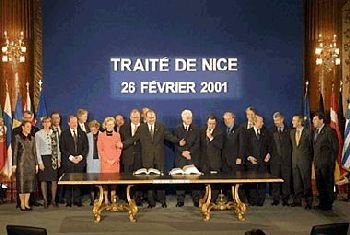
4. Since 2000 the issue of division of competences has become part of the fundamental reform of the Union. The Declaration on the Future of Europe, issued by the Nice European Council and attached to the Treaty of Nice, called upon the 2004 IGC to address the issues of “how to establish and monitor a more precise delimitation of powers between the European Union and the MemberStates, reflecting the principle of subsidiarity”. In 2004 the IGC made proposals which were incorporated into the failed Constitutional Treaty, but have subsequently, with some amendments, found their place in the ToL. They are as follows:
5. The ToL codifies and describes the division of competences between the Union and the MemberStates (Article 2 TFEU). It clearly identifies policy areas in which the EU exercises exclusive, shared, and supportive competences;
6. The importance of the principle of conferral is emphasized in the Treaties as well as in Protocols and Declarations attached to them. Under this principle the EU exercises only the competences which Member States have conferred upon it with the result that competences not conferred upon it remain within the Member States;
7. For the first time, the Treaties expressly provide for the possibility of reducing the competences of the Union, if appropriate. In this respect Article 48 (2) TEU specifies that proposals for the revision of the treaties “may, inter alia, serve either to increase or to reduce the competences conferred on the Union in the Treaties”. Although it has always been possible for Member States to reduce competences of the EU, until now this has never been specified so clearly and, in fact, any revision of the treaties has been in favour of the development of the acquis communautaire (under the ToL this is referred to as the “EU acquis”) and thus in favour of the extension of competences of the EC and the EU;
8. With regard to areas of shared competences, Protocol 25 on the Exercise of Shared Competences attached to the Treaties envisages a situation where an EU institution decides to cease exercising its competence in a particular area. This occurs in particular when an EU institution decides to repeal a legislative act in order to comply with the principles of subsidiarity and proportionality. The Protocol states that the Council may, at the initiative of one or several of its members and in accordance with Article 241 TFEU, request the Commission to submit proposals for repealing a legislative act. In the area covered by the repealed legislative act Member States would regain their competence;
9. National parliaments have been given an important role in policing the application of the principles of subsidiarity;
10. The ToL establishes special rules with regard to three areas: economic and employment policies which are to be co-coordinated by MemberStates and the CFSP;
11. The use of the “flexibility clause” contained in Article 352 TFEU has been marginalized;
12. Under Article 47 TEU, the EU has been granted legal personality. The EU, being the successor of the EC, has absorbed its legal personality. From now on there is only one legally recognized organization, the EU, with a single legal personality. However, the granting of legal personality to the EU does not have any implications on the allocation of competences between the EU and the MemberStates.
Declaration 24 attached to the Treaties confirms that “the fact that the European Union has a legal personality will not in any way authorize the Union to legislate or to act beyond the competences conferred upon it by the Member States in the Treaties”. Under the ToL the EU has not acquired any new exclusive competences although it has gained new shared and supporting competences. It is to be noted that prior to the entry into force of the ToL, the EU had already legislated in the majority of “new” areas on other legal bases. As a result, the ToL rather confirms the pre-existing competences of the EU than extends them. Entirely new competences, i.e. areas in which the EU had not acted or had no ability to act prior to the entry into force of the ToL, relate to: space policy; administrative co-operation aimed at improving the capacity of Member States, at their request, to implement EU law effectively; sport; crime prevention; establishment of a European Public Prosecutor; measures facilitating co-ordination and co-operation among Member States in respect of diplomatic and consular protection of EU citizens and the solidarity clause contained in Article 222 TFEU.