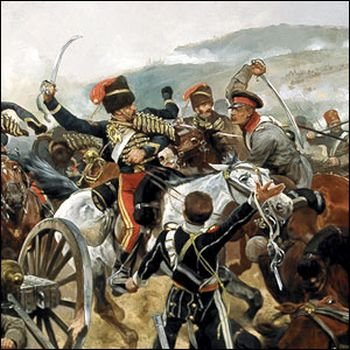
The Crimean War (October 1853 – February 1856) was a conflict between the Russian Empire and an alliance of the French Empire, the British Empire, the Ottoman Empire. The war was part of a long-running contest between major European powers for influence over territories of the declining Ottoman Empire. It is sometimes considered to be one of the first “modern” wars as it “introduced technical changes which affected the future course of warfare”, including the first tactical use of railways and the electric telegraph. The Crimean War was one of the first wars to be documented extensively in written reports and photographs: notably by William Russell (for The Times newspaper). News from war correspondents reaching Britain from the Crimea kept the public informed of the day-to-day realities of the battlefield for the first time.
PRELUDE TO UNIFICATION: THE CRIMEAN WAR
Before turning to the unifications of Italy and Germany, we should mention briefly another event that had some bearing on those events-the Crimean War (1853–1856). This war was named after the Crimean peninsula, part of the Russian Empire that juts out into the Black Sea. Britain and France launched an attack there to assist Turkey in resisting Russian claims on Ottoman Turkish territory and the Russian tsar’s efforts to extend protection over Christian subjects of the Ottoman Empire. The Kingdom of Sardinia also joined in the war against Russia, mainly to win support from England and France for the idea of a united Italy. Related to all of this was the issue of control over the Dardanelles, the critical straits that connect the Black Sea to the Mediterranean. The conflict was a nasty one of trench warfare, cholera, and huge casualties, a foreshadowing of what was to come a half century later in World War I. It was the first war covered by newspaper correspondents and the first in which women served as army nurses. Florence Nightingale became a legend when she commanded the British nursing services during the war. Russia’s defeat in the war led to the neutralization of the Black Sea, the extension of joint European protection over Ottoman Christians, and a European guarantee of the integrity of the Ottoman Empire. In addition, Romania and Serbia were recognized as self-governing principalities and soon thereafter became independent states. Even more important, however, was the impact of this war on the European balance of power.
Russia’s defeat in the war and Austria’s abstention from it weakened the two states that were most determined to preserve the peace settlements of 1815 and to prevent change. Furthermore, the Sardinian gambit succeeded in advancing the Italian question.
MAZZINI, CAVOUR, AND THE UNIFICATION OF ITALY
Before 1860, the Italian peninsula was a patchwork of about a dozen large states and a number of smaller ones. Sardinia (also known as Piedmont) in the northwest had the only native Italian dynasty in Italy. Lombardy and Venetia had, since 1814, belonged to the Austrian Empire, which also dominated Tuscany, Parma, and Modena. Across the middle part of Italy were a cluster of small Papal States controlled by the Roman Catholic Church at the Holy See in Rome. In the south, the Kingdom of the Two Sicilies (Naples and Sicily) was ruled by a branch of the Bourbon dynasty of France.
The Italian movement for national unification was known as Il Risorgimento (the resurgence) after a newspaper founded in 1847 by Count Camillo di Cavour (1810–1861), the prime minister of Sardinia after 1852.
It had earlier roots, though, in a number of secret independence societies and in the Young Italy movement of Giuseppe Mazzini (1805–1872), whom we encountered in chapter 4, on the 1848 revolutions. Mazzini was a nationalist revolutionary and spent most of his life in exile in France, Switzerland, and England. “A nation,” Mazzini proclaimed, “is the universality of citizens speaking the same tongue,” so he favored uniting all Italians in one national state. Although Mazzini won support from some leaders in Sardinia and elsewhere, Cavour had little sympathy for Mazzini’s revolutionary nationalism, preferring a more controlled movement toward unification under a liberal, constitutional monarchy. In 1848, popular nationalism had erupted all over Italy, with independent republics proclaimed in Venice and Rome and rebellions in Sicily against the Bourbon monarch. All of these uprisings were crushed, however, as they had been elsewhere on the Continent. A decade later, though, the situation in Italy was different.
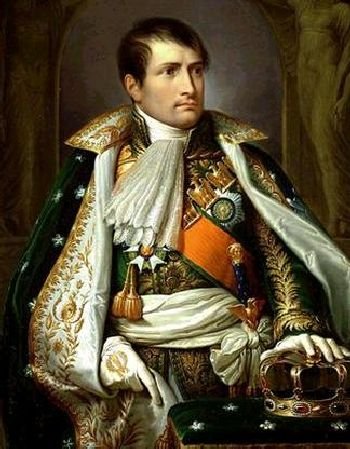
Sardinia had won gratitude from France and Britain for participating in the Crimean War. Napoleon III of France was willing to support Sardinia’s claims against Austria, which dominated much of northern Italy. With Napoleon’s backing, Cavour provoked a war with Austria in 1859. Napoleon III himself led one hundred thousand troops from France into northern Italy to fight against Austria, which suffered major defeats. Tuscany, Modena, Parma, and Romagna drove out their Austrian rulers and were annexed to Sardinia. In the south, the romantic revolutionary from Piedmont, Giuseppe Garibaldi, led his thousand “Redshirts” in a seizure of power in Sicily and Naples. Plebiscites there confirmed popular desire to join with Sardinia. In the peace settlement that ended the war, Austria held on to Venetia but little else; the pope still ruled in Rome but lost control over the Papal States, and France took Savoy and Nice. But Sardinia had won control over the rest of Italy. In May 1861, an all-Italian parliament was convened in Turin and proclaimed the Sardinian ruler Victor Emmanuel II as king of Italy. Five years later, when Austria was at war with Prussia, Italy seized Venetia. In 1870, when France was distracted by the Franco-Prussian War, Italy seized the rest of the Papal States, including Rome, and limited the pope’s dominion to the square mile of the Vatican. That completed the unification of Italy. The consolidation of territory, however, was only one part of the nation-building process. As one Italian nationalist remarked at the opening of the unification parliament in 1861, “Now that we have created Italy, we must start creating Italians.” At the time, only a minority of people living in Italy spoke the Italian language, which had evolved from Tuscan. The challenge of creating a sense of common Italian identity, particularly between northern and southern Italy, has endured until this day.
BISMARCK AND THE UNIFICATION OF GERMANY
The unification of Germany proceeded in a similar fashion to that of Italy, with a strong leader, Otto von Bismarck (1815–1898), of a powerful core state, Prussia, warring on neighboring states to consolidate other German territories under Prussia’s dominion. As in Italy, the first stab at national unity had been stymied in the failed revolutions of 1848. A generation later, Germany was finally unified when the issue was pushed by the king of Prussia and his forceful chancellor, Bismarck.
Bismarck was a Junker (the landlord class) from Brandenburg, in Prussia, and was appointed chancellor (or premier) of Prussia, the most powerful of the German states, in 1862. Bismarck was neither a nationalist, nor a liberal, nor a democrat, but he wanted to strengthen the position of Prussia in Germany and of Germany in Europe. “The position of Prussia in Germany,” he told the Prussian parliament, “will be determined not by its liberalism but by its power. . . . Not by speeches and majority votes are the great questions of the day decided-that was the great error of 1848 and 1849-but by iron and blood.” From this “blood and iron” speech and his forceful actions to achieve German unification, Bismarck became known as “the Iron Chancellor.”
Bismarck essentially wanted a new German confederation, but one without Austria. He accomplished this through a series of short decisive wars against Denmark, Austria, and France, each time seizing pieces of territory and pushing those neighboring states out of German affairs. The first of these wars, in 1864, against Denmark was over the long-disputed territories of Schleswig and Holstein. These two duchies were ruled by the Danish king, although they were not formally part of Denmark. Because large numbers of Germans lived in them, the separation of Schleswig-Holstein from Denmark became a passionate issue for German nationalists.
Bismarck simply wanted to incorporate them into Prussia, but the issue of Schleswig-Holstein was arcane and complex. The British Prime Minister Lord Palmerston once said that only three men truly understood the problem: One was dead; one had gone mad; and the third, Palmerston himself, had forgotten it. In any case, Bismarck’s opportunity arose when Denmark decided to incorporate Schleswig. Bismarck organized an alliance with Austria, and together the two large states quickly defeated Denmark. Prussia took Schleswig, and Austria took Holstein.
For Bismarck, though, Austria was a bigger target than Denmark. He wanted to isolate Austria internationally and remove it from the German equation, so that Prussia would have a free hand in shaping (and dominating) a north German confederation. The opportunity to attack Austria came in 1866, when Austria and Prussia were quarreling over control of Schleswig-Holstein. Austria, as we have seen, was already relatively isolated after the Crimean War and its conflict with France during Italian unification. In a startlingly swift victory, Prussia was able to defeat Austria in what became known as the Seven Weeks’ War. Prussian success was due in large measure to the application of new technologies to logistics and warfare: the new breech-loading “needle gun” (which could be fired from the prone position) and the use of the railroad and the telegraph to move and coordinate troops and supplies. In the aftermath of the war, Prussia annexed Schleswig-Holstein, Hanover, and a number of other territories, and Bismarck formed his North German Confederation of twenty-two states. The constitution for the confederation included a parliament with broad suffrage, a move that won widespread popular support for his emerging German empire.
The final piece of the puzzle for Bismarck was the addition to the empire of the southern German states (including Bavaria), but this was opposed by France, which understandably feared this expansion of Prussian power. In 1870, Bismarck provoked the French ruler, Napoleon III, into declaring war on Prussia over a minor issue involving the fate of the Spanish throne. The Franco-Prussian War lasted only six weeks, and the Prussian victory was so swift and unexpected that there was no French government left to surrender. Napoleon III was taken prisoner, abdicated, and took refuge in England. An insurrection in Paris (following those in 1789, 1830, and 1848) eventually led to the establishment of the French Third Republic (which survived until World War II). After six months of chaos, the French signed a humiliating peace accord, agreeing to pay huge reparations to Germany and ceding the territories of Alsace and Lorraine. Bismarck proclaimed the establishment of a new German empire, with Wilhelm I as emperor of Germany. The site for this important proclamation was not in Germany, but in France, in the Hall of Mirrors at Versailles. (The French did not forget this humiliation and, after World War I, forced the Germans to sign their surrender at the same site.) As with Italy, Germany had been unified from above and with force. Unlike Cavour, though, Bismarck did not rely on popular plebiscites to ratify the consolidation of the state. Bismarck had created Germany through blood and iron.
Giuseppe Garibaldi: Italian Nationalist and Romantic Revolutionary
The foremost military figure and most popular hero of the Italian unification movement was the flamboyant adventurer Giuseppe Garibaldi (1807–1882). Garibaldi was born in Nice, France (just across the border from Italy), and was largely self-educated. In his youth, he joined Young Italy, the movement organized by Mazzini to achieve freedom and independence for the Italian people. He was sentenced to death by a Genoese court for participating in an abortive insurrection in Piedmont, in 1834, but escaped to South America, where he lived for twelve years. There, he led military actions in civil wars in both Brazil and Uruguay, helping to assure the independence of Uruguay from Argentina.
During the Peoples’ spring of 1848, he returned to Italy to take part in the movement for Italian freedom and unification known now as Il Risorgimento. Organizing a corps of three thousand volunteers, he fought against the Austrians in Lombardy and supported the Roman Republic established by Mazzini.
In defeat, having lost most of his forces, he fled Italy, moved to Staten Island, New York, and became a U.S. citizen and a candle maker. In the 1850s, Garibaldi returned to Italy to support Cavour and Victor Emmanuel in their wars of Italian unification. In 1860, he took a force of one thousand men, known by their uniforms as “Redshirts” to Sicily, which was then controlled by the Bourbon king of Naples. He conquered the island, set up a provisional government, and then crossed to the mainland and took Naples (which controlled most of the southern half of the Italian peninsula). This was a key piece of the Italian puzzle, enabling the establishment, in 1861, of the Kingdom of Italy with Victor Emmanuel as king. Garibaldi was dissatisfied with the exclusion of Rome from the kingdom, though, and fought several times over the next years to attach the Papal States to Italy.
Eventually, Rome was annexed to Italy. Garibaldi was elected to Parliament in 1874, and died in 1882.