What is evolution? Charles Darwin’s brilliant idea explained
THE IDEA OF COMMUNISM
According to Marxist theory, when the workers own the means of production, the entire economic substructure will collapse and re-form, as will the superstructure of society. Social classes will disappear. In the words of the Manifesto, “in the place of the old bourgeois society with its classes and class antagonisms, there will be an association in which the free development of each is the condition for the free development of all.”
Without the bourgeoisie to skim off surplus value, workers and peasants will benefit from the full fruits of their labor. Capitalism, with its mass production, had provided enough material goods to satisfy the needs of everyone, and with a more equitable distribution of goods under communism, everyone’s basic needs will be satisfied. The governing principle of the new society will be “from each according to his abilities, to each according to his needs”: Each person will contribute to society what he or she does best and will get whatever he or she needs.
One might object that some greedy people will claim that they need more than they really do (i.e., what if someone needs a fifty-foot luxury yacht?), but the Marxist response to this is that human nature (part of the superstructure) will also have changed. Although capitalism requires human nature to be competitive, aggressive, and greedy (remember Adam Smith’s notion that private vice creates public virtue), communism will foster human values of cooperation and solidarity. Without exploitation of labor and with adequate reward for one’s work, workers will not feel the need to compete in the workplace. According to Marx and Engels, a “new man” will build a new society.
When social classes disappear, so too will poverty, exploitation, resentment, greed, and crime, so that there will be no need for a police force. Indeed, because government simply perpetuates the supremacy of the dominant class, without social classes there will be no need for government at all. The state, according to Engels, will simply “wither away.” As states disappear, so will national boundaries, national conflicts, and wars, and the planet will evolve into a global community of workers joined in solidarity.
Marxist theory, then, was both relentlessly logical and, in the end, broadly appealing. Its rigor and science appealed to many students and intellectuals, and fit with the nineteenth-century ethos of progress, realism, materialism, and science. For workers of all kinds, it offered both an explanation for their plight and an attractive resolution to it. Nevertheless, communism remained a small and isolated piece of political thought throughout the remainder of the century and might have remained a footnote in history were it not for the Russian revolutionaries who revived and adapted it at the beginning of the twentieth century.
THE LEGACY OF MARXISM
Marxism, as we have seen, was a reaction to and product of the Enlightenment, capitalism, and industrialization. It contributed to our understanding of history and human society, and to the way in which we study those topics. Marx was one of the first social scientists, in terms of his efforts, to apply scientific and systematic methods to the study of society. And, even though modern social scientists have rejected many of his ideas, his notion of economic determinism (that the economy determines much else in society) has broad applications in contemporary sociology, political science, economics, and other disciplines.
But Marx’s biggest impact, of course, was in the political realm rather than the academic. The writings of Marx and Engels were instrumental in the development of socialism and socialist parties in Europe, especially in the 1870s and 1880s. Although socialism never became much of a force in North America, it was a powerful political movement in Europe and remains so today, in the form of the socialist, democratic socialist and social democratic political parties that play a major role in virtually all of the European countries.
From the nineteenth century forward, most of these socialist parties were parliamentary parties in the sense that they worked for socialist outcomes and programs within the legal constraints of their political systems. They favored broad-based equality, social welfare, and public ownership of the means of production, while rejecting the proletarian revolution that was intrinsic to Marx’s theory. Communism, as such, was not a major political factor, or even much used in political vocabularies, until Russian radicals and revolutionaries resurrected it near the end of the century.
It was in Russia, of course, that Marxism eventually gained a foothold and a platform for expansion. Before 1905, tsarist Russia essentially had no parliament or democratic politics, so there was no room for legal political parties of any kind. The politics that did exist took the form of underground, illegal, or exile political organizations. This was how the first Russian Marxist party was formed, by Russian exiles in Switzerland, in 1883. Das Kapital had been translated into Russian just a decade before and attracted the attention of Russian radical’s intent on transforming the stultified Russian autocratic state. Marxism seemed to provide both an explanation for Russia’s backwardness and a solution to its problems.
Vladimir Lenin participated in the Second Congress of the Russian Social Democratic Labor Party (the Russian Marxist party) in Brussels and London in 1903, and he soon became the leader of the Bolshevik (majority) faction of the group. Russia’s involvement in World War I (1914–1918) gradually weakened the Russian autocracy and the Russian state, and the Bolsheviks seized power in November 1917. They proceeded to establish a government based on Marx’s ideas, as revised for Russian circumstances by Lenin. The official ideology of the new state was Marxism-Leninism. The Bolsheviks became the Communist Party, and the Russian Empire became the Soviet Union. The last words of The Communist Manifesto, “Working men of all countries, unite!” were emblazoned on the masthead of every newspaper published in the country (and on Communist Party newspapers all over the world). Communists ruled the country until its collapse in 1991. (All of this will be treated more thoroughly in chapter 10).
After World War II, communism spread into Eastern Europe, China, North Korea, Southeast Asia, and Cuba, and the communist ideology and model became hugely influential throughout the Third World. Only eleven people attended Karl Marx’s funeral in 1883. By the 1960s, half the world’s people lived under governments that ruled in his name.
Darwinism and Social Darwinism
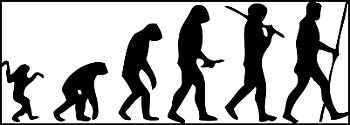
A decade after the appearance of The Communist Manifesto, the Englishman Charles Darwin published another revolutionary writing, Origin of Species. Just as Marx had produced a general theory about the history and development of societies, Darwin presented a universal theory about the origin and development of all living species. His theory of evolution by natural selection, backed by extensive evidence he had collected himself, revolutionized biology, and the sciences more generally, and stimulated the development of the social sciences as well. Evolutionary theory also directly challenged key elements of religious thought at the time, including literal interpretations of the biblical story of creation and also natural theology, with its harmonious image of nature designed by God. Darwinism raised questions about the very nature of humankind and those beliefs that were so fundamental to religion. Eventually, as Darwinism gained acceptance, it effected changes in religion and theology, too.
Darwinism, like Marxism, was a product of its time and place. Darwin’s commitment to empiricism and science reflected both the Scientific Revolution and the Enlightenment. He was influenced by the ideas of Adam Smith and Thomas Malthus and by recent evidence and theories from geology and paleontology that raised questions about the age of the earth. And, he was a product of his own upper-middle-class Victorian environment, which stressed the virtues of discipline and hard work but also often blamed the poor for their own circumstances.
Darwin’s study of the origin of species spun off another set of theories called social Darwinism. Popularized by the English philosopher Herbert Spencer, who coined the phrase “survival of the fittest,” social Darwinism applied Darwin’s ideas of the evolution of species to a description of society and the “evolution” of particular groups, races, and nations. Unlike Darwinism, however, which was exclusively descriptive, social Darwinism included a prescriptive dimension and, in its rawest form, called for the elimination of any government programs that might assist the poor, weak, or “inferior,” so that they might be allowed to die off in the natural struggle for survival. In the following decades, these ideas were marshaled in support of militarism, racism, imperialism, and the more virulent forms of nationalism.