“Divide an orange – it tastes just as good”
Chinese Proverb
VIDEO
Official video from EESC – Treaty of Rome
Aide – Mémoire
EU Big Events and Big Dates
9 May 1950 – The Schuman Plan. R Schuman, the French foreign minister, proposed the creation of the European Steel and Coal Community.
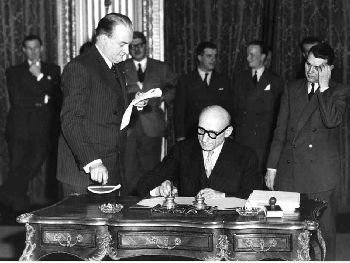
18 April 1951 – Signature of the Treaty creating the European Coal and Steel Community (CS Treaty), which entered into force on 23 July 1952 and expired on 23 July 2002.
25 March 1957 – Signature of the Treaty creating the European Economic Community (EC Treaty) and the European Atomic Energy Community (EA Treaty), both of which entered into force on 1 January 1958.
14 January 1963 – France vetoed the accession of the UK to the Communities. The second application by the UK was submitted in 1967 and immediately rejected by France.
8 April 1965 – The Merger Treaty was signed merging the executive bodies of the three Communities (the CS, EC, and EA) and creating a single Council and a single Commission. It entered into force on 13 July 1967.
1 July 1965 – Beginning of the “empty chairs” crisis ended by the Luxembourg Accord of January 1966.
29 January 1966 – The Luxembourg Accord ends the first major political crisis in the EC.
Under the agreement unanimity voting in the Council was agreed when “vital national interests” of a MemberState were at issue.
1 July 1968 – Elimination of all customs duties in respect of industrial products, the creation of the Customs Union among Member States and the establishment of the Common Customs Tariffs for goods from outside the Community. This was achieved 18 months in advance of the agreed timetable.
1-2 December 1969 – The Hague Summit. The Member States decided to meet regularly at the level of heads of state or government. These informal meetings were recognized as a Community institution, that is, the “European Council”, by the Paris Summit in December 1974.
24 April 1972 – Creation of the monetary “snake,” which constituted the first stage towards the creation of the European Monetary Union.
1 January 1973 – Accession of Denmark, Ireland and the United Kingdom to the Communities.
7 July 1978 – Creation of the European Monetary System (EMS), replacing the monetary “Snake”. The Exchange Rate Mechanism (ERM) was launched on 13 March 1979.
10 June 1979 – First direct elections of members of the EP by citizens of Member States based on universal adult suffrage.
1 January 1981 – Accession of Greece to the Communities.
14 June 1985 – The Schengen Agreement was signed between Germany, France and the Benelux countries aiming at abolishing the internal borders among them and creating a single external border, where checks for all the Schengen countries were to be carried out in accordance with a common set of rules.
1 January 1986 – Accession of Spain and Portugal to the Communities.
17 and 28 February 1986 – Signature of the Single European Act which entered into force on 1 June 1987.
19 June 1990 – Signature of the Schengen II Agreement which aimed at eliminating frontier controls between the participating Member States. It entered into force on 26 March 1995.
3 October 1990 – Reunification of Germany.
7 February 1992 – Signature of the Treaty of Maastricht, which entered into force on 1 November 1993, and which created the European Union.
31 December 1992 – The official completion of the internal market.
1 January 1995 – Accession of Austria, Finland and Sweden to the EU.
2 October 1997- Signature of the Treaty of Amsterdam, which entered into force on 1 May 1999.
1 January 1999 – The Euro became the currency for 11 Member States.
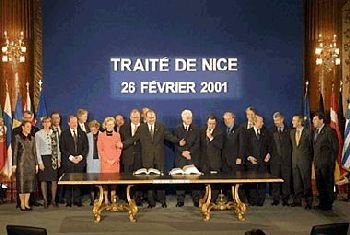
8 December 2000 – The European Council agreed on the Treaty of Nice, which was signed on 26 February 2001 and entered into force on 1 February 2003.
18 July 2003 – Approval of a draft of a Constitutional Treaty by the Brussels European Council Meeting. The proposed EU Constitution was signed in Rome on 20 October 2004 by the heads of state or government of the 25 MemberStates and the three candidate states.
21/22/23 June 2007 – The European Council decided to abandon the Constitutional Treaty. As a result, it never came into force.
1 May 2004 – Accession of 10 Member States to the EU: Cyprus, the Czech Republic, Estonia, Hungary, Latvia, Lithuania, Malta, Poland, Slovakia and Slovenia.
3 October 2005 – Official accession negotiations with Turkey and Croatia commenced.
1 January 2007 – Accession of Bulgaria and Romania to the EU.
23 June 2007 – The 2007 IG commenced its work on the Reform Treaty (the Treaty of Lisbon – the ToL).
13 December 2007 – The European Council approved the Reform Treaty (the Lisbon Treaty).
15 December 2007 – The Netherlands Antilles islands of Bonaire, Saabs, Saint Eustatius, Curacao, and Saint Martin became part of the EU.
1 December 2009 – the entry into force of the ToL.
Recommended Reading
Books
Cini, M. and Pérez-Solórzano Borragán, N. (eds), European Union Politics, 3rd Edition, 2010, Oxford: OUP
Ott, A. and Vos, E. (eds), Fifty Years of European Integration, 2009, Cambridge: CUP van Empel, M., ‘From Paris to Nice’: Fifty years of Legal Integration in Europe: International Pallas
Conference, Nijmegen, May 24, 2002, 2003, The Hague: Kluwer Law International
Vinen, R., History in Fragments: Europe in the Twentieth Century, 2002, London: Abacus
Articles
Birkinshaw, P., “A Constitution for the EU?” (2004) 10 (1) EPL, p 57
Curtin, D., “The Constitutional Structure of the Union: A Europe of Bits and Pieces”, (1993) 30 CMLRev, p 17
Dougan, M., “The Treaty of Lisbon 2007: Winning Minds, not Hearts” (2008) 45 CMLRev, p. 617
Sˇlosarcˇ ík, I., “Czech Republic 2006–2008: On President, Judges and the Lisbon Treaty” (2010) 16 EPL, p 1
Ward, I., “Bill and the fall of the Constitutional Treaty”, (2007) 13/3 EPL, p 461
Ziller, J., “The German Constitutional Court’s Friendliness towards European Law: On the Judgment of Bundesverfassungsgericht over the Ratification of the Treaty of Lisbon” (2010) 16 EPL, p 5