European Convention on Human Rights
Legal Diplomacy
From Great Idea to ‘Convention à la Carte’
A key question related to the broader process of drafting the European Convention is where did the idea of establishing a supranational human rights system come from, and which political and legal milieus advocated what was a radical reform of European inter-and intra-state legal affairs.
As suggested by A. W. Brian Simpson, the international legal academic Hersch Lauterpacht was clearly very central to the promotion of genuine legal instruments and institutions in the area of human rights in the aftermath of World War II.
He shrewdly used the International Law Society to ensure both the diffusion of his ideas among relevant national and international actors and the legitimacy of an organisation counting some 250 leading international lawyers.
At the UN, Lauterpacht had also been a central player, but in a somewhat indirect way. Regardless of his status as a pioneer in the subject area of international human rights law, he had not been appointed an official representative of the United Kingdom. This was due to the Foreign Office’s considering him a ‘disastrous’ candidate: He was not ‘sound enough’, that is, he was considered too idealistically and personally involved to perform the kind of pragmatic diplomacy favoured by the Foreign Office.
Perhaps even more critically, theForeign Office head legal advisor did not find him ‘English enough’ because of his Jewish ancestry. Nevertheless, the drafts supplied by the Foreign Office during the negotiation of the Universal Declaration were clearly marked by Lauterpacht’s thinking. On the European level, Lauterpacht’s involvement was also indirect; his only direct involvement in the negotiation and drafting of the ECHR was as an inactive member of the Juridical Committee – the Draupier Commission – which had been set up at The Hague in 1948 to produce a draft European Charter.
Moreover, Lauterpacht was not involved in drafting the Teitgen Report, nor was he involved in the many debates under the auspices of the Council of Europe. His role was that of contributing to an idea which is now taken for granted: International and European human rights can be protected only if powerful institutions are created to monitor and enforce such legal documents. However, as already suggested, the text finalised in 1950 was to be marked by some striking compromises as regards the institutional mechanisms.
The ECHR had at best a ‘refl exive’ institutional order, balancing legal autonomy with national sovereignty. It is telling that Lauterpacht turned out, eventually, to be in favour of an intermediary Commission, and even denounced the idea of an exclusive Court as ‘neither practicable nor desirable’.
The original introduction of the idea of a Court in the draft Charter produced after the Congress of Europe was, in fact, mainly seen as a pragmatic solution fi tted to another problem, namely, the aforementioned confl icts over the defi nition of the rights catalogue. A Court, the argument went, could be charged with carving out a detailed jurisprudence, and, thus, the delicate political problem of defi nition was, if not solved, then left for later, allowing the negotiations to proceed.
Introducing the idea of a Court in order to solve the problem of defining the rights catalogue, however, only opened up a new conflict concerning the actual desirability of such an institution. It is in this light that Lauterpacht’s somewhat surprising statement has to be seen. Even if the solution of a Court, at first glance, seemed to appeal to common law traditions, the British delegation was among the fiercest opponents of having an imprecise document left with an uncertain supranational institution.
Furthermore, as a later judge at the European Court writes:
‘It was considered unacceptable that the codeof common law and statute law which had been built up in the country over many years should be made subject to review by an International Court’.
Adding the argument of the paramount role of Parliament in the British political tradition, the almost insurmountable task facing the negotiators was plain to see. The question of establishing a Court was, in practice, met with considerable opposition from a host of countries well into the meetings held in the summer of 1950.
This had the effect that the idea of an intermediary body in the form of a Commission was gradually gaining support as a viable alternative.Only a small majority supported the question of individual petition, whilst the ongoing issue of whether to draft clear legal obligations or leave it to the Court to carve out the jurisprudence continued to see very conflicting views.
The only real agreement was that a document of this kind was needed in light of the geopolitical climate of the day, yet any consensus on the contents remained far off. In this context, it becomes apparent why, for example, the Teitgen Committee could play a decisive role. It basically provided the right blend of comprehensive legal solutions and ‘diplomatic appeasement’, which was much in demand if the project, was to succeed at all.
Moreover, by occasionally playing their trump cards as hardened World War II freedom fighters, these legalpolitical experts could unambiguously evoke the imminent dangers of the time – the looming imperialism of the Soviet Union – by a double reference to totalitarianism implying simultaneously the Nazis and the ‘Commis’. Besides Pierre-Henri Teitgen, a law professor, postwar French Minister of Justice and well-known member of la Résistance , the Committee also counted amongst its members Sir David Maxwell Fyfe, a British barrister and former Prosecutor at the Nuremberg War Crime trials, and Antonio Azara, a former Italian Minister of Justice and fi rst President of the Italian Court of Cassation. It was this all-star cast of legal and political expertise that was to ensure that most of the draft Convention could pass the final political screening before signature.
The learned opinions of even the most well-endowed and respected lawyer-politicians, however, do not necessarily equate with what can be voted for in a plenary meeting of politicians assisted by their senior legal advisors. In uncertain policy areas, the crafting, selection and promotion of the mainideas obviously constitute a key stage in the manufacturing of consent. In this respect, there is little doubt that the Teitgen Committee, and its predecessor set up at the Congress of Europe, generally managed to defi ne what this new subject should entail. Yet the idea of European human rights was, in a somewhat paradoxical way, both novel and well known; that is, even though Teitgen & Co. carried out impressive lobbying, the politicians and their senior legal advisors eventually started scrutinising these proposals and redrafting them according to national conceptions of human rights.
In the course of the many meetings and negotiations, the ‘new’ subject area of European human rights was also becoming increasingly familiar to the various national delegations, which meant that they also increasingly started to assume their traditional roles as brokers of national interests. As this became the case, it became equally clear that some compromises were badly needed if the Convention was to be saved.
To make a long and complex story short, the outcome of the decisive meetings in the late summer of 1950 was that a series of optional clauses were introduced in the final text. The acceptance of the Court, individual petition and the application of the Convention in the colonies were all made optional.
This was done in a last-ditch manoeuvre to satisfy what continued to be insurmountable differences of the not yet united Europe. As an effect, the great moral-politico framework of the ‘Free Europe’, which the project of the European Convention had fi rst emerged as in the late 1940s, was at the end of the day turned into more of a ‘Convention à la carte’. Human rights, the inalienable rights of European men and women, were being europeanised only inasmuch as the contracting states allowed for it.
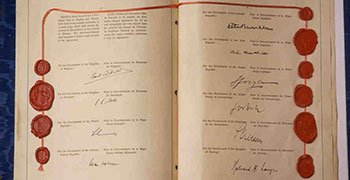
Furthermore, as a result of this situation, the negotiation of the idea of European human rights was to continue well beyond the day of signature of the ECHR, 4 November 1950: In 1952, the European Social Charter saw the light of day, and in the course of the following decades a series of other amendments, known as Protocols 2-5, also appeared. The bottom line was that the rise of a legal practice of European human rights was to take place in the context of a continuous political meddling with the idea of European human rights.
Law and politics did not, in other words, go separate ways after the drafting, as is the custom, but remained mutually dependent variables in the manufacturing of postwar human rights. As suggested in the following, the institutionalization and juridification of the Convention was to be considerably influenced by this logic of path dependence.