Institutions
A third major part of the analyses by the EEAG is policy recommendations about possible changes in institutions, needed to enhance the efficiency and overall welfare in the European economy. In fact, Ifo Institute started with monitoring and assembling information about different institutional arrangements in the European Union two years before the formation of the EEAG.
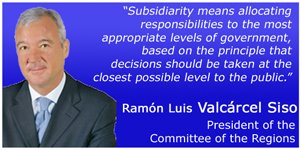
This database that has now accumulated over the past years is referred to as DICE – the Database for Institutional Comparisons in Europe.Institutions subject to investigation are, for instance, those that govern the functioning of financial markets, education and competition among firms. We start by revisiting the principle of subsidiarity, which is a central concept in the delineating the powers between the EU Commission and the national governments. It thus guides the determination the level of government responsible for taking action in the various different areas where policy actions are needed.
Rethinking Subsidiarity in the EU: Economic Principles
A reconsideration of the EU policies and the concept of subsidiarity have been timely due to the recent enlargements and the proposed constitution for the enlarged EU. The challenges ahead require careful consideration of the division of responsibilities for decision making of public sector activities.
Analysis of economic efficiency provides a useful guideline for assessing, which public sector tasks should be delegated to the competence of the EU and which tasks should be the responsibility of national governments of the member states. While there are reasons for using subsidiarity as the basic principle, in a number of tasks there are sound economic reasons for deviations from it. These exceptions must be analyzed case by case.
Maintenance and promotion of the single market is the most basic EU-level task. It involves not only the removal of obstacles to trade and economic integration but also activities, such as the design and implementation of an active competition policy, that facilitate the functioning of the single market.
The EU involvement has both an internal and an external dimension. In fact, it should not be forgotten that regional free trade areas might lead to trade diversion rather than trade creation. To be consistent with its ultimate goal of promoting the welfare of European citizens, EU-level trade policy should be geared towards global free trade.
A second reason for delegation of specific tasks to the EU-level of government arises from the existence of public goods, which have geographically widely dispersed benefits. Defence, foreign policy and internal security are public goods where common EU-level decision may be appropriate, though the forms of implementation could partly be national with the EU level having a co-coordinating capacity. Whether other public goods qualify for centralized provision is controversial, as in most cases benefits tend to be more concentrated locally.
A third reason for delegating public intervention to the EU level arises from the need to regulate economic activities that generate important spillovers or externalities across borders. This is the case for telecommunication networks, environmental concerns, aspects of standardization and product quality, as well as the financial system. The significance of spillovers and externalities must be assessed case by case. If the externalities involve only a few neighboring countries, the EU function could be limited to co-ordination.
In the area of environmental and resource administration, the management of fishing rights can be an EU concern because it involves management of a common property resource. However, it is difficult to extend the same argument to agriculture as a whole. A country or region should decide on its own whether to subsidies agriculture for aesthetic or environmental reasons, and implement its policy at the local level. Reforms of the EU agricultural policy that relies significantly on national policies should stay clear of providing nationally administered subsidies to production or exports as a way to promote competitiveness of national producers. If agricultural support moves to national level, the EU has a potentially important role in ensuring a level playing field and in defining food safety standards.
The current activities of the EU accord rather poorly with economic principles. Nearly half of the EU budget is devoted to agricultural subsidies and guarantees. Structural funds and operations are the second largest item in the EU budget. The remaining significant items in the EU budget consist of external action that is policies towards non-EU countries (for example, development aid and pre-accession strategy), international operations, research and technological development, and EU administration. While the EU budget is small in comparison to the budget of central government in federal states, the EU exerts great power through regulatory policies in different ways, including regulations, directives and decisions.
The regulatory activity of the EU has grown significantly over the years. Agriculture and fishery stand out also in terms of the number of EU regulations: looking at five-year periods, about 40–50 percent of the total is in this area. In terms of EU regulations, matters concerning the single market and non-sectoral business relations (especially competition policy) are also significant. As discussed above, activities associated with agriculture are not natural EU-level tasks, with the possible exception of food safety. Agriculture and structural policies are largely redistributive in nature and as such they are not natural responsibilities of the EU-level government.
Decentralization according to subsidiarity is likely to lead to competition between national jurisdictions, which can be good or detrimental depending on the nature of the activity. In general, beneficial effects can be expected from a yardstick competition, as countries try to imitate successful neighbors. However, in the case of factors of production that are mobile across borders, tax competition is problematic because it tends to drive tax rates down to a level that equals the marginal cost of providing public infrastructure.
So, with fiscal competition, in the long run taxes on mobile factors become similar to prices or user fees for public infrastructure. But this means that the tax base for generating revenue towards the general government budget is likely to erode with the passage of time. Note that the revenue from taxes on mobile factors may not even cover the cost of providing the infrastructure. This is because tax competition equates tax rates to the marginal costs of producing the infrastructure, but in the case of public goods marginal costs are typically below average production costs. In that case, tax competition would result in a race “below the bottom”, whereby infrastructure is under-priced and the immobile factors are forced to pay for the services enjoyed by the mobile ones. Unless the distortions from tax competition offset other distortions, such as the tendency of local and national government to spend and tax excessively for political-economy reasons, there are potentially large losses of welfare.
To prevent such outcome, tax harmonization on the EU level might be considered. However, mere tax rate harmonization will create a strong incentive at the country level to compete with each other through the provision of infrastructure goods, possibly resulting in overprovision of such goods.
This problem can be avoided if the EU ban on explicit subsidies is extended to indirect subsidies through the provision of under-priced infrastructure. In principle, the cost of infrastructure should be covered with taxes on the benefiting firms and agents alone.
With deepened integration and increased mobility of capital and people, the welfare state will come under financial pressure. In a closed system redistributive taxation and the welfare state can be seen as insurance systems as they protect citizens who happen to experience unfavorable personal circumstances. With open borders, increasing factor mobility puts limits to this insurance activity since rich net-contributors to the welfare state of a country may be inclined to move to countries with a less-redistributive system, while poor people have the opposite incentive – to migrate to countries with a relatively more redistributive welfare state. This has and will continue to create problems: The migrants from Eastern and South-Eastern Europe who have come to Western Europe after the fall of the iron curtain, and will continue to come in the foreseeable future, exhibit a highly differential mobility among European countries. This differential mobility is likely to trigger off a sort of deterrence competition among these countries. One important source of difficulties is the adoption of the “residence principle” for migrant workers and employees in the EU, as regards the eligibility to social benefits and social security contributions. While people who migrate from one EU country to another for reasons other than work are excluded from the welfare system of the host country, people who migrate in order to work are fully and immediately included. Full and immediate inclusion implies full participation in the national redistribution system.
This creates an incentive to migrate above and beyond the economic incentive from wage and employment differences. Moving away from a “residence principle” towards a “home-country principle” to define benefits and responsibilities for the migrants can in principle reduce distortions. Partially delayed integration, in which migrants are immediately entitled to contribution-financed social benefits but are only gradually entitled to social benefits that are funded from general tax revenues, may provide a practical solution.
Social standards in health, work, and elsewhere are another aspect of modern welfare state. The recent enlargements challenge these standards because of the differences across member states – especially between the EU-15 and the new EU members. Economic analysis suggests that rapid harmonization of work-related social standards is detrimental, since it would enforce the same mix of pecuniary wages and social standards on virtually all countries, whereas a different mix may best suit local labor market conditions. Different countries are in very different stages of economic development and premature harmonization of social standards would slow down the process of development. If instead countries are allowed to compete, these standards will rise in line with wages and living standards in the poorer EU countries. Instead of focusing on harmonization, it will be important to provide free access to new markets to the accession countries.
This is the best way to facilitate the development process.Redistribution among different EU countries raises difficult political issues and polarizes opinions. Once again, it is important to take into account the major differences in the stages of economic development. These differences suggest that inter-jurisdictional competition could be beneficial, as in the case of social standards discussed above. Interpersonal and interregional redistribution is primarily a national responsibility. Deviating from this principle could involve huge welfare and efficiency losses in Europe. East Germany is a good example of the problems that may occur. The quick adoption of the West German welfare system in East Germany has had extremely adverse consequences, because the underdeveloped market economy of East Germany turned out to be unable to generate jobs that could compete with the generous replacement incomes provided by the welfare state. Mass unemployment and a very poor growth performance were the result with little improvement in sight.