
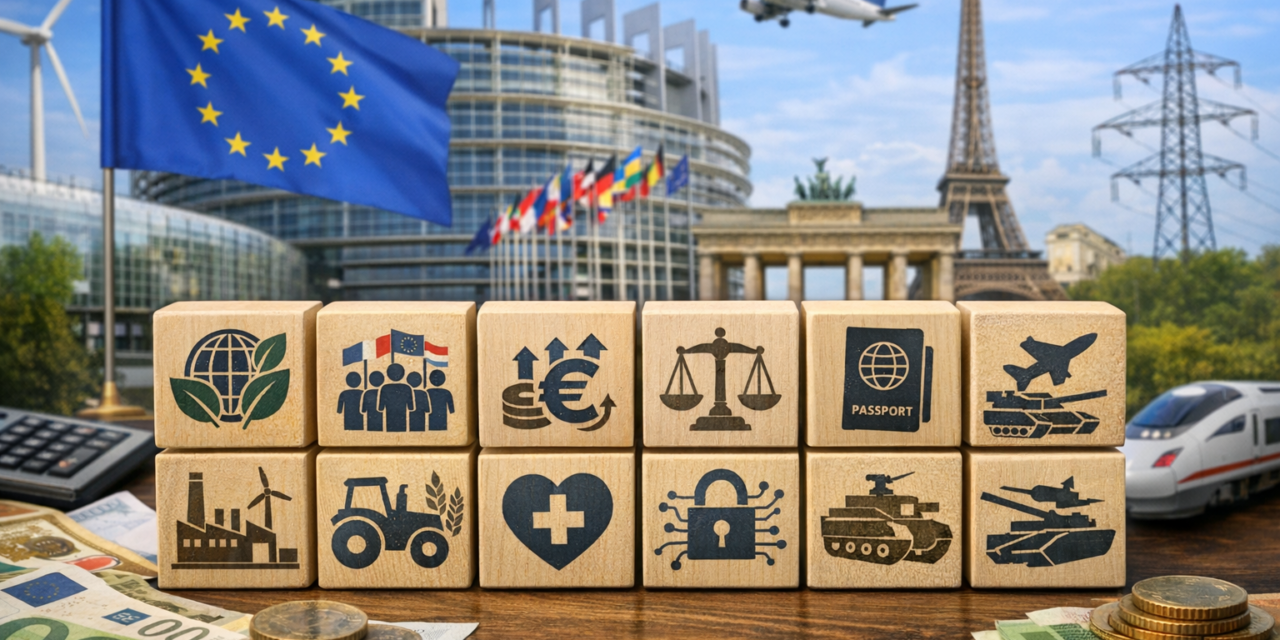
The European Union remains one of the world’s most ambitious political and economic projects, shaping the daily lives of more than 440 million people across 27 member states. Its influence extends far beyond trade, encompassing environmental protection, digital governance, security cooperation, and social welfare. As the EU moves through 2026, its core policies reflect both long‑standing integration goals and new priorities shaped by geopolitical tensions, climate imperatives, and rapid technological change. These ten major policy areas form the backbone of the Union’s governance and illustrate how the EU balances national sovereignty with collective action.
1. The Single Market and Customs Union
The Single Market is the EU’s foundational achievement, built on the free movement of goods, services, capital, and people. In 2026, the EU continues to deepen this market by removing regulatory barriers, modernizing customs systems, and strengthening cross‑border cooperation. A growing emphasis is placed on energy, digital services, and defence‑related industries, reflecting the Union’s push for greater competitiveness and resilience. The Customs Union complements this by applying a common external tariff, ensuring that goods entering the EU face uniform rules regardless of the entry point.
2. The Common Agricultural Policy (CAP)
The CAP remains one of the EU’s most significant and evolving policies. While it originally focused on food security and farmer income, today it prioritizes sustainability, climate resilience, and rural development. The current framework emphasizes environmentally friendly farming practices, biodiversity protection, and support for rural innovation. In 2026, the EU is also working to simplify administrative requirements for farmers while maintaining high environmental standards.
3. Competition Policy
The EU’s competition policy ensures fair and open markets across the Single Market. It targets cartels, abuses of dominant positions, and unlawful state aid. In recent years, enforcement has increasingly focused on digital markets, where large platforms hold significant influence. The EU continues to refine its approach to ensure that innovation thrives while preventing anti‑competitive behavior. At the same time, strategic flexibility is allowed in areas such as defence, energy, and green technologies to support Europe’s long‑term competitiveness.
4. Trade Policy
Acting as a single entity in global trade, the EU negotiates agreements that open markets while upholding high standards for labor, environment, and consumer protection. In 2026, trade policy is shaped by efforts to strengthen partnerships with like‑minded countries, diversify supply chains, and support Ukraine’s economic integration. The EU also continues to reduce dependency on Russian energy and raw materials, reinforcing its strategic autonomy.
5. Economic and Monetary Union (EMU)
The EMU governs the euro and the coordination of economic policies across the Eurozone. Beyond the shared currency, member states commit to fiscal discipline through rules designed to maintain stability and prevent excessive deficits. In 2026, the EU is focused on strengthening financial stability, deepening the Capital Markets Union, and improving access to investment for European businesses. These efforts aim to support sustainable growth and enhance the euro’s global role.
6. Justice and Home Affairs (JHA)
JHA policy covers security, migration, asylum, and judicial cooperation. The EU continues to strengthen its external borders, modernize asylum procedures, and enhance cooperation among police and intelligence services. Agencies such as Europol and Frontex play central roles in combating organized crime, terrorism, and human trafficking. In 2026, the EU is also expanding its crisis‑response mechanisms to better protect critical infrastructure and manage large‑scale emergencies.
7. Environmental and Climate Policy
The EU remains a global leader in climate action. Its environmental policy is anchored in the goal of achieving climate neutrality by 2050. Key initiatives include emissions trading reforms, renewable‑energy expansion, circular‑economy measures, and strict standards for air and water quality. In 2026, the EU continues to strengthen the Energy Union, reduce energy prices, and accelerate the transition away from Russian fossil fuels. The European Green Deal remains the guiding framework for these efforts.
8. Regional Development and Cohesion Policy
Cohesion Policy aims to reduce economic and social disparities between regions. Through structural and investment funds, the EU supports infrastructure, innovation, education, and employment in less‑developed areas. In 2026, the focus is on boosting competitiveness, supporting digital and green transitions, and preparing for the next long‑term EU budget cycle. The EU is also increasing support for Ukraine’s reconstruction and integration path.
9. Consumer Protection and Health Policy
The EU maintains some of the world’s highest standards for consumer safety and public health. Policies cover product safety, food labeling, pharmaceutical regulation, and digital consumer rights. The experience of the COVID‑19 pandemic has strengthened EU‑level coordination in health emergencies, leading to improved preparedness and joint procurement mechanisms. In 2026, the EU continues to reinforce consumer protections in both physical and digital markets.
10. Digital Single Market (DSM)
The DSM is one of the EU’s fastest‑developing policy areas. It aims to create a seamless digital environment across member states by removing online barriers and harmonizing regulations. Key legislation includes the General Data Protection Regulation (GDPR), the Digital Services Act (DSA), and the Digital Markets Act (DMA). In 2026, the EU is focused on cybersecurity, digital infrastructure, artificial intelligence governance, and support for European tech innovation. These efforts aim to ensure that Europe remains competitive while protecting users’ rights and safety.
Conclusion
These ten major policies define how the European Union functions and evolves. They reflect a constant balancing act between national interests and collective goals, shaped by changing global realities. As of January 2026, the EU’s strategic focus centers on competitiveness, defence readiness, energy independence, digital transformation, and democratic resilience. Together, these policies continue to advance the Union’s mission of stability, prosperity, and shared values across its diverse membership.
Bibliography
- European Union. EU Legislative Priorities for 2026. Publications Office of the European Union.
- European Commission. European Green Deal: Policy Updates and Implementation Reports (2024-2026).
- European Commission. Single Market and Competitiveness Strategy 2025-2026.
- European Commission. Trade and International Partnerships Annual Review 2025.
- European Parliament. Justice and Home Affairs Cooperation Framework (2025-2026).
- European Commission. Digital Services Act & Digital Markets Act Implementation Reports (2024-2026).
- European Commission. Economic and Monetary Union: Fiscal and Financial Coordination Reports (2025).
- European Commission. Cohesion Policy and Regional Development Overview (2021-2027).
- European Food and Agriculture Directorate. Common Agricultural Policy Strategic Plans (2023-2027).
- European Environment Agency. Climate and Energy Progress Report 2025.