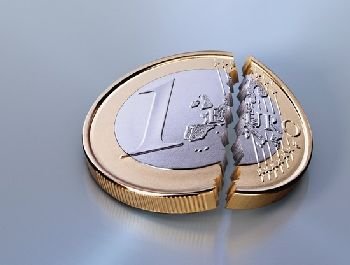
Fourteenth years into the euro experience, one can evaluate the extent to which the single currency has met its promises. One issue that has emerged is that there are benefits from membership in the euro area as well as challenges. In tranquil times, the benefits (and costs) are sizeable, but in a crisis, the benefits appear to be magnified.
Will the Euro Survive?
Is there a chance that the euro area might fall apart? One can start asking what the answer to this question would have been before the 2007 to 2010 crisis and what it could be now. Before the crisis exploded, one might have been worried that countries such as Italy and Portugal that were doing so poorly could have succumbed to the temptation to exit to be able to use competitive devaluations to get out temporarily from stagnation. Inside the euro, both countries would have needed large real wage adjustment to restore a balance between nominal wage growth, productivity, and inflation. The possibility of either country abandoning the euro seemed rather remote, but the current Italian interior minister had expressed that view a few years back when not in office-and at some point, the issue was publicly debated in Portugal.
Nevertheless, Eichengreen concludes that before the crisis, the event of a major country exiting and of EMU breaking down was highly unlikely in the medium run, and we agree. The crisis-perhaps paradoxically-has strengthened the euro area. Countries with traditionally weak currencies have realized that without the anchor of the euro, they would have experienced a spiral similar to that of developing countries: a speculative attack, a balance- of- payments crisis, interest rates jumping through the roof, and so forth.
The Euro and Structural Reform
The main reason why continental Europe—that is, most of the countries that now form the euro area-in the past twenty years has been unable to keep up with growth in the United States-and also in the United Kingdom and in the Nordic countries-is its reluctance to reform. Has the euro provided new stimulus for economic reform? Or as the evidence sometimes suggests, has euro membership produced “reform fatigue,” in the sense that after having painfully met the Maastricht criteria, euro member countries have taken a break from reform?
The adoption of the euro has facilitated the introduction of structural reforms, defined as deregulation in the product markets and liberalization and deregulation in the labor markets. They find that the adoption of the euro has been associated with an acceleration of the pace of structural reforms in the product market. As for the labor market, the evidence is more complex. Reforms in the primary labor market have proceeded very slowly everywhere, and the euro does not seem to have generated much of an impetus here. On the other hand, in many countries-including many euro ones, such as France, Italy, and Spain-new forms of labor contracts have been introduced based on temporary agreements between employers and workers.
Productivity growth has been relatively stronger in those countries and sectors that relied more on competitive devaluations to regain price competitiveness before the euro was adopted. This finding is confirmed when the authors analyze firm-level data from the Italian manufacturing sector. Low- tech businesses, which arguably benefited most from devaluations, have been restructuring more since the adoption of the euro. Restructuring has entailed a shift of business focus from production to upstream and downstream activities, such as product design, advertising, marketing, and distribution, and a corresponding reduction in the share of blue- collar workers.
These results run contrary to our prior and challenge the view that entry into the euro has produced “reform fatigue.” They are encouraging for Europe, suggesting that at least in some parts of the economy-though probably less so in the labor market-firms have responded to the macroeconomic constraint imposed by the single currency and the single monetary policy by accelerating the pace of restructuring. These observations also bring to center stage issues of sequencing of labor market and product market reforms. The creation of new firms (or newly restructured firms) and the destruction of older ones-those that used to rely on the temporary breath afforded by competitive devaluations. If this is true, aggregate statistics-for instance, on the pace of productivity growth-could be misleading, as they might reflect a shift in composition: an acceleration of firms exiting and entering.
The possibility of the breakup of the euro area was already being mooted, even before the single currency existed. These scenarios were then lent new life five or six years on, when appreciation of the euro against the dollar and problems of slow growth in various member states led politicians to blame the European Central Bank (ECB) for disappointing economic performance.
Highly placed officials, possibly including members of the governing council of the German central bank, reportedly discussed the possibility that one or more participants might withdraw from the monetary union. How seriously should we take these scenarios? And how much should we care? How significant, in other words, would be the economic and political consequences?
The conclusion of the author is that it is unlikely that one or more members of the euro area will leave in the next ten years and that the total disintegration of the euro area is more unlikely still.4 The technical difficulties of reintroducing a national currency should not be minimized. Nor is it obvious that the economic problems of the participating member states can be significantly ameliorated by abandoning the euro, although neither can this possibility be dismissed. And even if there are immediate economic benefits, there may be longer- term economic costs and political costs of an even more serious nature. Still, “In a world of sovereign states . . . nothing can be regarded as truly irreversible.” Policy analysts should engage in contingency planning, even if the contingency in question has a low probability.
While it is widely argued that the technical and legal obstacles to a country unilaterally reintroducing its national currency are surmountable, it will be argued here that the associated difficulties could in fact be quite serious.
To be sure, there are multiple historical examples of members of monetary unions introducing a national currency. It has also been suggested that the legal problems associated with the redenomination of contracts can be overcome, as they were when the ruble zone broke up or when Germany replaced the mark with the Reichs mark in 1923/ 1924. But changing from an old money to a new one is more complicated today than it was in Germany in the 1920s or in the former Soviet Union in the 1990s. Computer code must be rewritten. Automated teller machines must be reprogrammed. Advance planning will be required for the process to go smoothly, as was the case with the introduction of the physical euro in 2002. Moreover, abandoning the euro will presumably entail lengthy political debate and the passage of a bill by a national parliament or legislature, also over an extended period of time. Meanwhile, there will be an incentive for agents who are anticipating the redenomination of their claims into the national currency, followed by depreciation of the latter, to rush out of domestic banks and financial assets, precipitating a banking and financial collapse. Limiting the negative repercussions would be a major technical and policy challenge for a government contemplating abandonment of the euro.
The economic obstacles revolve around the question of how debt servicing costs, interest rate spreads, and interest rate- sensitive forms of economic activity would respond to a country’s departure from the euro area. A widespread presumption is that departure from the euro area would be associated with a significant rise in spreads and debt- servicing costs. But further reflection suggests that the consequences will depend on why a country leaves. (The defector could conceivably be a Germany, concerned with politicization of ECB policy and inflationary bias, rather than an Italy, facing slow growth and an exploding public debt.) They will depend on whether credible alternatives to the ECB and the Stability and Growth Pact are put in place at the national level (whether national central bank independence is strengthened and credible fiscal reforms are adopted at the same time that the exchange rate is reintroduced and depreciated). It seems likely that there would be economic costs but that these could be minimized by appropriate institutional reforms.
The political costs are likely to be particularly serious. The Treaty on European Union makes no provision for exit. Exit by one member would raise doubts about the future of the monetary union and would likely precipitate a further shift out of euro- denominated assets, which would not please the remaining members. It might damage the balance sheets of banks in other countries with investments in the one abandoning the euro. Diplomatic tension and political acrimony would follow, and cooperation on nonmonetary issues would suffer. The defector would be relegated to second- tier status in intra- European discussions of nonmonetary issues. And, insofar as they attach value to their participation in this larger process of European integration, incumbents will be reluctant to leave.